
COINing Coordination: Enhancing Multi-Agent Intelligence for Complex Sequences
COllective INtelligence with Sequences of Actions: Coordinating actions in Multi-Agent Systems
The paper presents an enhanced COllective INtelligence (COIN) framework designed to coordinate Multi-Agent Systems (MAS) in sequence-based tasks. By utilizing the Wonderful Life Utility (WLU) and integrating advanced Reinforcement Learning (RL) techniques like Q(λ) and model-based planning, the authors achieve near-optimal coordination in complex token-retrieval benchmarks.
TL;DR
Building a Multi-Agent System (MAS) that actually collaborates is hard because agents often "trip" over each other while chasing rewards. This paper breathes new life into the COllective INtelligence (COIN) framework by extending it for sequences of actions. By refining the Wonderful Life Utility (WLU) and adding advanced RL tricks like Q(λ) and Model-Based Planning, the authors show how a group of independent learners can achieve near-perfect coordination in environments that usually lead to chaos or stagnation.
Background: The Tragedy of the Grid
In the world of MAS, there are two common but flawed ways to reward agents:
- Selfish Utility (SU): Every agent works for itself. Result? High-value targets get crowded, and low-priority but necessary tasks are ignored.
- Team Game (TG): Everyone shares the total reward. Result? The "Lazy Agent" problem—it's hard for one agent to know if its specific move helped the team (low signal-to-noise ratio).
COIN offers a middle ground through the Wonderful Life Utility (WLU). It asks: "What would the world look like if this agent didn't exist?" The agent’s reward is the difference between the actual team performance and the performance of the rest of the team without it. This aligns individual goals with the collective good.
The Core Innovation: Solving the "Loop" Problem
The authors discovered a hidden flaw: in sequence-based tasks, COIN agents often got stuck in loops. Because an agent wants to avoid penalties from others, it might prefer revisiting a "safe" empty square (0 reward) rather than venturing out and risking a clash (-penalty).
1. The State-Revisit Penalty
To fix this, the authors introduced a penalty for revisiting any square within the same epoch. This forces the agents to keep moving and exploring, effectively "pushing" the collective toward global coverage of the grid.
2. Temporal Propagation of Penalties
Standard WLU only penalizes agents if they collide at the same time step. The authors extended this to Temporal Penalty (TP). If Agent A takes a token that Agent B was planning to get 5 steps later, Agent A is penalized. This foresight is critical for long-term task allocation.
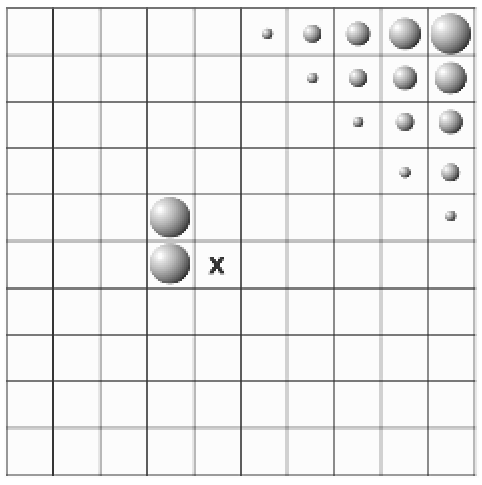 Figure 1: Typical grid-world setups. (a) Standard token clusters; (b) Coordinated retrieval where agents must split up to succeed.
Scaling with Advanced RL
The paper doesn't just change the reward; it upgrades the "brain" of each agent.
- Watkins' Q(λ): By using eligibility traces, rewards and penalties are "smeared" back across the entire path of actions. If an agent hits a penalty at step 10, it learns much faster that step 1 was the start of a bad path.
- Model-Based Planning: Instead of learning once per epoch, agents use a "mental model" of their teammates' moves to simulate and learn from their paths multiple times, drastically speeding up the time it takes to "find" the optimal coordination strategy.
Experimental Showdown
The results are striking when comparing the standard "Selfish" approach to the "Enhanced COIN" approach:
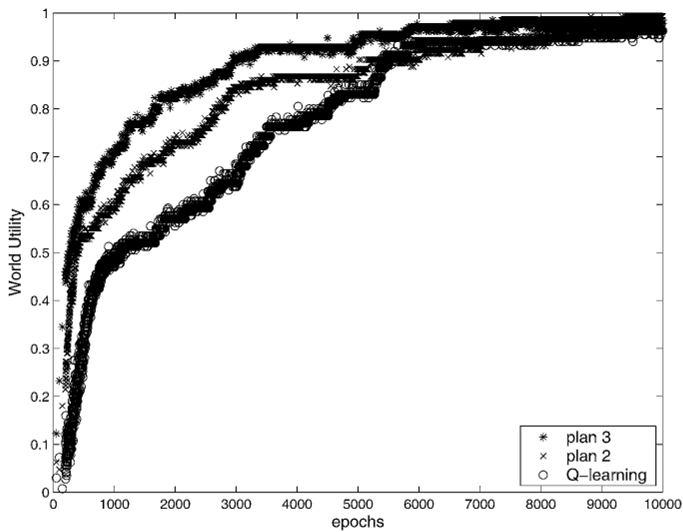 Figure 2: Performance comparison. Note how Q(λ) and COIN enhancements allow the system to reach full utility (1.0), whereas standard methods plateau much lower.
In a "Full Grid" test where agents must disperse to cover the maximum area, the Selfish Utility failed because agents wouldn't leave their local clusters. The Enhanced COIN agents, however, learned to spread out like a well-drilled team, hitting nearly 85-90% efficiency.
Critical Insight & Conclusion
The true value of this work lies in the realization that marginal contribution (the "Wonderful Life" concept) is highly sensitive to temporal dynamics. You can't just reward an agent for what it does now; you must reward it for how its entire sequence of actions affects the entire sequences of others.
Limitations: The computational cost of calculating WLU increases as the number of agents grows (as you have to simulate the "world without agent X"). For massive swarms, further efficiency improvements or approximations of the WLU will be necessary.
Final Takeaway: This paper proves that complex coordination doesn't require a "central brain." With the right reward shaping and temporal awareness, collective intelligence emerges naturally from simple, local learning.