
Collective Intelligence: Why Your AI Coder Needs a "Swarm" of Minds
Collective intelligence for smarter neural program synthesis
The paper introduces a novel framework that combines Collective Intelligence (CI) and Swarm Intelligence (SI) to enhance Neural Program Synthesis (NPS). By merging user intents from multiple developers and optimizing API/type selection via an improved Ant Colony Optimization (ACO) algorithm, the system significantly improves the accuracy of generating Java code from natural language.
TL;DR
Neural Program Synthesis (NPS) often fails because users don't know exactly what to ask for. This paper proposes a framework that crawls the web to gather "Collective Intelligence" from multiple developers and uses an improved Ant Colony Optimization (ACO) algorithm to pick the best APIs for the job. The result? A 37% boost in synthesis accuracy by simply being "smarter" about user intent.
The "Prompt" Problem: Why Individual Input Isn't Enough
In the world of Neural Program Synthesis (NPS), we try to turn natural language into code (e.g., using models like Bayou). However, there is a fundamental bottleneck: Human Incompleteness.
An individual developer might remember they need an Iterator, but forget they also need StringBuilder to efficiently concatenate strings. If the input "labels" (APIs and types) are incomplete, the neural network—no matter how powerful—will likely generate a hallucinated or incorrect code sketch.
The authors argue that coding shouldn't be a solo sport. By looking at how thousands of developers solved similar problems online (Collective Intelligence), we can fill in the gaps that a single user leaves behind.
Methodology: Ants, Matrices, and Collective Wisdom
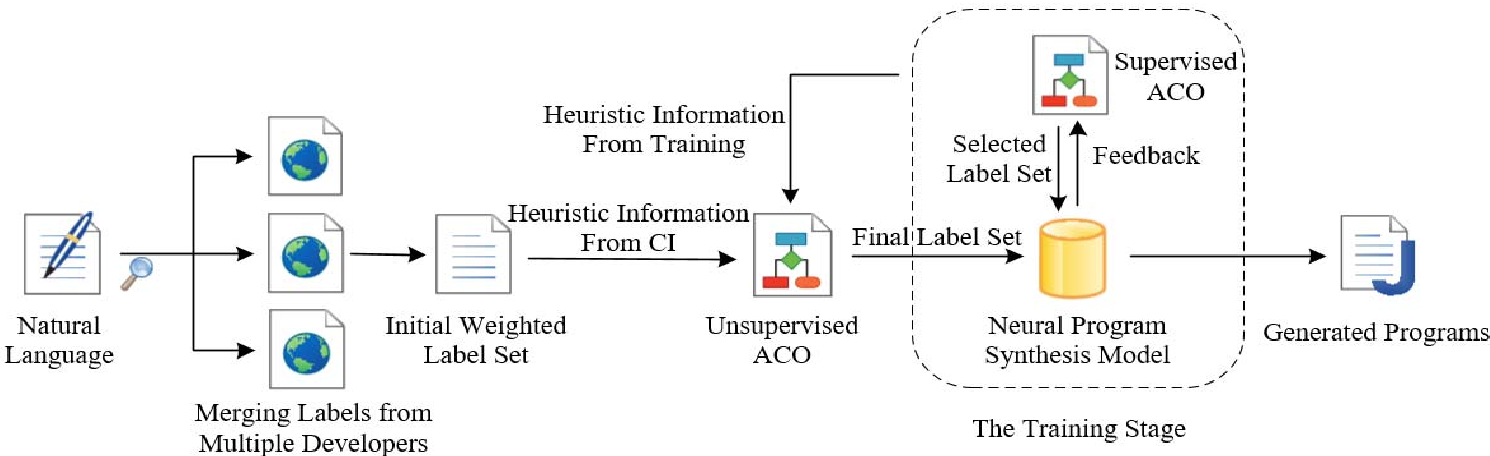
The framework splits the problem into two distinct phases using Swarm Intelligence (SI).
1. The Training Stage: Learning "What Goes Together"
The authors introduced Supervised ACO (SACO). In this stage, "ants" explore the space of Java APIs. If a combination of APIs leads to a lower "generation loss" in the neural model, that path is reinforced with pheromones.
- LMEM (Label Moving Efficiency Matrix): This is a crucial innovation. It records which APIs are "efficiently" used together across 466,129 Java methods. Think of it as a professional intuition of which libraries belong in the same code snippet.
2. The Prediction Stage: The Power of the Crowd
When a user provides a task description, the system doesn't just rely on that user.
- CI Crawling: It searches Google, StackOverflow, and JavaDocs to see how others solved it.
- UACO (Unsupervised ACO): It then runs an unsupervised version of the ant colony algorithm. It combines the frequency of APIs found on the web (Swarm Term) with the "professional intuition" (LMEM) learned during training to select the final, most representative label set.
Experimental Proof: Better Together
The researchers tested their approach against "Isolated" developers (who only searched one source) and "Collaborative" environments.
- Accuracy Boost: The
CollectUacomethod (merging 10 agents/webpages) achieved an M1 score of 0.56, compared to just 0.19 for isolated agents. - Noise Filtering: Even when 30% of the input labels were random "noise," the ACO algorithm was able to filter them out and focus on the correct logic.
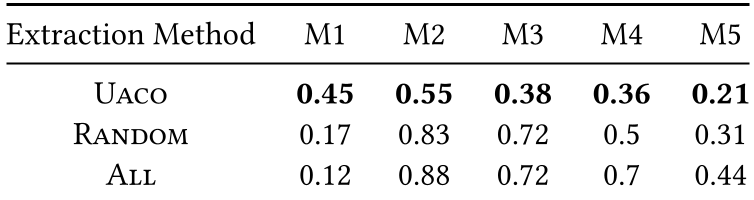
Table: UACO vastly outperforms random selection or using all provided labels (which usually contains too much noise).
Deep Insight: Beyond Just "More Data"
The real beauty of this work isn't just that it "uses more data." It’s the selective merging. As shown in their motivation example, simply "dumping" all possible APIs together (User 6 in their study) actually failed to produce correct code.
The neural model gets "confused" by too many labels. The ACO algorithm acts as a sophisticated filter, ensuring that only the most relevant, co-occurring tokens reach the decoder. It balances "what the crowd says" (Web frequency) with "what the data says" (LMEM).
Limitations and Future Outlook
While highly effective for Java standard libraries (java.io, java.util), the study is constrained by its vocabulary. Scaling this to the massive, ever-changing ecosystem of NPM or Python packages would require even more robust crawling and faster optimization loops.
Takeaway: In the era of LLMs, this paper reminds us that the best "prompt engineering" might not come from a human at all—it might come from an ant colony foraging through the collective wisdom of the internet.