
Collective Intelligence: Boosting Metaheuristics via Democratic Consensus
A Collective Intelligence Strategy for Enhancing Population-based optimization Algorithms
This paper introduces a universal Collective Intelligence (CI) strategy that enhances population-based optimization algorithms (like DE and PSO) by using dimension-wise K-means clustering and a voting mechanism to generate high-quality trial solutions. The resulting methods, CIDE and CIPSO, achieve significant performance gains across the CEC-2017 benchmark suite.
TL;DR
Optimization is often viewed as a "survival of the fittest" race. However, this paper argues that even the "less fit" individuals hold partial truths. By introducing a Collective Intelligence (CI) strategy based on dimension-wise K-means clustering and voting, the authors demonstrate that the "consensus" of a population can generate trial solutions far superior to standard heuristic operators.
The "Lonesome Best" Problem
Existing population-based algorithms like Differential Evolution (DE) and Particle Swarm Optimization (PSO) suffer from a common structural flaw: they are elitist but narrow-minded.
- In DE, mutation typically involves three random vectors.
- In PSO, particles chase the local or global best.
In both cases, the vast amount of environmental data gathered by the rest of the population is discarded. The authors' insight is: What if the population voted on the best value for each dimension?
Methodology: The Power of the Crowd
The proposed CI strategy is elegant and can be "plugged" into any population-based algorithm. It follows a unique workflow:
- Dimension-wise Deconstruction: Instead of looking at individuals as points in N-dimensional space, the algorithm analyzes each dimension separately.
- K-means Clustering: For a specific dimension , it clusters the values of all individuals into groups.
- The Democratic Vote: It identifies the most "crowded" cluster. The logic is that if a majority of individuals are gravitating toward a specific range in that dimension, it likely represents a promising region.
- Centroid Synthesis: The average value of this crowded cluster becomes the coordinate for the new trial vector.
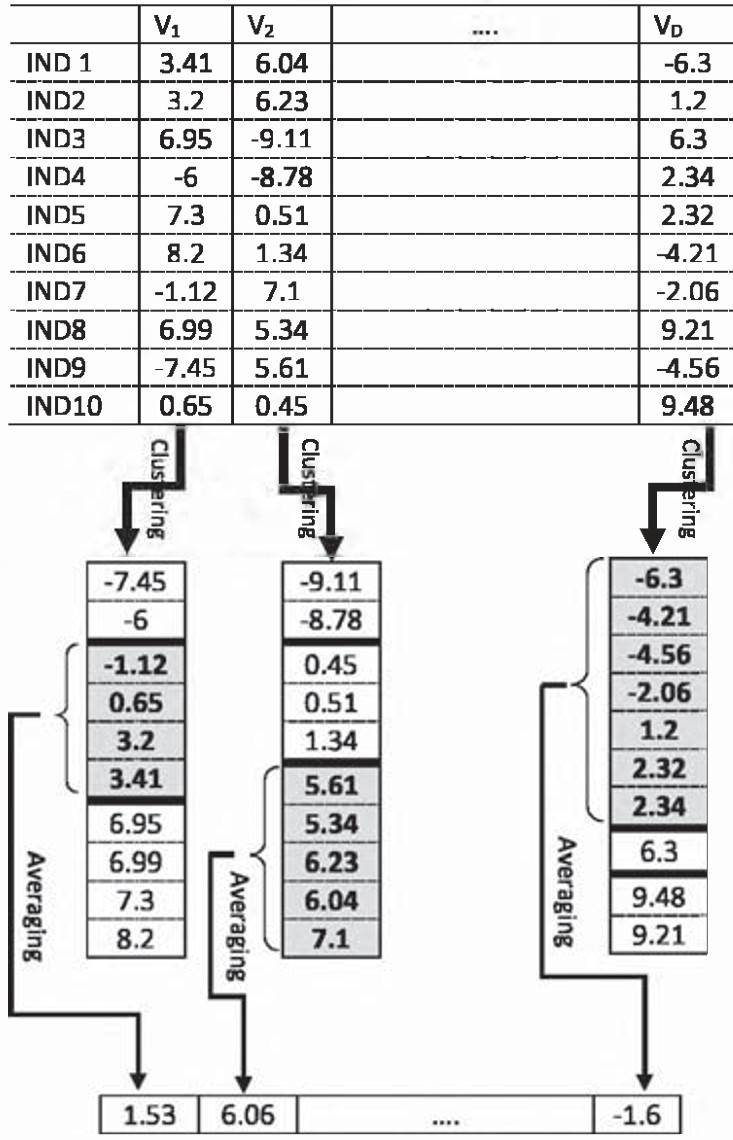 Figure 1: Visualizing how a CI-vector is synthesized from the consensus of 10 individuals.
Why Dimension-wise?
By clustering per dimension rather than in the full search space, the method avoids the Curse of Dimensionality. Clustering 100 individuals in 100-D space is sparse and ineffective; clustering 100 scalars in 1-D space (repeated 100 times) is computationally efficient and statistically robust.
Experimental Battleground: CEC-2017
The authors tested CIDE and CIPSO against their standard versions across 30 complex functions.
Key Evidence:
- Superior Individuals: The CI-generated individual isn't just "average." In high-dimensional cases (D=100), it ranked better than the population's best solution about 8% of the time and was better than 60-70% of the entire population on average.
- Scalability: As the number of dimensions () increased, the performance gap between the CI versions and the standard versions widened, proving that collective intelligence is more crucial in vast, complex search landscapes.
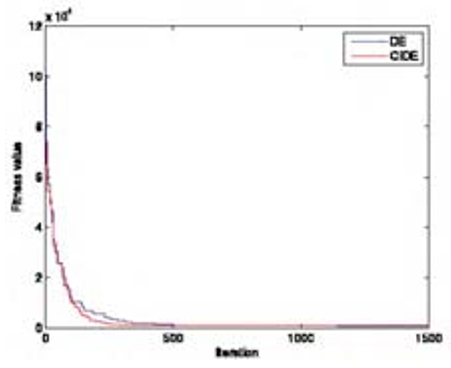 Figure 2: Convergence plots showing CIDI/CIPSO (CI-versions) significantly outpacing standard DE/PSO in error reduction.
Critical Insight: When Democracy Wins
The effectiveness of this method hinges on the "Democratic Assumption"—the idea that the majority, as they converge, are more likely to be right than a few random noise-filled individuals.
Limitations:
- In the very early stages of a search (high entropy), the "crowded cluster" might just be a capture of initial random bias.
- The strategy adds a small computational overhead due to the -means iterations, though 1D-clustering is extremely fast.
Future Outlook
This work opens a door to "Weighted Democracy" in optimization. Future iterations could weigh votes by the fitness of individuals, allowing the elite to have a louder voice while still considering the diversity of the crowd. It represents a shift from competitive evolution to collaborative intelligence.
Takeaway: If your optimizer is stuck, stop looking only at the winner—start listening to the crowd.