
Towards Functional Security: Building Trust-Based Student Profiles via Collective Intelligence
A Collective Intelligence Approach for Building Student's Trustworthiness Profile in Online Learning
This paper proposes a Student’s Trustworthiness Profile (TSP) model designed to enhance information security in online collaborative learning environments. By leveraging Collective Intelligence (CI) and peer-to-peer assessment data, the framework moves beyond static technological security (like PKI) to a functional, dynamic trust-based evaluation system.
TL;DR
Information Security (IS) in online education is often treated as a technical hurdle—passwords, encryption, and signatures. However, this paper argues that true security in Computer Supported Collaborative Learning (CSCL) requires a functional approach. The authors propose a Student’s Trustworthiness Profile (TSP) that uses Collective Intelligence (peer assessments and behavioral data) to dynamic evaluation and predict student reliability, filling the gap where traditional PKI (Public Key Infrastructure) fails.
Problem & Motivation: The Limits of Static Security
In the wake of a 74% increase in security incidents in educational institutions, the "reality vs. feeling" of security has become a critical trade-off. Current Learning Management Systems (LMS) like Moodle are vulnerable:
- Technological Gaps: Even the strongest digital certificates don't prevent a student from cheating during an online exam once they are logged in.
- Static nature of IS: Traditional security doesn't account for the evolving behavior of students throughout a semester.
- Lack of Context: Standard profiles show grades and bio-data but offer zero insight into whether a student is a reliable collaborator or a trustworthy peer-evaluator.
The authors' insight is simple: Trust is dynamic. By treating the student body as a "collective sensors," we can build a more resilient security framework.
Methodology: The Architecture of Trust
The proposed model shifts assessment from a centralized "teacher-to-student" flow to a peer-to-peer Continuous Assessment (CA) cycle consisting of three stages:
- Questionnaire (Q): Individual responses to challenges.
- Forum (F): Dynamic collaboration to discuss topics.
- Peer-to-Peer Survey (P): Students assess each other’s contributions and trustworthiness.
The Two-Layer Profile Strategy
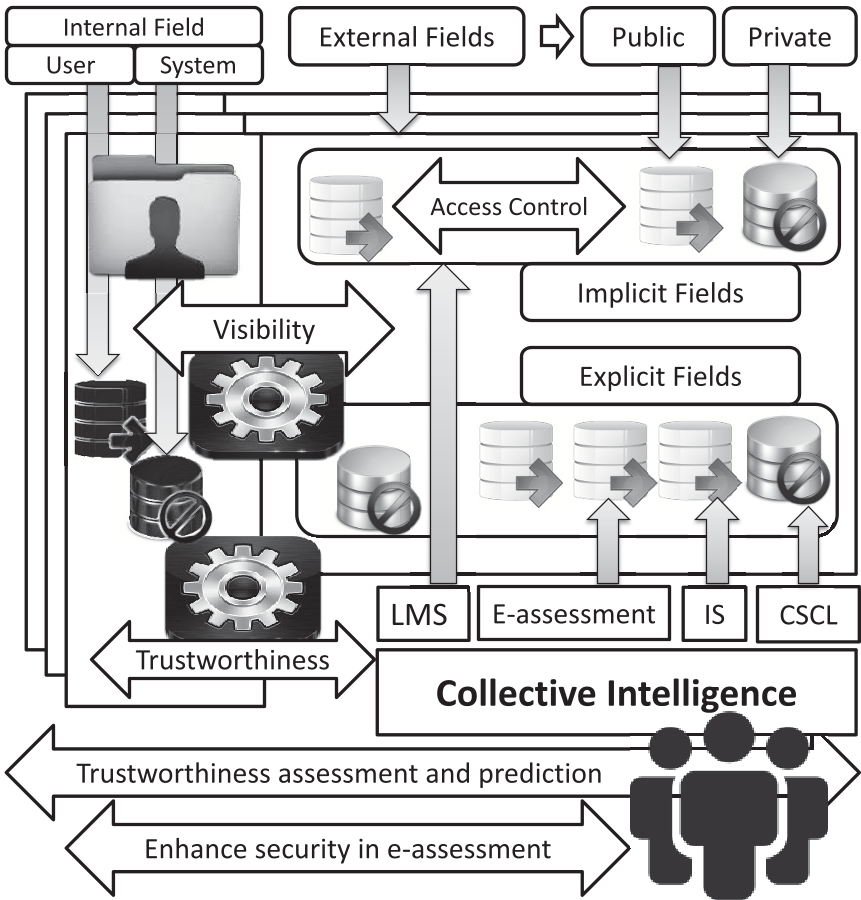
To manage this data, the TSP is structured into two distinct layers:
- User Layer: A public-facing "presentation layer" showing normalized trustworthiness levels. This helps students when forming study groups.
- System Layer: A private layer for tutors and administrators containing raw logs, internal validation fields, and "Trustworthiness Indicators" used for predictive modeling.
Mathematical Intuition: Implicit vs. Explicit
The core of the TSP lies in the validation of Implicit Indicators (e.g., how much time a student spends reading a forum) against Explicit Feedback (peer scores). The authors use Pearson Correlation Coefficients to ensure that automated system logs aren't being "gamed" by bot scripts or web injection. If the correlation doesn't meet a specific threshold, the data is flagged as unreliable.
Experiments & Results: Real-Time Scalability
A significant hurdle in CI-based models is the computational cost of analyzing massive amounts of log data.
- Computational Efficiency: The authors highlight a parallel processing approach that allows trust models to be built in real-time, even with large student cohorts.
- Social Validation: By applying O'Reilly's seven principles of Web 2.0 to e-assessment, the model ensures that "users add value" to the data, creating a self-correcting community mass.
Critical Analysis & Conclusion
The "Takeaway"
This research successfully moves the needle from "Security as a Shield" to "Trust as a Currency." By embedding trustworthiness directly into the student profile, the system incentivizes positive behavior rather than just punishing vulnerabilities.
Limitations & Future Work
- Critical Mass: As noted, these communities struggle in their early stages before enough data is collected to be representative.
- Privacy Concerns: While the paper suggests customizable access controls, the psychological impact of being "publicly rated" by peers on a trustworthiness scale could lead to social anxiety or bias.
Future Outlook: The integration of this TSP model into mainstream LMS will likely involve "Trustworthiness Prediction" engines that can alert tutors to potential academic dishonesty before it happens, based on deviations in a student's established trust profile.