
Collective Intelligence: Beyond Simple Data Aggregation to Synergistic Knowledge
Collective Intelligence Generation from User Contributed Content
This paper introduces a framework for generating "Collective Intelligence" by integrating user-contributed multimedia content with social dynamics. It proposes a five-layer architecture—Personal, Media, Mass, Social, and Organizational—to transform raw data into actionable knowledge for emergency response and consumer services.
TL;DR
This research establishes a foundational framework for Collective Intelligence (CI) derived from user-contributed multimedia. By decomposing CI into five distinct layers—Personal, Media, Mass, Social, and Organizational—the authors demonstrate how the fusion of social dynamics and automated content analysis creates a "sum greater than its parts" effect, specifically optimized for high-stakes scenarios like emergency response.
The "Understanding" Gap in Web 2.0
In the era of massive user contribution (YouTube, Facebook, Wikipedia), we are drowning in data but starving for wisdom. The authors argue that prior works hit a ceiling because they couldn't:
- Automatically "Understand" content at scale.
- Bridge the Gap between raw media (images/video) and the social context of the person who uploaded it.
- Account for Social Dynamics which influence how information trends and evolves.
The core motivation was to move from simple "Information Sharing" to "Intelligence Generation"—a shift from hosting files to understanding situations.
Methodology: The Five Layers of Intelligence
The paper’s core innovation is its formulaic approach to intelligence:
1. The Architecture of Synergy
The authors break down the complexity into five orthogonal layers:
- Personal Intelligence: Focuses on the user-centric flow and limitations of capture devices (mobile/PDA).
- Media Intelligence: The "heavy lifting" of automated analysis—extracting semantics from raw text, visual, and speech data.
- Mass Intelligence: Identifying trends and patterns from the "wisdom of the crowd" (e.g., Q&A platforms like Lycos iQ).
- Social Intelligence: Analyzing interaction patterns using communication models (Watzlawick) and social network analysis (hubs and authorities).
- Organizational Intelligence: The final bridge, ensuring the right knowledge reaches the right decision-maker.
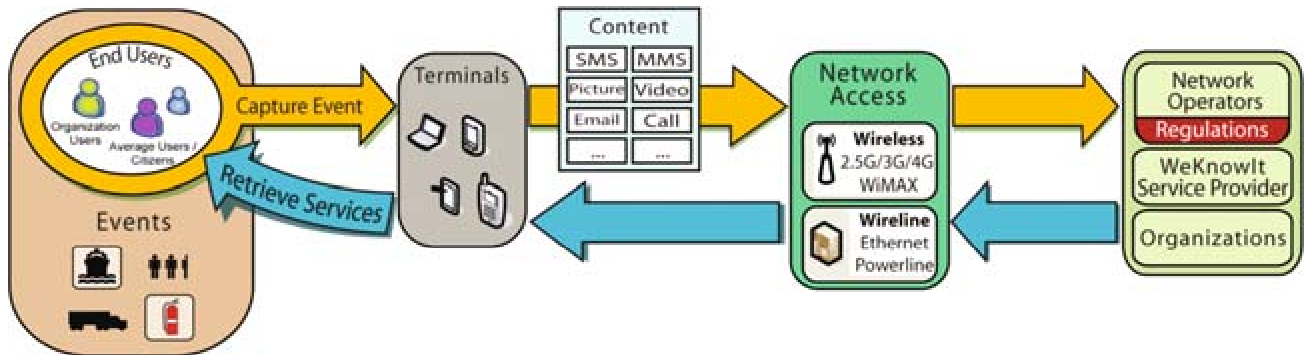 Figure 1: The user-centric interaction and end-to-end information flow model.
Bridging Content and Context
A standout feature of this methodology is the Media Intelligence layer's focus on "noise-aware" processing. In an emergency, audio is rarely clean; therefore, the system combines standard transcription with phonetic search to identify critical keywords (like names of places) that traditional systems would miss.
 Figure 2: The scaling down of information quality from the user's perception to the system's capture.
Experimental Validation: Emergency Response & Travel
The framework was tested in two highly diverse environments:
- Emergency Response: Enabling citizens to act as distributed sensors. Planners can filter the "noise" of mass uploads to find specific insights (e.g., which roads are truly open), allowing for a two-way dialogue between responders and the public.
- Consumers Social Group: A travel planner that harvests "Media Intelligence" from past trip reports and "Social Intelligence" from group preferences to suggest optimal itineraries.
Critical Analysis & Conclusion
Takeaway
The paper successfully argues that Collective Intelligence is a methodology of integration. It’s not just about better algorithms for image recognition, but about how that image recognition is weighted by the social status of the uploader or the mass trends of the moment.
Limitations
- Privacy and Trust: While the authors mention "potential hazards" in organizational intelligence, the paper lacks a robust technical solution for managing privacy in such a deeply integrated social/media stack.
- Computational Cost: Fusing all five layers in real-time for an emergency scenario presents massive scalability challenges that were only beginning to be addressed at the time of publication (2010).
Looking Forward
As we move toward 2026, the arrival of Large Language Models (LLMs) provides the "Media Intelligence" layer that this paper dreamt of. The next frontier is likely the Organizational-Social bridge—using AI to manage the "fuzzy" roles of communities while maintaining the "strict" requirements of professional agencies.