
Collective Intelligence: Turning User Clicks into Video Semantic Maps
Collective Intelligence in Video User’s Activity
The paper proposes a novel approach to extract "Collective Intelligence" from implicit user interactions (pause, seek, scrub) in web videos. By identifying "bell-shaped" patterns in aggregated user activity, the authors accurately detect high-semantic value video scenes, achieving a cross-correlation of up to 0.673 with human-annotated ground truth.
TL;DR
Ever wondered if your habit of rewinding a video to catch a missed detail could actually help others? This paper explores how Collective Intelligence (CI)—the aggregated behavior of thousands of viewers—can be used to automatically identify the most important scenes in a video. By treating user interactions like "Play," "Pause," and "GoBackward" as signals, the authors developed a system that detects "peaks" of interest which correlate strongly with human-defined highlights.
Background: The Limits of Content-Based Analysis
Most video search engines today analyze pixels and audio to guess what a video is about. However, "visual structure" doesn't always equal "semantic importance." A lecture video might have no scene changes but contain 5 minutes of gold-standard information. The researchers argue that the users themselves are the best annotators. Their navigation (skipping the boring parts, rewatching the complex parts) creates a "viewing pattern" that reveals the video's true heart.
Methodology: Finding the "Bells" in the Noise
The authors propose that when many users interact with a specific segment, it forms a bell-like distribution in the activity log. They used a three-stage process to decode this:
- Noise Removal: Using a moving average a window (T) to smooth out accidental clicks.
- Activity Aggregation: Identifying clusters where user actions are concentrated.
- Pattern Detection: They tested two specific techniques:
- Stochastic Approach: Calculating correlation coefficients between the smoothed signal and a Gaussian (bell) reference pattern.
- Pattern Matching: Using a distance measure that is invariant to scaling and shifting to find the best fit for the "interest signal."
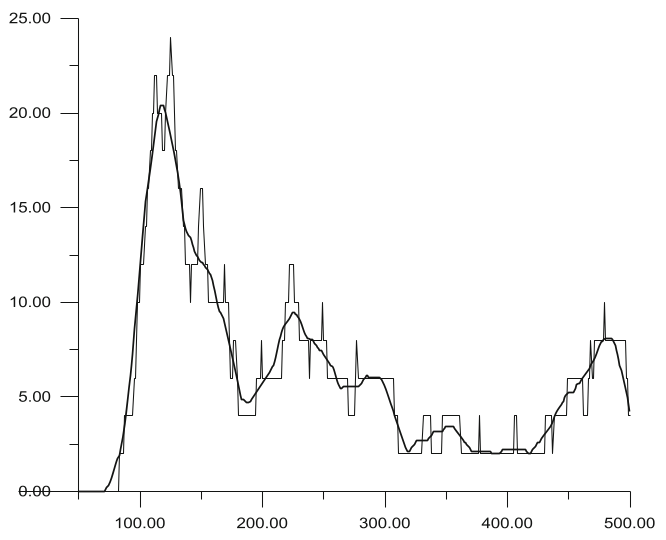 Figure 1: The concept of matching user activity aggregates to a reference bell-shaped pattern.
Key Insights from Experiments
The study analyzed two types of content: a visually static lecture (Video A) and a fast-paced documentary (Video B).
- The "GoBackward" Signal: This was the most "intelligent" signal. Users rewind when a scene is interesting or complex. Aggregated rewinds mapped almost perfectly to the most important parts of the lecture.
- The "GoForward" Noise: Interestingly, skipping forward was less reliable. Because the experiment had a time limit, users skipped forward simply to finish the task, creating "noisy" data that didn't always reflect the content's quality.
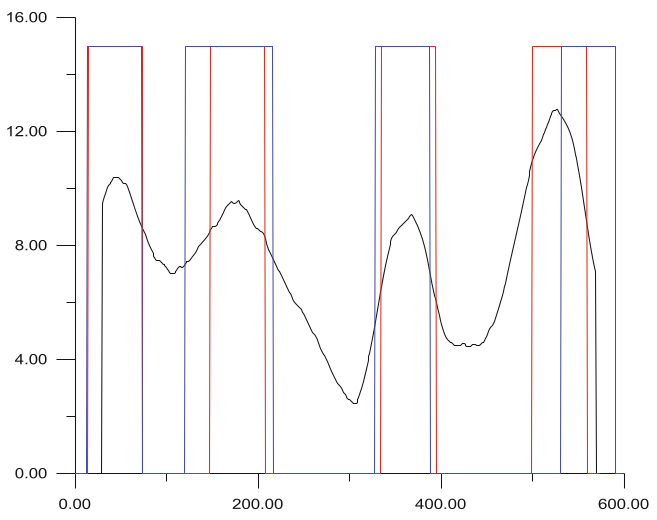 Figure 2: The alignment between detected user activity aggregates (red/black) and the ground-truth importance (blue).
Performance vs. Human Ground Truth
The results were impressive for a methodology that doesn't "look" at the video frames:
- The Stochastic approach achieved a 67.3% correlation with ground-truth annotations.
- The Pattern matching approach achieved up to 76.8% overlap with the scenes identified as important by the video authors.
Critical Analysis & Future Directions
The beauty of this research lies in its simplicity and scalability. It provides a "zero-shot" way to generate video thumbnails or summaries based on real human interest rather than algorithmic guesses.
Limitations:
- Cold Start Problem: This method requires a significant number of initial viewers to generate the data signal. It won't work for brand-new videos with zero views.
- Task Bias: As seen in the "GoForward" results, user motivation (e.g., a time limit) can skew the data.
Future Outlook: Imagine a YouTube where the progress bar itself glows brighter in segments where the "Collective Intelligence" has peaked. This work paves the way for automated, crowd-sourced video navigation, making the massive sea of web content much easier to navigate.
Summary Table
| Metric | Achievement |
|---|---|
| Core Mechanism | Signal processing of Seek/Rewind actions |
| Top Overlap Score | 76.8% (Pattern Matching) |
| Best Performance | Informational/Lecture-style videos |
| Application | Automated Thumbnails, Smart Seekbars |