
Knowledge is Contagious: Characterizing Collective Sharing in Q&A Networks
Characterizing Collective Knowledge Sharing Behaviors in Social Network
This paper investigates the contagiousness of knowledge sharing behaviors in large-scale Q&A social networks using datasets from Zhihu and Quora. By employing Kendall coefficients and Logistic Regression, the authors demonstrate that knowledge sharing is a contagious collective behavior driven by both social influence and individual interests.
TL;DR
Why do you answer a specific question on Zhihu or Quora? It turns out it's not just about what you know—it's about who you follow. This research proves that knowledge sharing is contagious. By analyzing millions of interactions on Zhihu and Quora, the study reveals that you are significantly more likely to share knowledge if your friends have done so first, especially if those friends are more "elite" or active than you.
The "Why": Beyond Individual Expertise
Most research on Q&A platforms treats answering as a solitary act of altruism or reputation building. However, this paper shifts the focus to the social ecosystem. The authors argue that existing studies often rely on narrow field experiments or single-dataset observations. To find the "universal law" of knowledge sharing, they compared the Chinese giant Zhihu with the global platform Quora, looking for patterns that transcend cultural and UI differences.
Methodology: The Mechanics of Influence
The researchers didn't just look at "who followed whom." They built a sophisticated model based on three pillars:
- Friend Influence: Tracking if a user answers a question after their 1st, 2nd, or 3rd-degree friends.
- User Interest (via Doc2Vec): Using natural language processing to convert a user's entire history into a vector to see if they actually care about the topic.
- Interest Attenuation: Applying a "forgetting curve" (half-life of 30 days) because our curiosity about a topic fades over time.
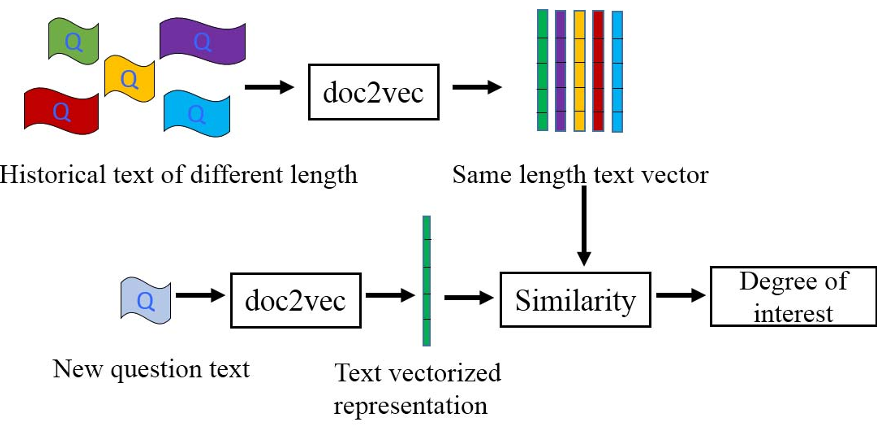 Fig: Calculating user interest levels using Doc2Vec and historical data.
Key Insights: Status Matters
The study’s most striking finding is the Asymmetry of Contagion. Behavioral spread isn't a horizontal "flu"; it's a top-down waterfall.
- Upward Comparison: Users are much more likely to be "infected" by peers who have more followers and have written more answers than themselves. In sociology, this is known as Upward Social Comparison—we emulate those we perceive as more successful.
- The Trust Factor: Users with "complete" profiles (real location, education, job) are vastly more influential. Completeness equals trust, and trust is the fuel for behavioral contagion.
- Decay and Degree: While the influence of a 1st-degree friend is strongest (14% higher probability to answer), the effect remarkably lingers even at the 3rd degree of separation.
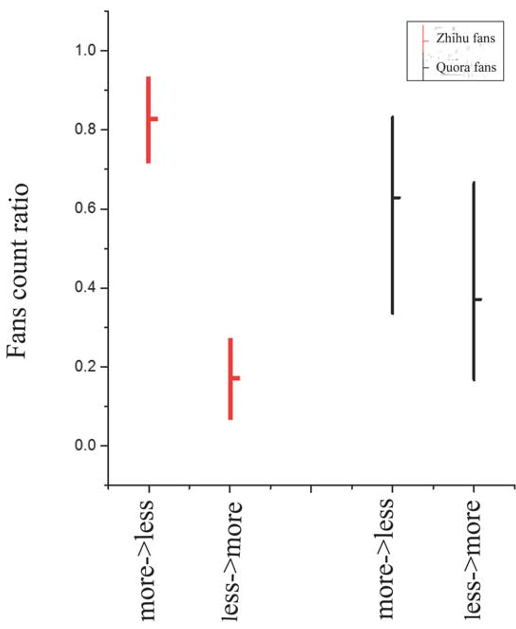 Fig: Visualization of how followers impact the direction of behavioral contagion.
Results: Zhihu vs. Quora
The researchers found that while both platforms show contagion, Zhihu users are more influenced by their immediate social circle (Logistic coef 0.73) compared to Quora users (0.35).
Why? The authors suggest this is due to platform architecture:
- Zhihu is more "social" and personal, relying heavily on a timeline of followed individuals.
- Quora is more "professional" and topic-centric, where users follow specific subjects and interests, making them slightly more immune to the peer pressure of their social group.
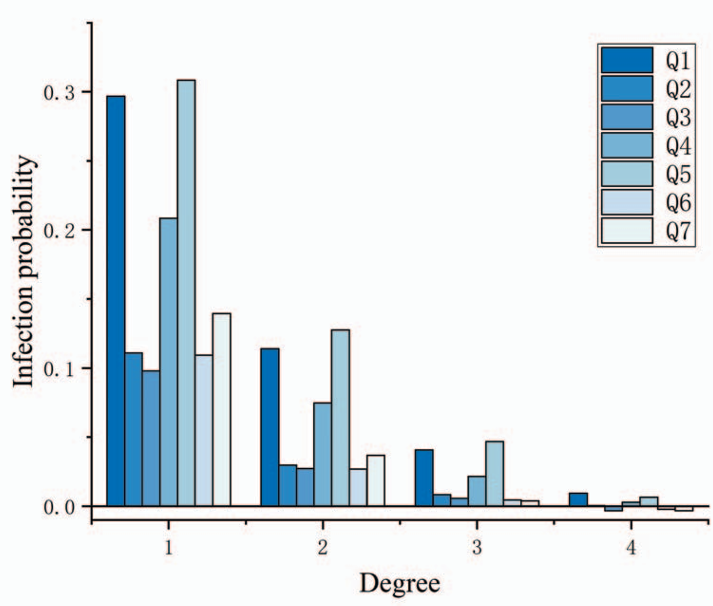 Fig: Distribution of Kendall Tau coefficients across different topic groups, proving contagion prevalence.
Conclusion & Future Outlook
This paper provides a roadmap for platform designers. If you want a new topic to trend or a technical concept to spread, you shouldn't target users randomly. Instead, target the "Influential Trusted Nodes"—users with high profile integrity and answering activity.
The main limitation is the focus on text-based Q&A. As social networks move toward video (TikTok, YouTube), exploring if "knowledge contagion" works the same way in visual formats remains a fertile ground for future PhDs.