
Collective Privacy Management: Solving the "My Photo, Your Data" Conflict in Social Networks
Collective privacy management in social networks
The paper introduces a game-theoretic framework for "Collective Privacy Management" in social networks, specifically addressing the conflict of interest when multiple users (co-owners) appear in a single shared data item like a photo. It utilizes the Clarke-Tax mechanism to aggregate individual privacy preferences into a single optimal policy while ensuring user truthfulness.
TL;DR
In the era of Web 2.0, content sharing is social, but privacy controls remain individual. This paper proposes a groundbreaking solution using Game Theory—specifically the Clarke-Tax mechanism—to allow multiple co-owners of a photo to "vote" on its privacy settings. By creating a credit-based system, it ensures that privacy decisions are fair, truthful, and representative of all stakeholders appearing in the data.
Background: The Privacy Vacuum in Social Sharing
When Alice uploads a photo of Bob and John to Facebook, Alice currently holds all the power. She decides who sees the photo. Bob might want it private, while John wants it public. This "originator-take-all" approach creates a massive privacy gap. The core challenge is: how do we merge conflicting privacy preferences into a single group policy without ruining the user experience or requiring endless manual negotiations?
Methodology: Privacy as a "Public Good"
The authors view a shared photo's privacy level as a Public Good. They treat the selection of a privacy policy as an auction.
1. Identifying Co-owners
The system uses id-tags (metadata) to automatically identify potential owners. The originator then confirms these users, granting them "co-ownership" rights.
2. The Clarke-Tax Mechanism
To prevent users from "gaming the system" (e.g., Bob falsely claiming a photo is ultra-sensitive just to force it private), the paper employs the Clarke-Tax:
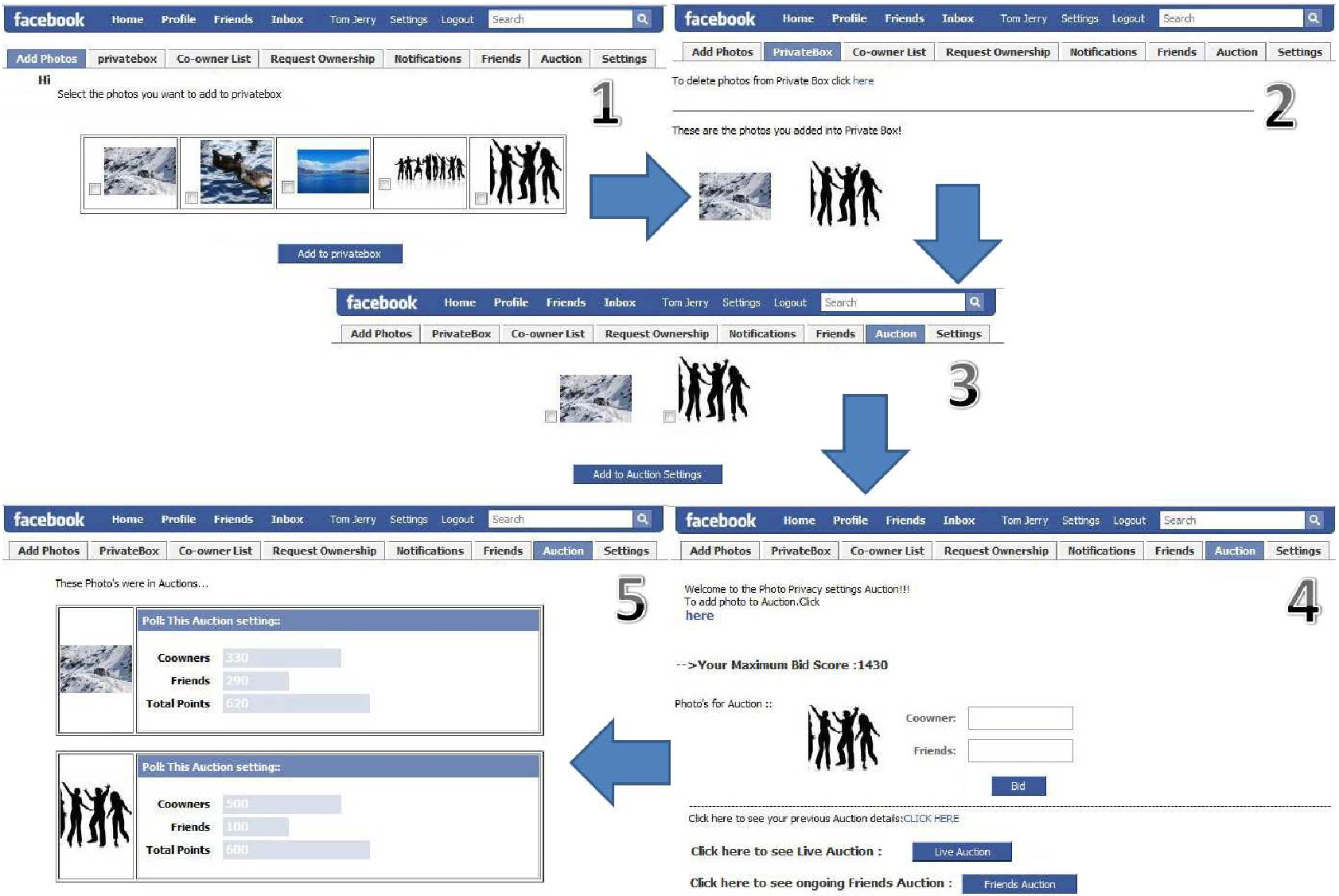
- Each user bids a value () on different privacy outcomes (Friends, Public, Private).
- The system picks the outcome that maximizes total social utility.
- If a user's presence changes the outcome (a "pivotal" user), they are "taxed" in system credits. This ensures that truthful revelation of their actual privacy preference is the best strategy.
3. Automated Inference
To avoid "voter fatigue," the authors propose using Folksonomies (collaborative tagging). If a group of friends always votes "Friends Only" for photos tagged with "Party," the system infers this preference for future similar photos.
Experiments and Results
The authors built Private Box, a Facebook-integrated app. Their testing focused on scalability:
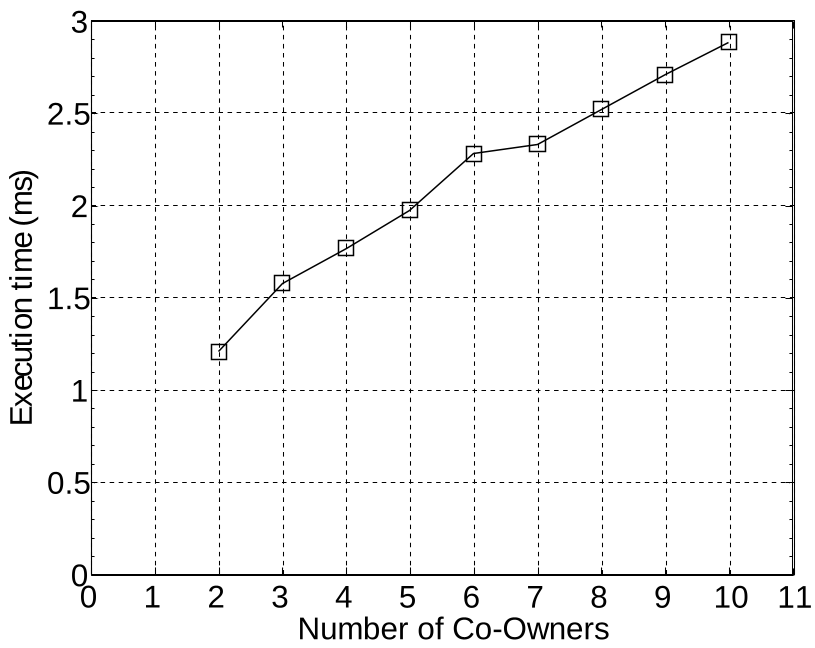
- Performance: Calculating the social utility and taxes for 12 co-owners (well above the average 2-4 faces per photo) was almost instantaneous.
- Feasibility: The linear increase in execution time relative to the number of co-owners makes it perfectly suitable for large-scale social platforms.
Critical Insight: Why This Matters
The genius of this approach lies in its Inductive Bias toward truthfulness. By borrowing from microeconomics, the researchers solve a human social problem (conflict) with a mathematical guarantee. While most privacy research focus on encryption or anonymization, this paper tackles the social logic of privacy.
Limitations
- Numeraire Complexity: Users might find it difficult to assign a "dollar value" or credit value to their privacy.
- Inference Reliability: Folksonomies are messy; a "Party" in one context might be more sensitive than another.
Summary
This paper is a seminal look at how we might move away from the "dictatorship" of the content uploader toward a more "democratic" and mathematically fair social web. It provides a blueprint for platforms like Instagram or LinkedIn to handle collaborative content more ethically.