
Navigating the Crowd: Automated Collective Semantic Behavior Extraction in Social Networks
10006_Collective semantic behavior extraction in social networks.
This paper proposes a novel framework for automatically extracting collective semantic behaviors from social networks by integrating Latent Dirichlet Allocation (LDA), DeepWalk, and density-based clustering. The method successfully identifies representative group behaviors in large-scale semantic social networks such as Weibo and Douban.
TL;DR
Understanding what a crowd "thinks" or "does" is far more complex than tracking a single user. This paper introduces a systematic framework that transforms raw social media text into a structured "Semantic Social Network." By leveraging LDA for topic extraction, DeepWalk for graph embedding, and Density-Based Clustering, the authors provide a way to automatically distill the essence of community behaviors from thousands of scattered posts.
Problem & Motivation: Beyond Individual Actions
In the era of Facebook, Twitter (X), and Weibo, we are drowning in data but starving for insight into group dynamics. Most existing research focuses on either Community Detection (who talks to whom) or Sentiment Analysis (what is the vibe). However, there is a missing link: Collective Semantic Behavior.
Why is this hard?
- Scale: Manual labeling of group themes is impossible for millions of users.
- Emergence: Collective behaviors are not just a simple sum of individual actions; they exhibit distinct patterns.
- Topology vs. Content: Most graph algorithms only look at links, ignoring the semantic "meat" of the conversation.
Methodology: The Three Pillars of Semantic Extraction
The authors propose a pipeline that bridges the gap between natural language processing and graph theory.
1. Building the Semantic Graph
Instead of using explicit "Follow" buttons, the authors build links based on Homogeny.
- Topic Modeling: Using Latent Dirichlet Allocation (LDA) to turn a user's post history into a probability distribution of topics.
- Pearson Correlation: Linking users whose topic distributions are highly correlated (exceeding a threshold ).
2. From Graph to Vector Space
To make the network mathematically "tractable," they use DeepWalk. This treats random walks across the user-link graph as sentences, using Skip-gram models to embed each user into a continuous vector space.

3. Community Detection & Strategic Extraction
The paper employs a density-based algorithm to find "density peaks"—nodes that are surrounded by lower-density neighbors but are far from other high-density peaks. Once communities are found, they use two strategies to find the "Representative" behavior:
- Strategy 1: The node closest to the community density center (representing the majority trend).
- Strategy 2: The node closest to the center of a minimized circle covering the community (representing the breadth of types).
Experiments & Results: Real-World Validation
The framework was tested on two massive datasets:
- Weibo: Over 400,000 posts. The model identified two primary communities even as topic numbers varied, proving the stability of the semantic structures.
- Douban: Movie reviews. Since all users discussed the same movie, the model correctly identified a single, dense community.
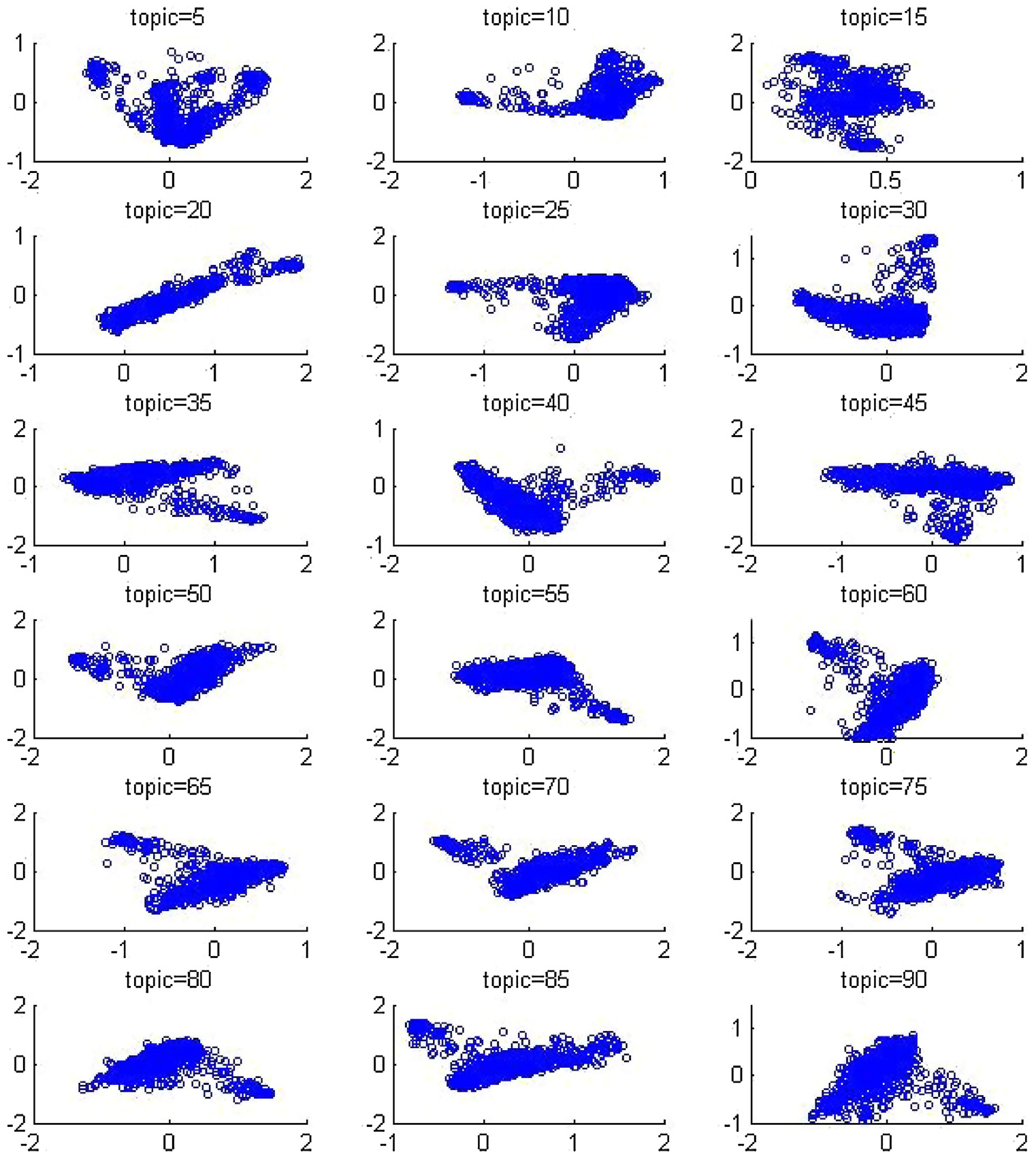 Figure: The visualization of detected communities in the Weibo dataset using the proposed pipeline.
The experiments highlighted that parameter (threshold) is critical; a higher threshold leads to sparser, more specialized networks, while a lower threshold captures broader social trends.
Critical Analysis & Future Outlook
Takeaway
The true innovation here is the pipeline. By combining LDA (the "what") with DeepWalk (the "where"), the authors treat social networks as dynamic semantic landscapes rather than static grids.
Limitations
- Short Text Problem: Standard LDA struggles with the brevity of tweets. The authors acknowledge that versions like "Twitter-LDA" or aggregating posts per user (MSG model) are necessary workarounds.
- Contextual Blindness: Currently, the model ignores social roles, trust, and offline relationships, focusing purely on semantic similarity.
Future Work
The research points toward a future where "Collective Intelligence" can be automatically mapped. Imagine a system that can pinpoint the exact moment a niche hobby becomes a mainstream community movement just by analyzing the geometry of its semantic embedding.
Senior Editor's Note: This work serves as a foundational bridge for researchers moving from pure Graph Convolutional Networks (GCNs) to more content-aware Social computing. It reminds us that in digital sociology, the "topic" is often as important as the "connection."