
Beyond Content: Collective Spammer Detection in Multi-Relational Networks
Collective Spammer Detection in Evolving Multi-Relational Social Networks
The paper proposes a content-independent framework for detecting sophisticated spammers in evolving, multi-relational social networks like Tagged.com. It integrates graph structural features, activity sequence modeling using k-grams and Markov models, and collective reasoning via Hinge-loss Markov Random Fields (HL-MRFs).
Executive Summary
TL;DR: This paper presents a comprehensive framework for catching "sophisticated" spammers—those who have already evaded initial filters. By shifting focus from content (what they say) to context and behavior (how they navigate multiple interaction types like messages, views, and winks), the authors achieve high-precision detection (85%+) using a combination of graph structural features, sequence mining, and a unique "collective reasoning" approach for abuse reports.
Context: Published in KDD '15, this work sits at the intersection of Graph Mining and Statistical Relational Learning, proving that behavioral metadata in high-dimensional (multi-relational) social graphs is a potent weapon against adversarial adaptation.
Problem & Motivation: The Content-Filter Catastrophe
Spam detection is an arms race. Traditional filters focus on keywords or URLs, but spammers have mastered "content randomness" and "message splitting" to bypass these checks. Moreover, in an era of end-to-end encryption and strict privacy, platforms often cannot read user content.
The authors identify a critical gap: existing methods often treat social networks as simple graphs. In reality, sites like Tagged.com are multi-relational. A user doesn't just "link" to another; they message, friend, "wink," or play social games. These diverse activities form a sequence of behaviors that are much harder for a spammer to fake than a simple text message.
Methodology: The Three-Legged Stool
The framework rests on three distinct analytical components:
1. Multi-Relational Graph Features
Instead of one graph, the authors build ten (e.g., , , ). For each, they extract:
- Centrality: PageRank and k-core metrics.
- Connectivity: Triangle counts and connected components.
- Activity: In-degree vs. Out-degree ratios.
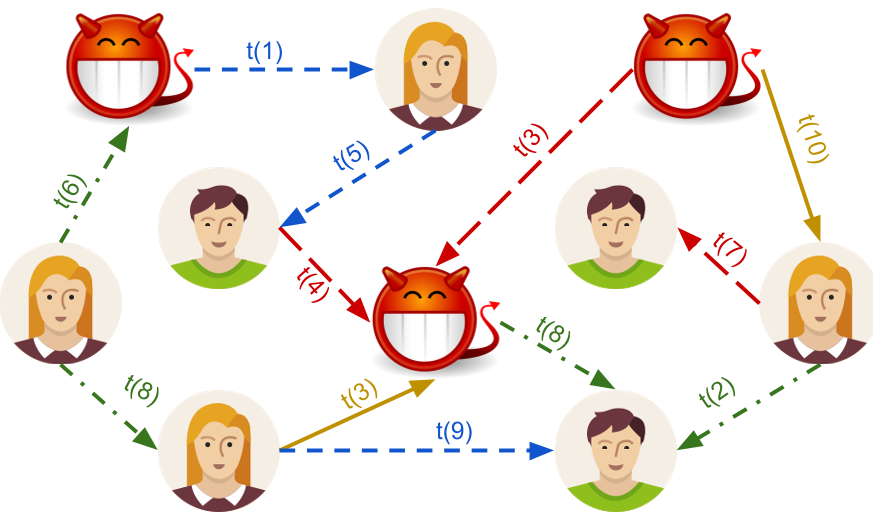 Figure 1: Visualizing the multi-relational structure where spammers and legitimate users interact via different temporal edges.
2. Sequence Modeling
Spammers typically follow a "script." The paper uses k-grams (specifically bigrams) to track the transition between actions (e.g., how often does a user "view profile" then immediately "send message"?). They further refine this with a Mixture of Markov Models, treating each user class (Spammer vs. Legitimate) as a separate generative process for action chains.
3. Collective Reasoning with PSL
The "Abuse Report" system is often noisy; spammers report legitimate users to cause chaos. To fix this, the authors use Probabilistic Soft Logic (PSL) and HL-MRFs.
- The Intuition: A reporter's credibility should increase if they report someone who is independently flagged as a spammer, and decrease if they report a reputable user.
- The Model: By reasoning collectively about reporter credibility and the reported user's spam status, the system filters out malicious reports and amplifies accurate ones.
Experiments & Results: Real-World Impact
Using a massive dataset from Tagged.com (5.6M users, 912M actions), the researchers benchmarked different configurations:
- Multi vs. Single Relation: Combining all activity types (relations) yielded significantly better AUPR (0.328) than any single relation alone (0.187).
- The Full Stack: When Graph features, Sequence features, and Demographic data (age/gender) were combined, the AUROC reached a staggering 0.963.
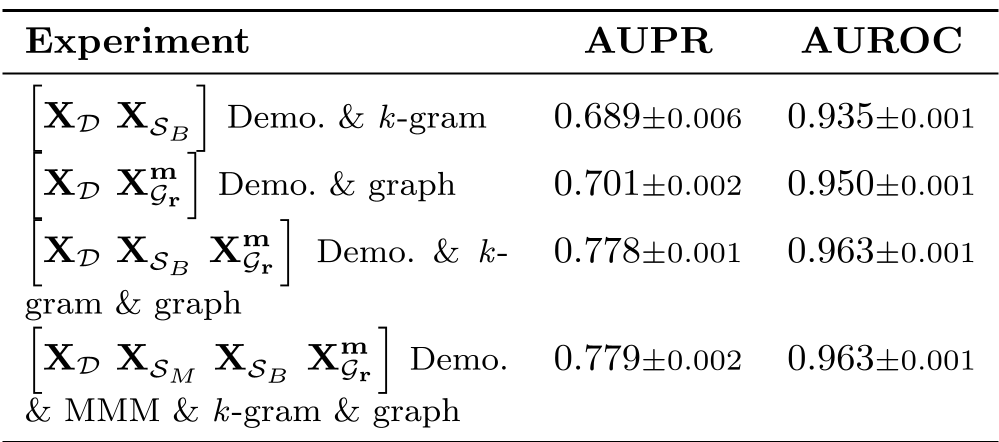 Table: Performance comparison showing the jump in metrics as the model moves from simple k-grams to the full integrated framework.
The collective model for reports alone saw a massive lift in AUPR—from 0.674 (baseline) to 0.884—simply by including the joint reasoning of reporter credibility.
Critical Analysis & Conclusion
Takeaways
- Architecture Matters: Multi-relational modeling provides the "inductive bias" needed to separate human behavior from bot behavior.
- Collective Intelligence: Don't take metadata at face value. The "Reporter-Reported" trust cycle modeled via HL-MRFs is a brilliant way to handle adversarial noise.
Limitations & Future Work
The model is currently batch-oriented. In a production environment, spammers adapt in minutes. Bridging this framework with Online Learning would be the next logical step. Additionally, while content-independent, integrating this with "lightweight" content features (like URL frequency) could provide even higher precision.
Final Thought: Fakhraei et al. remind us that in the age of sophisticated AI bots, the most reliable signal is often the most fundamental: the structural pattern of human interaction.