
Game Theory Meets Fountain Codes: Defeating Collusion in Social Rescue Networks
11099_A Collusion Avoidance Node Selection Scheme for Social Network-Based Distributed Data Storage.
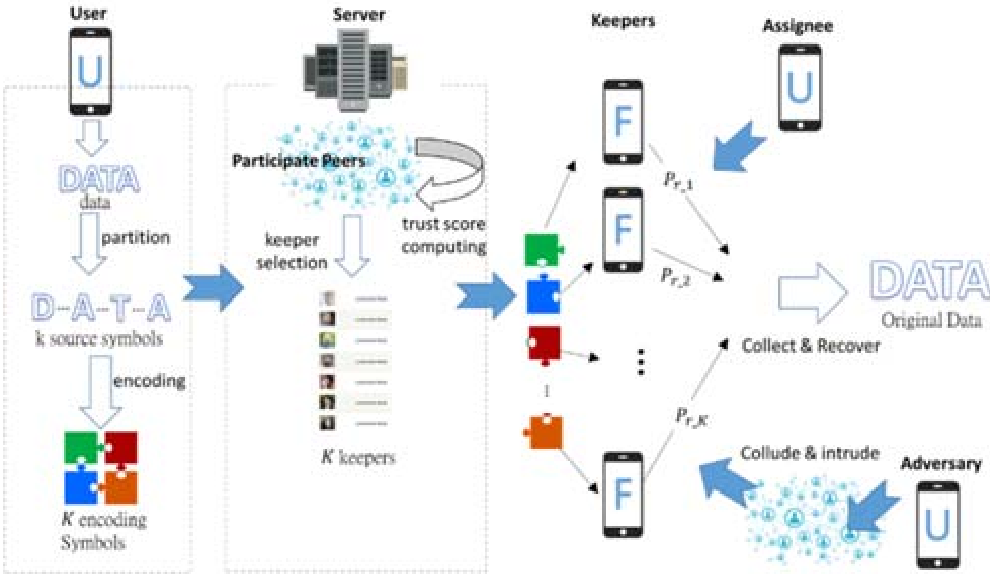
This paper introduces a robust privacy-preserving scheme for social network-based emergency rescue systems using Fountain Codes (FC) and Game Theory. It proposes a distributed storage framework where sensitive personal data is encoded and distributed among "keepers," utilizing a novel trust score mechanism to mitigate collusion risks.
TL;DR
When disaster strikes, your private data (medical history, identity) needs to be accessible to rescuers but protected from prying eyes. This paper proposes a decentralized storage system that uses Fountain Codes to split data and Game Theory to select "keepers." By implementing a dynamic penalty for choosing "friends of friends," the system effectively prevents malicious collusion while ensuring high data availability.
Background: The Social Network Vulnerability
In emergency rescue systems, distributed storage is often preferred over centralized databases for resilience. However, in a social network context, "trust" is a double-edged sword. If you store data shards with friends, they might have a higher incentive to help, but they also have a higher probability of knowing each other. If these keepers collude, they can combine their shards to illegally reconstruct your private data.
The Problem: The Inductive Bias of Trust
Most existing systems select nodes based on the highest Trust Score. This paper identifies a critical flaw: selecting the top-N most "trustworthy" nodes often results in picking a tightly-knit cluster of friends. In cryptographic terms, this increases the risk of a "Collusion Attack" where a subset of nodes exceeds the Fountain Code reconstruction threshold.
Methodology: Dynamic Selection & Trust Evaluation
The authors propose a multi-faceted approach to keeper selection:
1. The Trust Score ()
The trust score isn't static. It evolves based on a node's historical behavior:
- Risk Factor (): Accounts for the amount of data a node has previously handled.
- Experience Evaluation (): Rewards successful data recovery and penalizes suspected collusion.
2. Collusion-Aware Selection Logic
The most innovative part of the methodology is the selection iteration. When a node is selected, its friends' scores are immediately penalized to reduce the likelihood of a "clique" managing all the data shards.
The selection score is updated as follows: This ensures that even if a node is highly trustworthy, if many of its friends are already keepers, its selection priority drops.
Experiments & Results
The researchers compared three strategies: Random Choosing, Best Trust Score, and Greedy Keepers Selection.
- Security: The "Greedy" method showed a significantly lower rate of successful collusion compared to "Best Trust Score," as it effectively spread shards across different social clusters.
- Efficiency: By utilizing Fountain Codes, the system achieves "rateless" properties—rescuers only need to collect a sufficient number of any shards to reconstruct the original data, regardless of which specific keepers are online.
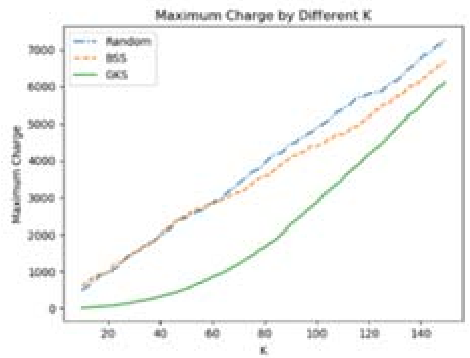
The results confirm that incorporating the Ratio of Charge (rc) and social penalties creates a more sustainable and secure ecosystem for distributed data.
Critical Insight: Why This Matters
The fundamental takeaway is that trust is not transitive in privacy-preserving systems. My trust in node A and node B individually does not mean I should trust them together with my data. This paper provides a mathematical framework to quantify this "collective risk" and mitigate it through game-theoretic selection.
Future Outlook
While the current model focuses on Social Networks, the logic is highly applicable to Decentralized Identifiers (DID) and Web3 Social Graphs. However, the current model assumes a static social graph; future iterations would need to account for dynamic relationship changes or "sybil attacks" where one entity creates multiple fake accounts to bypass the collusion penalty.
Index terms — Social Network Privacy, Fountain Code, Game Theory, Collusion, Distributed Storage.