
MAS-Social-Sim: Decoding Group Evolution Through Multi-Agent Intelligence
Colony Evolution in Social Networks Based on Multi-agent System
This paper presents a social network evolution model implemented via a Multi-Agent System (MAS) to simulate how group dynamics shift based on individual behaviors. By categorizing agents into eight distinct psychological profiles (from "Kindhearted" to "Mean"), the study identifies how information flow and wealth gaps dictate the speed and stability of social integration across different network topologies.
TL;DR
How do individual whims—ranging from blind loyalty to calculated betrayal—shape the grand architecture of society? This paper develops a Multi-Agent System (MAS) to simulate social networks, proving that the speed of "social integration" is driven by a delicate balance of random actors, wealth inequality, and the "topology" of who knows whom.
Background: Beyond Static Graphs
Classical sociology often views networks as static structures. However, in the digital age, relationships are fluid. People join, leave, and betray groups based on utility. The authors argue that to understand Colony Evolution, we must stop looking at agents as mere nodes and start looking at them as autonomous decision-makers with specific psychological profiles.
The Problem: The Over-Simplicity of Prior Work
Existing models (like Ohtsuki’s cooperation formulas) often assume only two types of people: cooperators or defectors. This "binary" view ignores the nuances of human behavior, such as:
- Information Silos: You can only act on what your direct neighbors tell you.
- Trend Following: Some people only betray a group when they see profits starting to dip.
- Mobility: People don't just change state; they change groups.
Methodology: The 8 Personas of Social MAS
The researchers defined a spectrum of characteristics, forming the "DNA" of their agents:
- The Kindhearted (k-1, k-3, k-5): Loyalists who choose groups randomly, by size, or by following the wealthiest person.
- The Mean/Selfish (k-2, k-4, k-6): Rational actors who betray groups when profitability trends change.
The "Intelligence" of these agents is governed by a utility function:
Network Architectures Compared
The study tests these agents on two distinct stages:
- Cycle Graph Model (CM): Simulates rigid, hierarchical organizations where information travels slowly.
- Random Strongly Connected Graph (RSCM): Simulates the chaotic, multi-channel reality of modern social life.
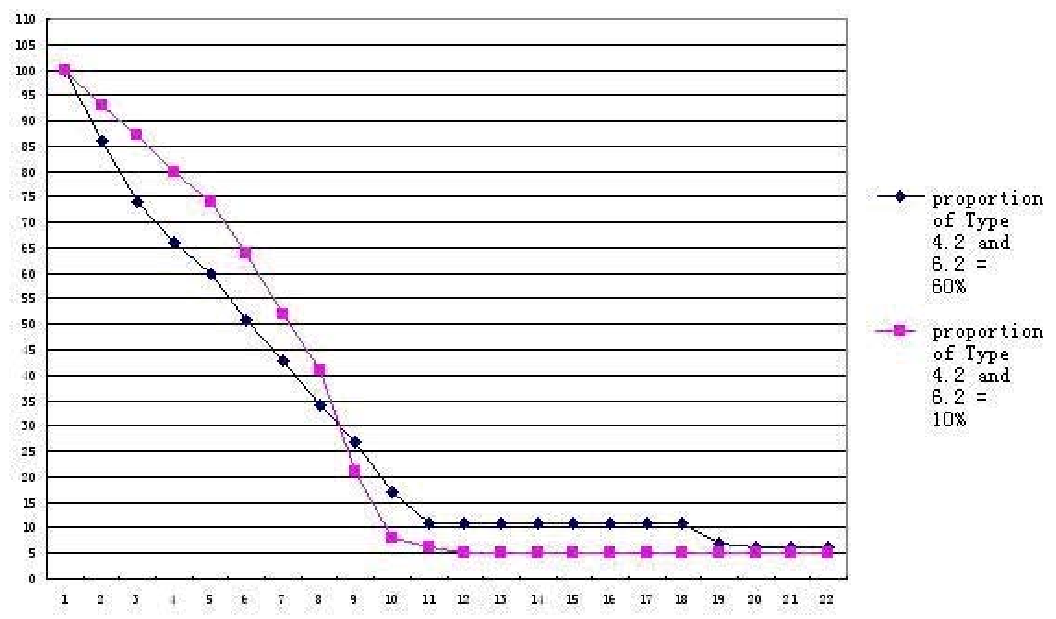 Table 1: The stark difference in integration. RSCM reaches a unified state (1 group) more frequently than the rigid CM structure.
Key Insights from Experiments
1. The Necessity of "Random" Individuals
One might think "purposeless" individuals (Types k-1 and k-2) are social noise. On the contrary, in rigid structures (CM), they act as bridges. Without them, information about successful groups gets stuck at "borders," preventing the society from ever reaching a consensus.
2. The Magnetism of Wealth
Does inequality help or hurt social cohesion? The simulation found that larger initial wealth gaps actually accelerate integration in the short term. The wealthiest individuals act as "gravity wells," pulling agents into large groups. However, this creates a trade-off: while integration is faster, the final society is more likely to settle into several competing powerful groups rather than one single community.
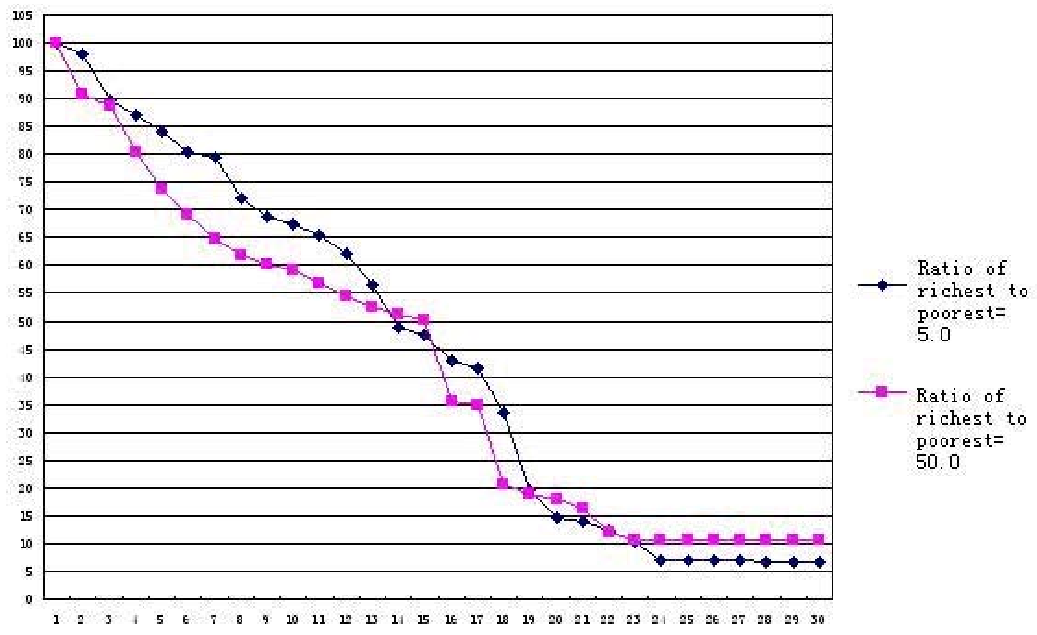 Figure 2: Contrast of evolution with different wealth gap ratios. Note how the "appeals" of rich agents drive faster initial group consolidation.
Critical Analysis & Takeaways
The beauty of this MAS model is its recognition of Inductive Bias in human behavior. By modeling "Mean" individuals who track profit trends, the authors provide a more realistic look at "churn" rates in social groups.
Limitations:
- The model assumes a "closed society" where total benefit is redistributed.
- It does not account for agent growth—only their movement and momentary profit.
The Future of Product/Research: For developers of DAO (Decentralized Autonomous Organizations) or social platforms, this research suggests that randomized recommendations (simulating k-1 agents) are not just a feature—they are a requirement for preventing "network fracture" and ensuring long-term platform health.
Conclusion
Colony evolution is a dance between the structure of the net and the psychology of the nodes. This paper reminds us that "Kindness" provides stability, but "Selfishness" and "Inequality" often provide the momentum for social change.