
Beyond the Smile: Decoding Emotions Through Facial Skin Color Changes
Color Analysis of Facial Skin: Detection of Emotional State
This paper presents a novel approach to human emotion detection by exclusively analyzing facial skin color changes. Using a custom high-resolution dataset of spontaneous emotions, the authors demonstrate that hemoglobin and oxygenation variations can be captured via standard RGB cameras, achieving a 77.08% accuracy in binary valence classification using Latent-Dynamic Conditional Random Fields (LDCRF).
TL;DR
Can your computer tell how you feel just by looking at the "glow" of your skin? This research says yes. By bypasses traditional facial expressions (like smiles or frowns) and focusing entirely on subtle hue shifts caused by blood flow, researchers achieved over 77% accuracy in identifying emotional states using standard video cameras.
Context: This work shifts the focus of affective computing from "outward" muscle movements to "inward" physiological signals, positioning skin color as a high-fidelity biometric for emotion detection.
The Problem: Expressions Can Be Faked, Physiology Cannot
Most AI systems today recognize emotions by tracking the geometry of the face—the curve of the lips or the narrowing of the eyes. However, humans are experts at masking emotions (posed expressions).
The true "tell" lies beneath the surface. Changes in hemoglobin concentration and blood oxygenation occur involuntarily when we experience emotions. Prior attempts to capture this used expensive specialized hardware like hyperspectral or thermal cameras. The challenge addressed here is: Can we detect these subtle physiological shifts using nothing but a standard DSLR camera and machine learning?
Methodology: The Science of the "Flush"
The authors hypothesized that the forehead and cheeks are prime windows into the autonomic nervous system.
1. Data Collection & Preprocessing
The team built a diverse dataset (Caucasian, African American, Hispanic, and Asian) to ensure the method wasn't biased by base skin tone. They used a color opponent model to calculate three specific indices:
- RedX:
- GreenX:
- BlueX:
These indices highlight the distance of a specific color from the others, making the subtle "redness" of embarrassment or the "paleness" of fear much easier for the computer to see.
2. The Model Architecture
While they tested several algorithms (KNN, Decision Trees, Logistic Regression), the standout was the Latent-Dynamic Conditional Random Field (LDCRF).
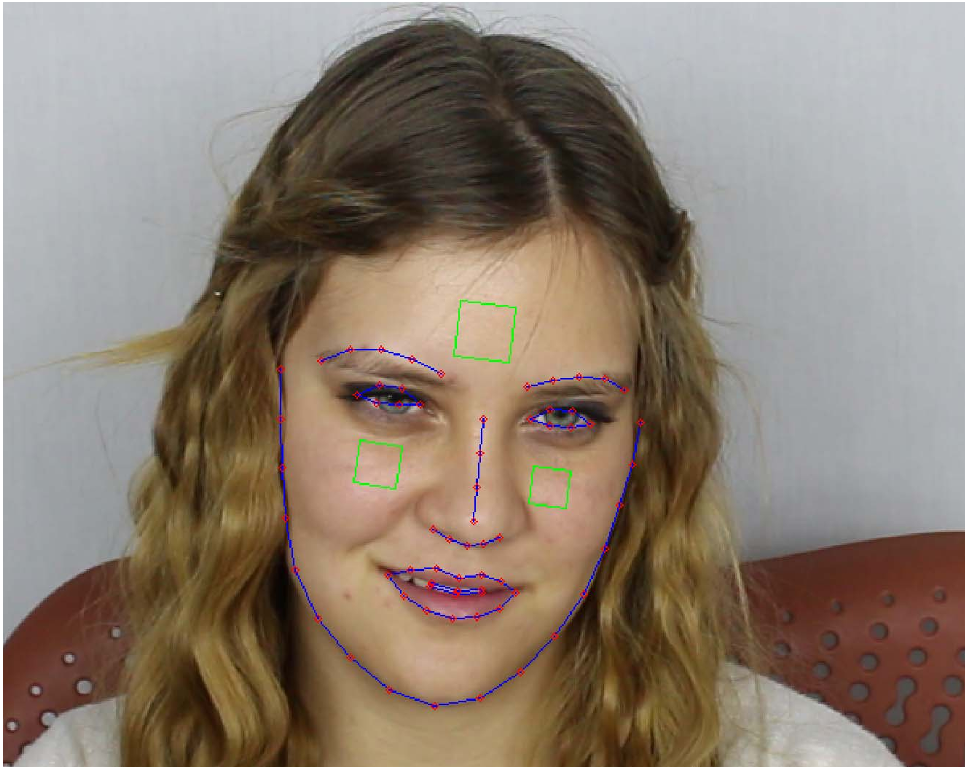 Figure: The system tracks 66 facial landmarks to lock onto the forehead and cheeks, ensuring color data is consistent even if the subject moves.
Why LDCRF? Because emotions aren't static snapshots; they are temporal sequences. LDCRF models the "hidden" transitions between states, effectively "smoothing" the noise of human movement to find the underlying emotional signal.
Key Results: The Significance of the Left Cheek
The results revealed a fascinating physiological quirk. The most effective combination for predicting emotion was the Forehead (FH) + Left Cheek (LC).
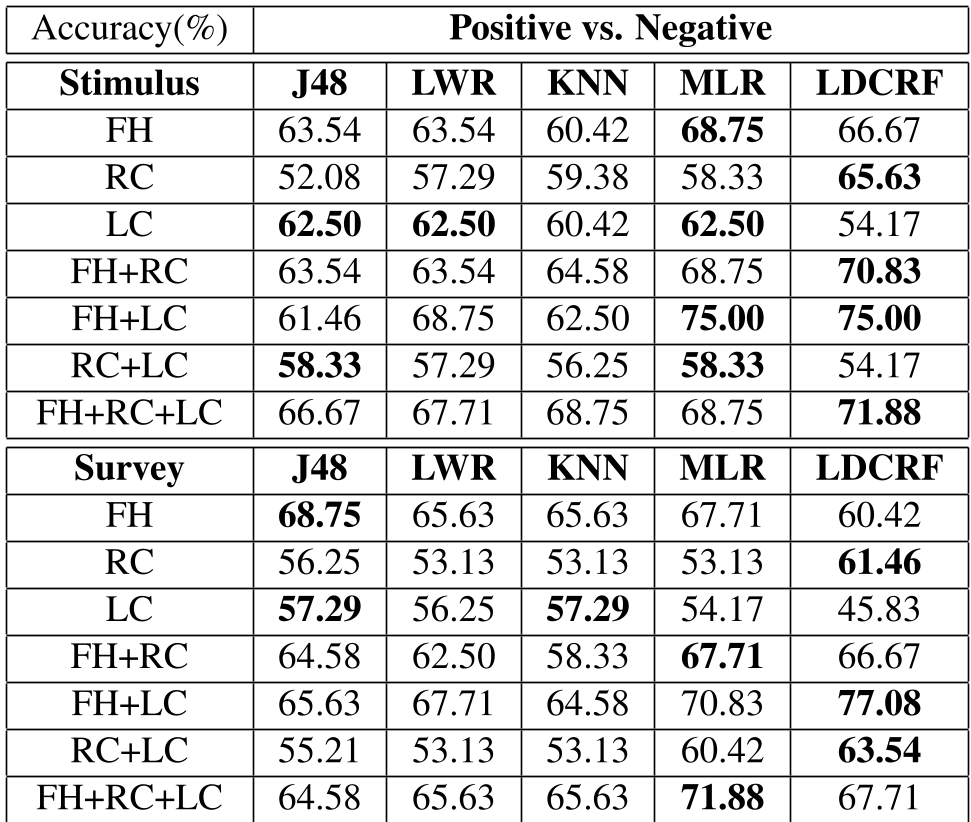 Table: Comparison of ROI performance. Note how FH+LC consistently outperforms other combinations.
Key Insights from the Experiment:
- Binary Accuracy (Pos vs. Neg): 77.08%
- Ternary Accuracy (Pos vs. Neu vs. Neg): ~56.25%
- Asymmetry Point: The left side of the face was found to be more "expressive" in the color domain, aligning with neuropsychological theories that the right hemisphere of the brain (controlling the left side of the body) is more involved in emotional processing.
Critical Analysis & Future Outlook
Takeaway
This paper fundamentally proves that skin color is a reliable feature for valence detection. It bridges the gap between high-end medical sensors and consumer-grade vision.
Limitations
- Lighting Sensitivity: The study was conducted under controlled laboratory lighting. In the "wild," fluctuating light sources (like a flickering monitor or sunlight) would create significant noise.
- Glasses and Occlusion: The current model excluded subjects with glasses, which is a significant portion of the population.
The Future of Affective Computing
The authors suggest that the next step is moving toward Deep Recurrent Neural Networks to better capture the complexities of emotional flow. Imagine a future where your video conferencing software can detect your stress levels not by your voice, but by the subtle, invisible-to-the-eye reddening of your brow. This research brings us one step closer to that reality.