
CoLT: Accelerating MLLM Reasoning with Chain of Latent Thoughts
CoLT: Teaching Multi-Modal Models to Think with Chain of Latent Thoughts
CoLT (Chain of Latent Thoughts) is a novel multi-modal reasoning framework that replaces verbose textual Chain-of-Thought (CoT) with a few continuous latent thought vectors. By utilizing a three-way step-level supervision mechanism, it achieves SOTA performance on 8 benchmarks, including a +3.4% average accuracy improvement over text-based CoT.
TL;DR
The "Reasoning Era" of AI, epitomized by models like DeepSeek-R1 and OpenAI o1, relies on massive text-based Chain-of-Thought (CoT). However, CoLT (Chain of Latent Thoughts) demonstrates that models don't need to "talk to themselves" in text to think. By replacing hundreds of text tokens with just 3 latent thought vectors, CoLT achieves a 10.1x speedup while actually surpassing text-based reasoning accuracy on complex multi-modal benchmarks.
The Bottleneck of "Thinking out Loud"
Standard Multi-modal Large Language Models (MLLMs) are currently trapped in a "textual reasoning bottleneck." While generating explicit reasoning steps helps solve complex math or visual logic problems, it introduces three fatal flaws:
- Extreme Latency: Generated chains can span thousands of tokens, making real-time inference impossible.
- Deterministic Collapse: Once a word is chosen, the model's internal probability distribution collapses, limiting alternative reasoning paths.
- Error Propagation: A single early mistake in the text chain often leads to a "hallucination spiral."
Previous "Latent Reasoning" attempts often failed because unconstrained continuous vectors are prone to semantic drift, making them "meaningless noise" to the model.
Methodology: The Three Pillars of Latent Supervision
CoLT's breakthrough lies in how it regulates the latent space during training without adding overhead during inference. The authors introduce a lightweight External Decoder (e.g., a 0.6B Qwen model) to provide three specific types of training signals:
1. External Decoder Supervision
- Forward Mode: The model is forced to ensure its latent thought contains enough information to reconstruct the next textual reasoning step.
- Backward Mode: It aligns the latent states with the hidden states produced when the decoder "reads" the ground-truth reasoning text, anchoring the latent space to human logic.
2. Internal Step-to-Step Consistency
To ensure the "thought" evolves logically, an internal MLP profection head predicts the next latent state from the current one, enforcing a coherent transition across the chain.
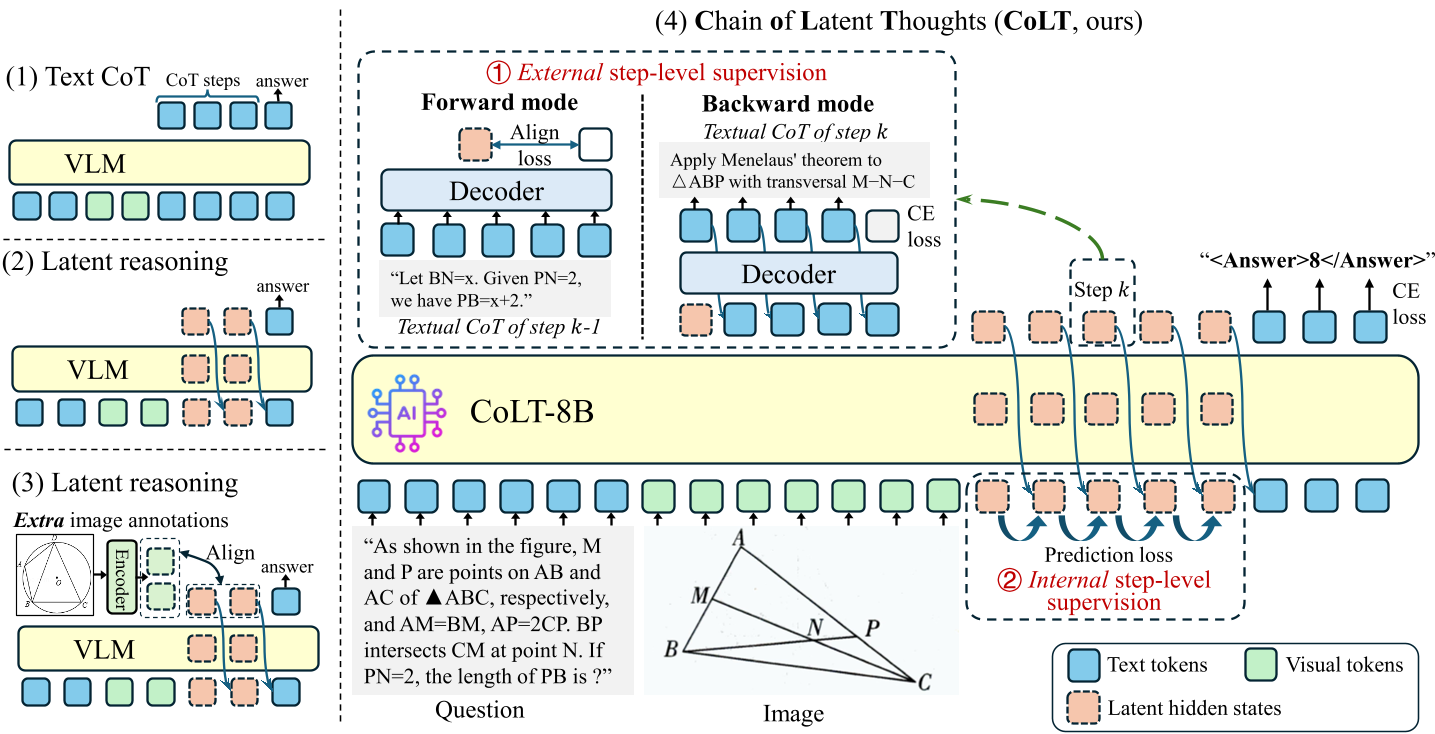 Figure 1: CoLT architecture vs. traditional paradigms. Note how the external decoder is removed at inference time for maximum efficiency.
Experimental Performance: Faster AND Smarter
The results across 8 benchmarks (SeedBench, ChartQA, etc.) are striking. CoLT doesn't just match the "Slow Thinking" of text CoT; it beats it.
- Efficiency: On MMStar, CoLT reduces generation time from 7.24s (Text CoT) to just 0.32s.
- Accuracy: CoLT achieves a +3.4% average improvement over Text CoT. In data-heavy tasks like ChartQA, the gain is a massive +9.6%.
- Robustness: Unlike text CoT, which breaks when input text has typos or images are noisy, CoLT’s continuous vectors are more resilient to perturbations.
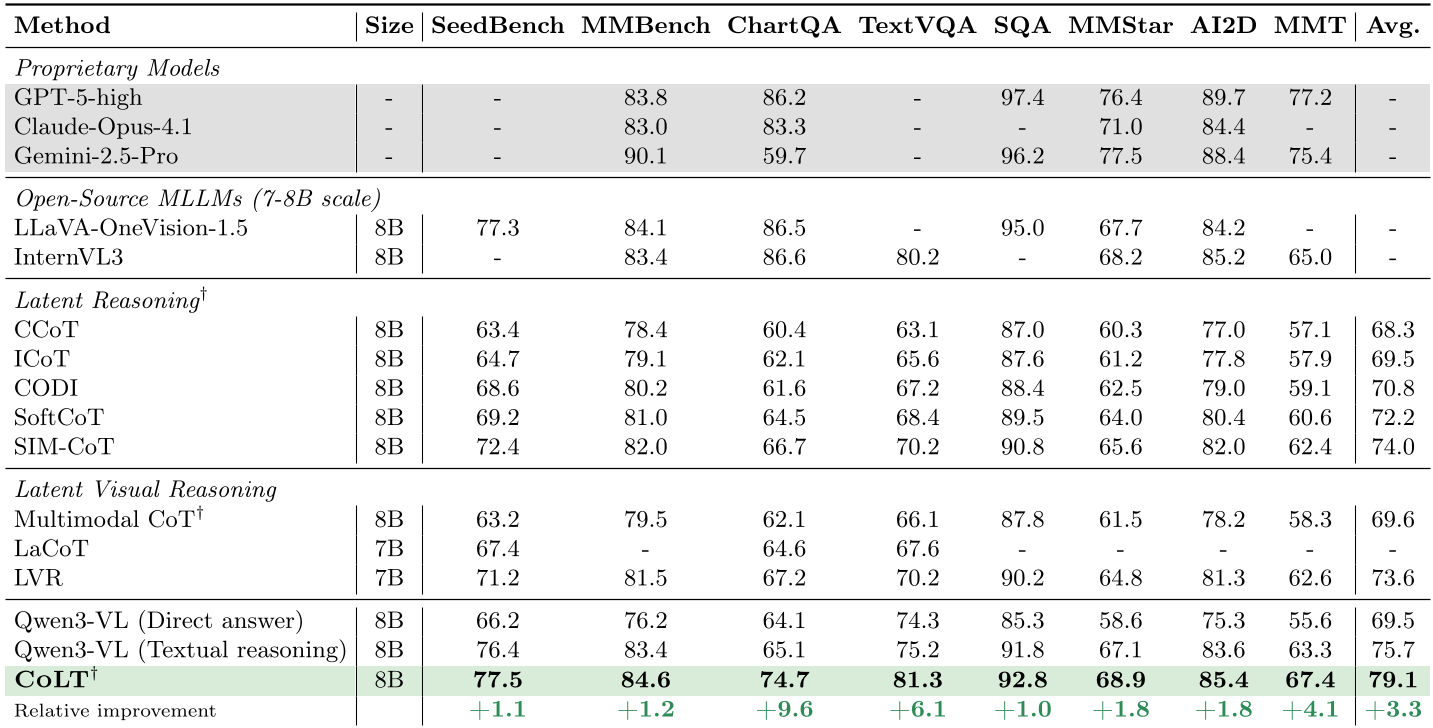 Table 1: Performance comparison. CoLT (bottom row) consistently outperforms both text-based and visual-latent baselines.
Visualizing the "Invisible" Thought
Does the model really "think"? By using the forward decoder to project the 3 latent steps back into text, the authors show that each step focuses on a distinct logical phase. For instance, in a pattern-matching task, Step 1 identifies the rows, Step 2 analyzes the green slices, and Step 3 computes the final missing piece.
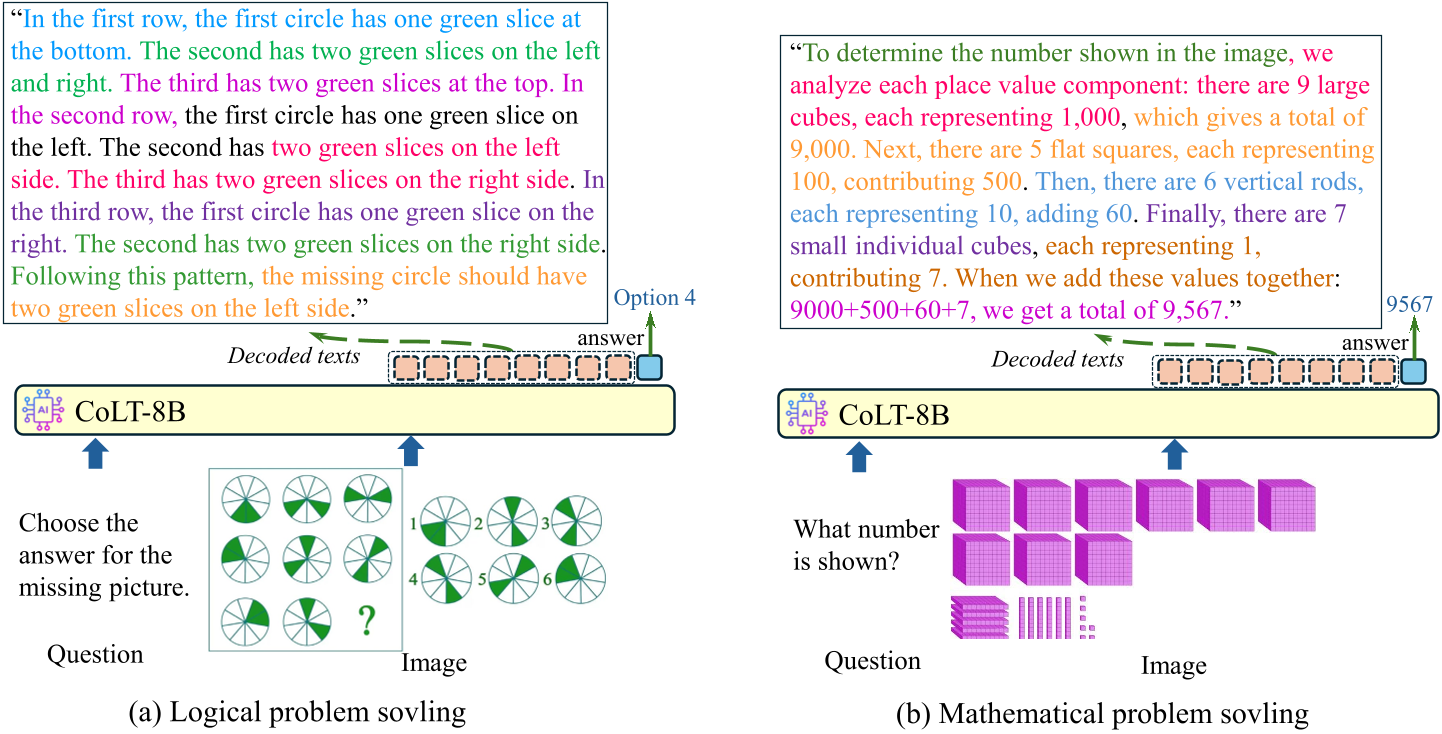 Figure 2: Interpreting latent thoughts by decoding them back into text. Each color represents a different latent step's contribution.
Critical Analysis & Conclusion
CoLT represents a significant shift from "Scaling Laws via Token Length" to "Scaling Laws via Latent Depth."
Strengths:
- Eliminates the need for expensive "Latent Visual Reasoning" annotations.
- Achieves massive speedups without sacrificing (and even improving) accuracy.
Limitations:
- The optimal number of steps () was determined empirically. Very complex "System 2" tasks might still require more steps or an adaptive mechanism.
Future Work: The most exciting path forward is Adaptive Latency—allowing the model to decide whether a problem requires 1 "thought" or 100, dynamically adjusting its reasoning time based on difficulty.