
Intelligent Filtering: Reshaping Social Networks to Combat Information Overload
Combat Information Overload Problem in Social Networks With Intelligent Information-Sharing and Response Mechanisms
The paper proposes an agent-based framework to mitigate "Information Overload" in social networks through automatic decision-making and intelligent response mechanisms. It introduces six selective information-sharing strategies and two response mechanisms (prioritized ordering and dynamic disconnection) to ensure relevant communication while reducing resource consumption.
TL;DR
In the era of "SNS fatigue," we are drowning in information but starving for relevance. This paper tackles the Information Overload problem by replacing the "forward-to-all" habit with Intelligent Information-Sharing agents. By using automated selection strategies and dynamic network reshaping (disconnecting "noisy" friends), the authors demonstrate a path toward a social network that respects human attention and computational resources.
The Core Conflict: Propagation vs. Attention
Information propagates in social networks following the "six-degree-of-separation" theory, allowing messages to reach millions rapidly. However, this speed acts like a double-edged sword. When sharing becomes effortless, the cost is shifted to the receiver's cognitive load.
The authors argue that the current problem stems from a lack of selective agency. If you are overloaded, you lack the energy to decide who actually wants to see a post, so you blast it to everyone. This paper proposes that the solution lies in the same technology that caused the problem: Automated Agent-Based Modeling.
Methodology: The Anatomy of an Intelligent Agent
The researchers built a framework where every user is an autonomous agent defined by two primary models.
1. The Multi-Subject Interest Profile
Unlike simple keyword matching, the paper defines a user's interest across subjects, using three dimensions:
- Interest Factor (): How much do you care? (0–5)
- Relevance Threshold (): How "pure" must the message be for you to accept it?
- Subject Diversity: A message is evaluated against these interests to determine a match.
2. Selective Sharing Strategies
The authors tested six strategies, ranging from ELI (Even Little Interested)—the "noisy" approach—to HIR (High Interested and Relevance)—the "selective" approach.
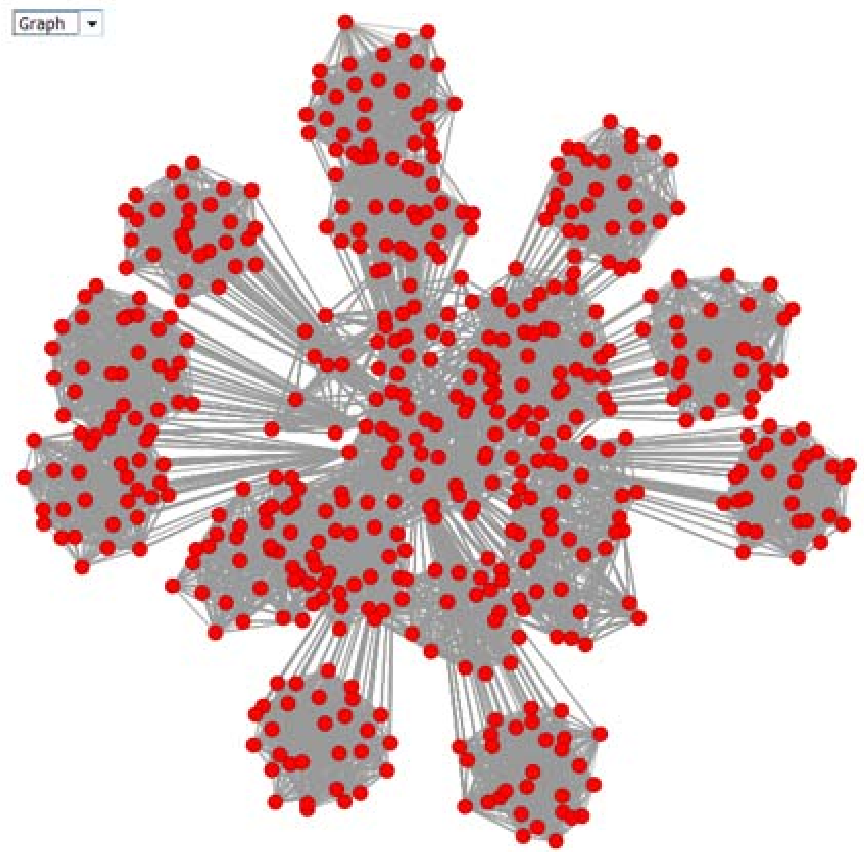 Fig 1. The simulation environment uses a force-directed graph where cluster leaders act as information hubs.
Intelligent Response: The Survival of the Relevant
Perhaps the most innovative part of this work is how the network evolves based on behavior.
- Phase 1: Learning. Agents observe which neighbors send "appreciated" content (content that matches their interest profile).
- Phase 2: Ordering. Inboxes are sorted by the "Appreciation Ratio" of the sender. If you have a read limit, the noisy senders simply never get heard.
- Phase 3: Disconnection. If a neighbor's Appreciation Ratio falls below a threshold (e.g., 0.6), the receiver disconnects the link.
Experimental Validation: Real-World vs. Simulation
The authors didn't just rely on synthetic data. They mapped their model onto a real-world Student Cooperation Net (185 nodes, 360 links).
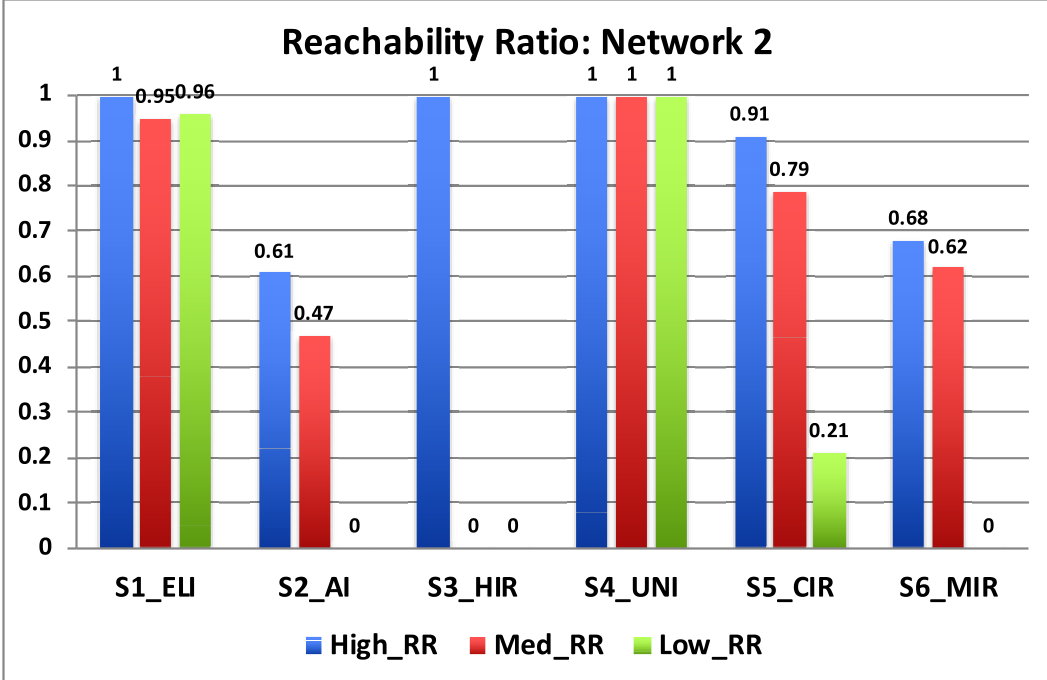 Fig 2. Comparison of reachability. Selective strategies maintain high reach among the interested while dropping the noise.
Key Findings:
- Selectivity Wins: The S3_HIR strategy allowed messages to reach 100% of highly interested people with zero "junk mail" to others.
- The Penalty of Noise: In mixed-strategy settings, nodes using the unselective S1_ELI strategy were disconnected by 3+ neighbors at a rate nearly 40% higher than selective nodes.
- Efficiency: Selective mechanisms reduced the Message-to-Node ratio, significantly cutting down on the "hidden" computational and transmission costs of social media.
Critical Insight: Social Capital as a Feedback Loop
The value of this paper lies in its treatment of Relational Links as a finite resource. In current social platforms, there is little penalty for being a "noisy" neighbor. By introducing Automated Response Mechanisms, the authors create a feedback loop where social capital (connectedness) is directly tied to the quality and relevance of the information one shares.
Future Outlook
While the model assumes users will provide honest interest profiles, the paper acknowledges that Privacy-Preserving Relevance Analysis is the next frontier. How do we build these "filters" without letting the platform (or the agents) read our private thoughts? Furthermore, using Natural Language Processing (NLP) to automatically map posts to these subject lists will be crucial for moving this from a simulation to a production plug-in.
Conclusion
The "Forward to All" button is the enemy of the modern social network. By empowering agents to be selective and allowing networks to prune low-value connections, we can move from Information Overload back to Information Utility.