
Dynamic Defense: Catching Social Spammers by Their Temporal Footprints
Combating the evolving spammers in online social networks
The paper proposes a novel framework for spammer detection in Online Social Networks (OSNs) by leveraging temporal evolution patterns. By introducing a dynamic metric based on sliding windows and combining unsupervised clustering with supervised SVM classification, the authors achieve superior performance on real-world Sina Weibo datasets, significantly reducing false positives.
TL;DR
Static defenses are failing. As spammers learn to mimic "normal" profiles at any given moment, this research shifts the battlefield from what a user is to how they change. By modeling users' behavioral evolution using a dynamic window-based metric, the authors built a detection system that is significantly harder to trick and 53% more accurate at avoiding "collateral damage" (wrongfully banning real users).
The "Static Snapshot" Trap
Most modern OSN security systems look at a user's profile like a photograph: Does this person have 1,000 followers? Do they post 10 URLs a day? Spammers have figured out the "posture" required to pass these tests. They buy aged accounts, drip-feed posts to avoid burst-detection, and use "Spam Drift"—changing wording while keeping intent—to bypass content filters.
The authors argue that while a spammer can fake a state, they struggle to fake a process. Legitimate users have organic, relatively stable evolution patterns, whereas spammers must constantly pivot their strategies to stay ahead of bans.
Methodology: Capturing the "Emergence"
The core innovation lies in the Dynamic Metric. Instead of measuring raw activity, the researchers measure Emergence (e)—the degree of change relative to a sliding window of past behavior.
1. The Activity Matrix
The system tracks 8 core sequences ():
- Graph-based: Degree Centrality, Bidirectional Link Ratio, Betweenness Centrality, and Local Clustering Coefficient.
- Content-based: Total tweets, Hashtag frequency, URL ratio, and Retweet/Reply counts.
2. Measuring Change
The emergence sequence is calculated by comparing the current activity value to the mean of a previous time window . This makes the model hyper-sensitive to "abnormal points"—sudden shifts in behavior that suggest an account has been compromised or a new spam campaign has launched.
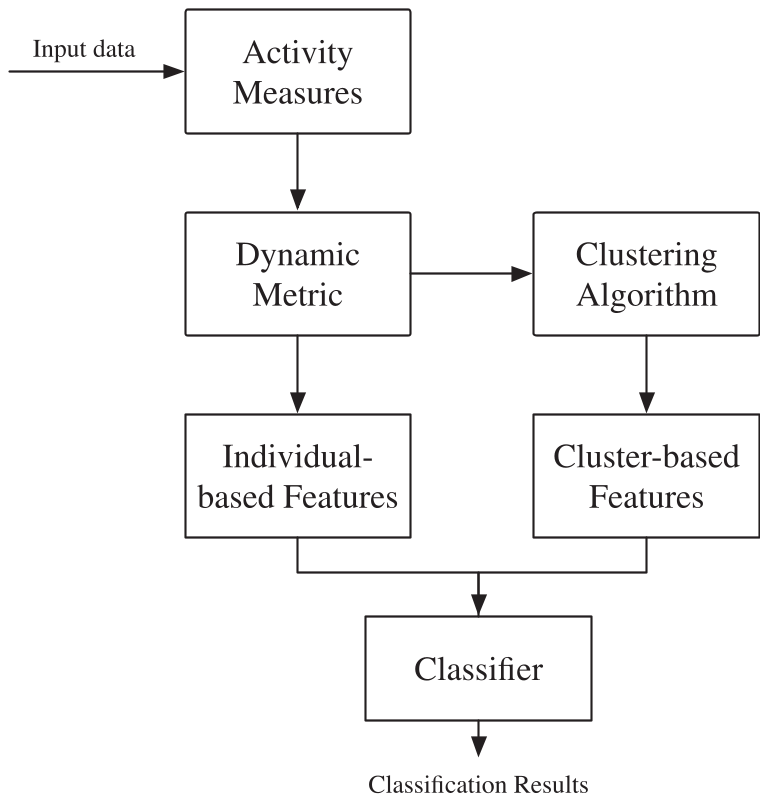 Figure: The Proposed Spammer Detection Framework
3. Clustering & Classification
Spammers don't act alone; they control "farms." The authors hypothesized that accounts in the same "farm" would show high similarity in their evolution patterns.
- Unsupervised Step: They use a modified Single Linkage clustering algorithm. Since user features are probability distributions, they use Kullback-Leibler (KL) Divergence to calculate distance.
- Supervised Step: They extract 28 features (4 cluster-based, 24 individual-based) and feed them into an SVM to make the final "Spammer vs. Legitimate" call.
Experimental Results: Reliability over Speed
Tested on a real-world Sina Weibo dataset (23 million tweets), the results were striking.
- The Spammer Signature: Spammers showed 50% higher variance in their "Emergence" sequences compared to legitimate users. They change tactics, and it leaves a mark.
- Performance Comparison:
- Common Features (SVM): 72.5% Detection Rate.
- TrustRank (Graph-based): 78.7% Detection Rate.
- Dynamic Framework (Combined): 94.5% Detection Rate.
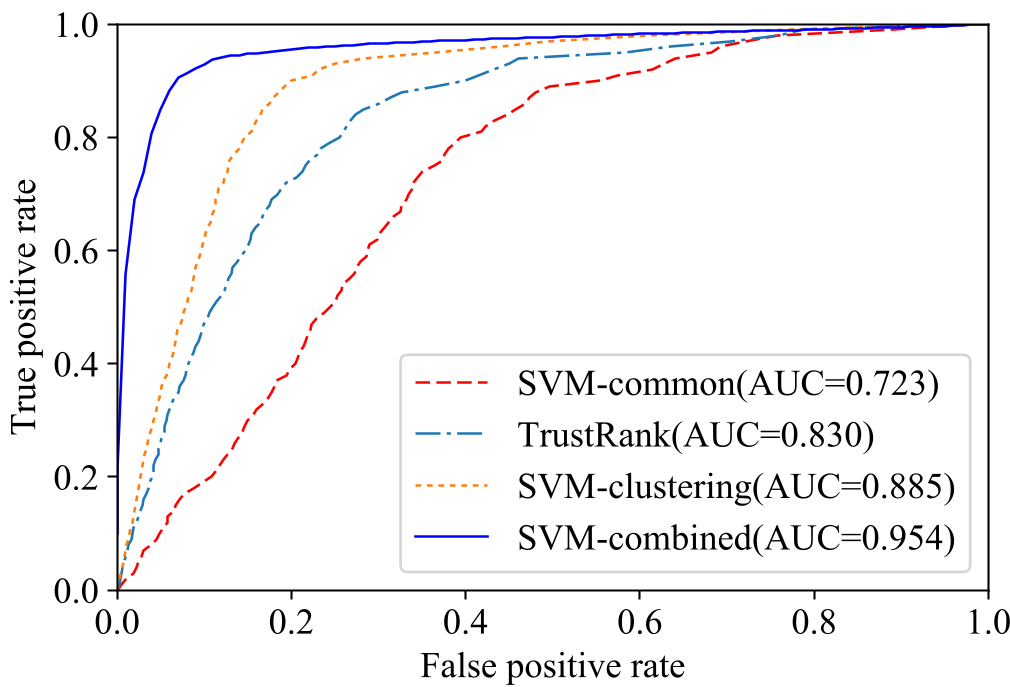 Figure: ROC Curve Comparison showing the superiority of the Combined Dynamic approach (top-left).
Critical Insight: Why This Works
The "magic" isn't just in the accuracy; it's in the False Positive Rate (FPR). In the real world, banning a real user (False Positive) is a disaster for platform reputation. This model achieved an FPR of only 5.3%. By combining the behavioral "group-think" of clusters with individual temporal fluctuations, the system successfully filters out niche but legitimate users who might otherwise "look" like spammers to simpler algorithms.
Limitations & The Road Ahead
While powerful, the method currently operates as an offline system. For production environments, this needs to move toward real-time stream processing. Furthermore, as AI-generated content (LLMs) becomes the primary tool for spammers, the "content-based" metrics (like URL ratios) might need to be replaced with deeper semantic evolution metrics.
Conclusion: This paper provides a robust blueprint for the next generation of OSN defenses. By proving that spammers cannot hide their evolutionary history, it offers a sustainable way to clean up our social feeds without punishing real humans.