
Combating Online Abuse: The Psychology Behind the "Report" Button
Combating Online Abuse: What Drives People to Use Online Reporting Functions on Social Networking Sites
This study investigates the socio-psychological drivers behind the use of built-in reporting functions on Social Networking Sites (SNSs) like Facebook to combat online abuse. Drawing on the Theory of Cognitive Appraisal and social appraisal literature, it identifies perceived responsibility and perceived usefulness as critical motivators, while evaluation apprehension acts as a significant barrier.
TL;DR
Online abuse is rampant, yet reporting rates remain surprisingly low. This study moves beyond simple UI/UX fixes and delves into the cognitive and social appraisal processes that dictate whether a user will report an incident. It finds that Perceived Responsibility and System Usefulness are the primary drivers, while the Fear of Social Judgment (Evaluation Apprehension) is the ultimate deal-breaker.
The "Bystander" Dilemma in the Digital Age
We've all seen it: a toxic comment, a harassing post, or a cyberbullying thread. Platforms like Facebook and Twitter have "Report" buttons, but why don't we use them? Prior work suggests many victims choose to "ignore" the abuse because they feel helpless. This paper shifts the focus to the Cognitive Appraisal—the mental gatekeeping we do before deciding to act.
The authors argue that reporting isn't just a technical task; it’s a social and moral decision.
The Framework: Three Layers of Appraisal
To understand this behavior, the researchers split the decision-making process into three distinct phases:
- Primary Appraisal (The "Should I?" phase): Does this incident look like an emergency? Am I responsible for doing something?
- Secondary Appraisal (The "Can I?" phase): Is the reporting tool actually useful? Is it easy to use?
- Social Appraisal (The "What will they think?" phase): Will I look foolish for reporting this? Will others support me?
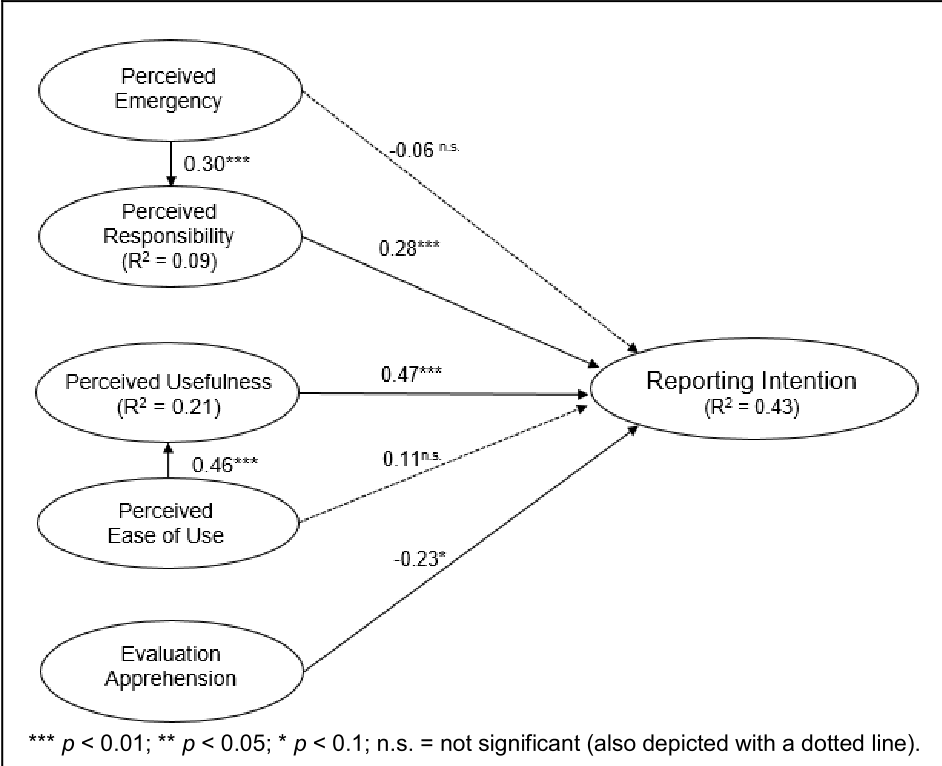 Figure: The research model illustrating the paths from cognitive/social appraisals to reporting intention.
Methodology: Testing the Theoretical Model
The team surveyed 117 Facebook users (primarily young adults, who are at the highest risk for online abuse). They used Partial Least Squares (PLS) to analyze the relationships between these psychological constructs.
Key Metrics & Findings:
- Perceived Responsibility (β = 0.28, p < 0.01): If a user feels a moral obligation to help, they are far more likely to click report.
- Perceived Usefulness (β = 0.47, p < 0.01): This was the strongest predictor. If users don't believe the platform will actually do something about the report, they won't bother.
- Evaluation Apprehension (β = -0.23, p < 0.1): The fear of being judged negatively by peers or the community acts as a significant deterrent.
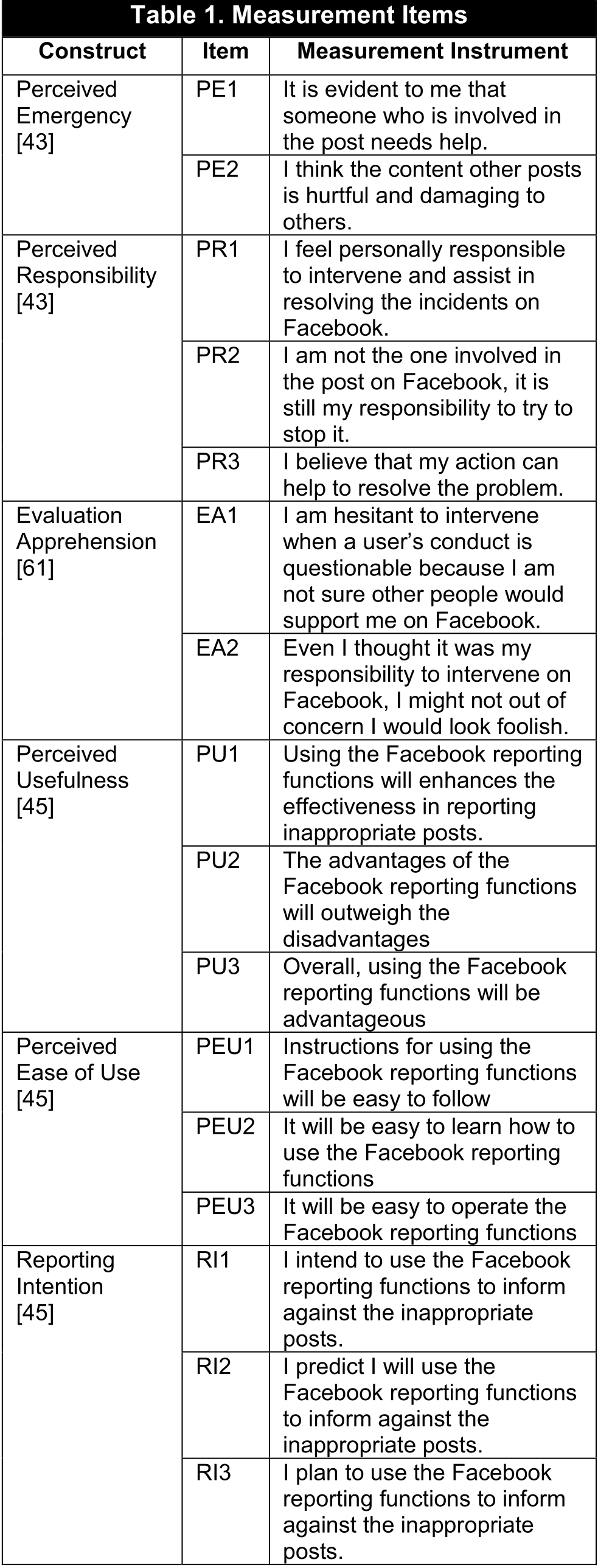 Table: The survey items used to quantify abstract concepts like "Emergency" and "Apprehension."
Surprising Results: Why Ease of Use Isn't Everything
In a world obsessed with "frictionless" design, this study found that Perceived Ease of Use had no significant direct effect on the intention to report. For the digital-native generation, their ability to navigate a menu is a given; the hurdle isn't the how, but the why.
Additionally, Perceived Emergency did not directly drive reports. Instead, it only worked indirectly by heightening the user's sense of Responsibility. This suggests that just showing users that an incident is "bad" isn't enough; you have to make them feel that it is their job to fix it.
Critical Insight & Practical Takeaways
The study highlights a critical gap in how social media platforms handle moderation:
- Demonstrate Impact: Platforms need to show "success stories"—evidence that reporting actually leads to the removal of toxic content.
- Protect the Reporter: To combat Evaluation Apprehension, platforms must better guarantee anonymity and create a social norm where reporting is seen as a "civilian duty" rather than "snitching."
- Moral Education: The findings suggest that educational campaigns focusing on moral responsibility and internet etiquette might be more effective than simply redesigning the UI of the reporting button.
Conclusion
This research provides a robust psychological map of the "Report" button. It proves that online safety is not just a technical challenge but a social-psychological one. For future researchers, the next step is investigating how these factors change in anonymous environments vs. real-name environments (like LinkedIn).
Author Insight: The 43% variance explained is a strong start, but factors like "moral development" and "self-efficacy" likely fill the remaining gaps in our understanding of why people choose to stand up to online bullies.