
CRA-Provision: Optimizing Social Clouds via Truthful Combinatorial Auctions
Combinatorial Reverse Auction-Based Service Provision in Social Clouds
The paper proposes CRA-Provision, a service provision model for Social Clouds using combinatorial reverse auctions. It introduces a critical payment-based mechanism that supports multi-provider task partitioning while ensuring truthfulness and minimizing procurement costs for consumers.
TL;DR
Social Clouds allow users to share idle computing resources within trusted social networks. However, matching diverse demands with fragmented supply remains inefficient. This paper introduces CRA-Provision, a model using Combinatorial Reverse Auctions to allow consumers to buy bundles of services from multiple friends simultaneously. By employing Critical Payment logic, the system forces providers to bid their true costs, leading to lower prices and higher resource utilization.
Background & Motivation: Why Social Clouds?
Traditional clouds (AWS, Google) are centralized and expensive. Social Clouds leverage existing trust relationships in platforms like Facebook to create a peer-to-peer sharing economy. The challenge is two-fold:
- Heterogeneity: A user might need a "bundle" (Storage + CPU + Database), which no single friend can provide entirely.
- Self-Interest: Providers want to overcharge, leading to market efficiency loss.
Previous models (RA-Provision) failed because they couldn't split tasks among multiple providers or guarantee that providers wouldn't game the system.
Methodology: The Core of CRA-Provision
The authors solve this by framing service provision as a Winner Determination Problem (WDP) focused on minimizing the consumer's procurement cost.
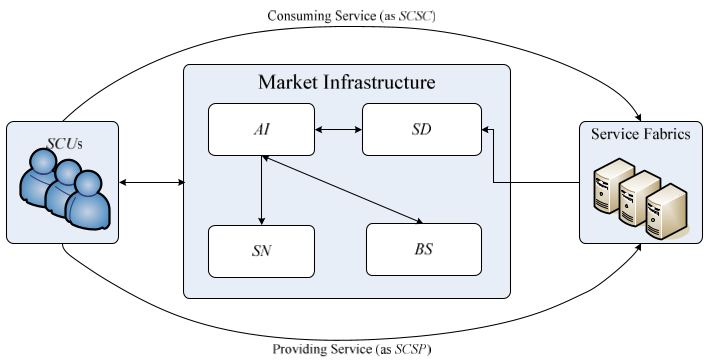
1. System Framework
The framework acts as an intermediary (Auction Intermediary - AI) that interacts with the Social Network (SN) and Service Directory (SD) to identify candidate providers (friends) for a specific request.
2. The Critical Payment Mechanism
To ensure Incentive Compatibility (Truthfulness), the authors implement WDA-CP (Winner Determination Algorithm based on Critical Payment).
- Allocation: The AI sorts providers by their unit cost for each service type and fills the consumer's demand greedily.
- Payment: Instead of paying providers their bid price, the AI pays them the Critical Value—the highest price they could have bid and still won.
This is the mathematical "secret sauce" derived from the VCG (Vickrey-Clarke-Groves) mechanism, which makes lying about costs a losing strategy.
Experimental Validation
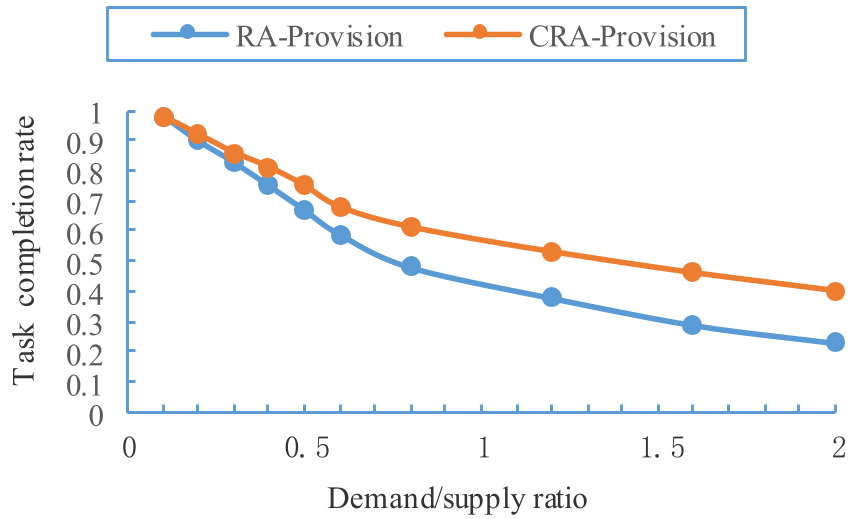
Using a trace from the LiveJournal community (1000 users) and simulated tasks based on Google Cluster Data, the authors compared CRA-Provision against standard Reverse Auctions (RA).
Key Findings:
- Task Completion Rate (TCR): CRA-Provision excels when resources are scarce because it can "partition" a large task across 5 providers where a single provider would have failed.
- Utilization: Since services can be fragmented, average utilization stays higher compared to the "all-or-nothing" approach of RA-Provision.
- Procurement Cost: By finding the optimal combination of the cheapest units across the network, consumers pay significantly less.
Critical Insight & Conclusion
The brilliance of this work lies in recognizing that Social Clouds are not just technical systems, but economic ones. By introducing combinatorial bidding, the authors allow for a "Liquid Market" where services are treated as divisible commodities.
Takeaway: If you are building a decentralized resource-sharing platform, simple "pay-as-you-go" or basic auctions will lead to market manipulation. Integrating monotone allocation functions and critical payments is the proven path to maintaining a stable, truthful, and efficient provider ecosystem.
Limitations: The model currently assumes a static trust relationship and linear pricing. Future iterations would benefit from dynamic reputation scores that influence the auction's "Critical Value" calculation.