
WALK-8: Outsmarting Virus Spread via Combinatorial Trace and Graph Summarization
Combinatorial trace method for network immunization
The paper introduces WALK-8, an efficient spectral algorithm for network immunization. By establishing a link between network vulnerability (spectral radius) and the combinatorial count of 8-length closed walks, it achieves state-of-the-art performance in reducing virus spread across large-scale graphs.
Executive Summary
TL;DR: The "Network Immunization Problem" asks: which nodes should we protect to stop a virus from paralyzing a network? While the largest eigenvalue () is the gold standard for measuring vulnerability, finding the optimal nodes to reduce it is NP-Hard. This paper introduces WALK-8, a method that moves beyond simple neighbor-counting to analyze 8-length closed walks. By using graph summarization, the authors achieve high-accuracy immunization on million-node networks with linear complexity.
Background: This work sits at the intersection of Spectral Graph Theory and Network Security. It evolves from previous "NetShield" heuristics by proving that higher-order combinatorial traces (length 8) provide a much tighter bound on network vulnerability than the standard first-eigenvector approach.
The Core Intuity: Why Closed Walks Matter?
In epidemiology, the virus dies out if the infection rate is lower than . Therefore, the goal of immunization is to maximize the Eigendrop—the decrease in after removing nodes.
The authors' key insight is rooted in the Trace Method: As increases, the largest eigenvalue dominates the sum. By counting the number of closed walks of length passing through a node, we directly measure that node's contribution to the network's global vulnerability. While previous works stopped at length 4 or 6, this paper pushes the boundary to length 8, providing a much higher resolution of the network's "bottleneck" structures.
Methodology: The WALK-8 Framework
1. The 8-Length Closed Walk Formula
The paper provides the first-ever closed-form expression for , breaking down the occurrences of node into several combinatorial cases (v appearing 1, 2, 3, or 4 times in the 8-walk).
2. Scalability via Graph Summarization
Calculating for a network with 1 million nodes is computationally impossible. To solve this, the authors use Graph Summarization:
- Partition into supernodes.
- Create a smaller weighted graph (summary graph ).
- Calculate walk counts on the small graph and project them back to the original nodes.
 The Score function (Eq 2) ensures we select nodes that are not just important, but also structurally diverse (minimizing redundancy in walk coverage).
Experimental Battlefront
The authors tested WALK-8 against NetShield (the current SOTA) on massive real-world datasets including Facebook, Amazon, and YouTube.
Key Result 1: Superior Vulnerability Reduction
As shown in the eigendrop charts, WALK-8 (red lines) consistently achieves a higher reduction in specifically as the immunization budget grows. This suggests that for large-scale deployments, higher-order walk counts identify critical "bridge" nodes that first-order spectral methods miss.
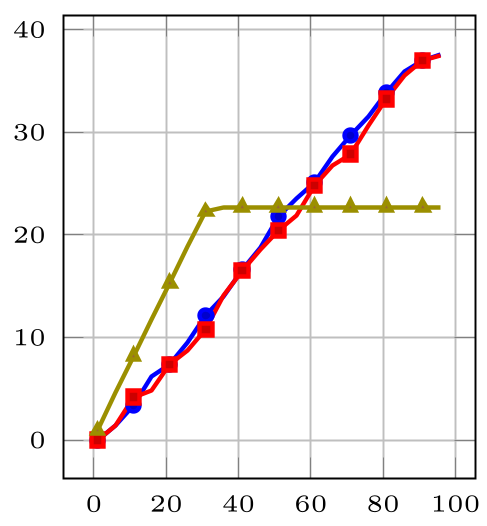 Figure: Eigendrop percentage comparison. WALK-8 scales effectively, outperforming NetShield on nearly all large-scale benchmarks.
Key Result 2: SIR Simulation
In Susceptible-Infected-Recovered (SIR) model simulations, networks immunized by WALK-8 showed a significantly lower infection rate over time, proving the theoretical "Eigendrop" translates directly to real-world epidemic control.
Critical Analysis & Conclusion
Takeaway: WALK-8 proves that we don't need to choose between speed and accuracy. By combining the theoretical rigor of spectral traces with the practical efficiency of graph summarization, we can protect massive infrastructures with high precision.
Limitations:
- The current method assumes the network is static. In real-world social networks or computer networks, edges appear and disappear constantly.
- The summarization quality relies on the partitioning strategy; while random partitioning works, it may lose nuances in highly community-structured graphs.
Future Outlook: Integrating this walk-based approach with Dynamic Graph Neural Networks (DGNNs) could lead to "predictive immunization," where we protect nodes that will become critical as the network evolves.