
Saupodoc: Bridging the Gap Between Unstructured Text and Semantic Logic for Complex Labeling
A Combined Approach for Ontology Enrichment from Textual and Open Data
The paper introduces Saupodoc, an automated framework for labeling documents with specific target concepts by combining text analysis, Linked Open Data (LOD) extraction, and Description Logic learning. It achieves superior classification performance (F-measure ~75%) by enriching a domain ontology with both textual property assertions and external knowledge from DBpedia.
TL;DR
Saupodoc is a hybrid framework that solves the "invisible label" problem—classifying documents with complex concepts (e.g., "Winter Watersport Destinations") that never explicitly appear in the text. By combining NLP, DBpedia extraction, and Description Logic learning, it transforms raw text into a formally defined knowledge base, outperforming standard machine learning classifiers by significant margins.
Context: When Keywords Aren't Enough
In modern information retrieval, we often need to categorize entities based on high-level user needs. Consider the concept "Destination where you can practice Watersports during Winter" (DWW). A travel brochure might mention "diving" and "August," but it rarely mentions the specific winter temperature or humidity required for such a label.
Traditional methods (SVM, Trees) struggle here because:
- Lexical Absence: The label "DWW" isn't in the text.
- Missing Context: Specifics like average January rainfall are usually external knowledge.
- Structural Blindness: Bag-of-words models ignore that "scuba" and "snorkeling" are both types of "Watersports."
The Saupodoc Pipeline: How It Works
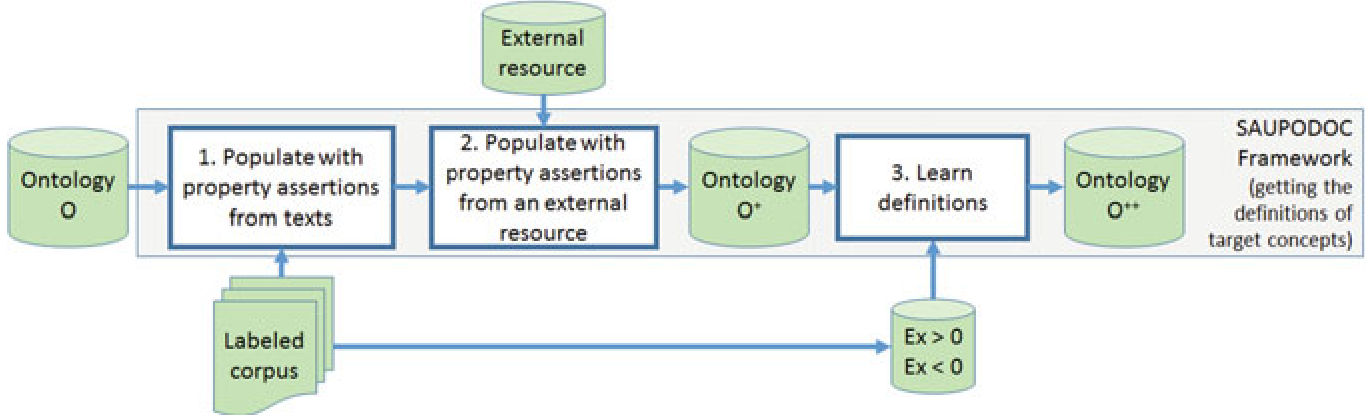
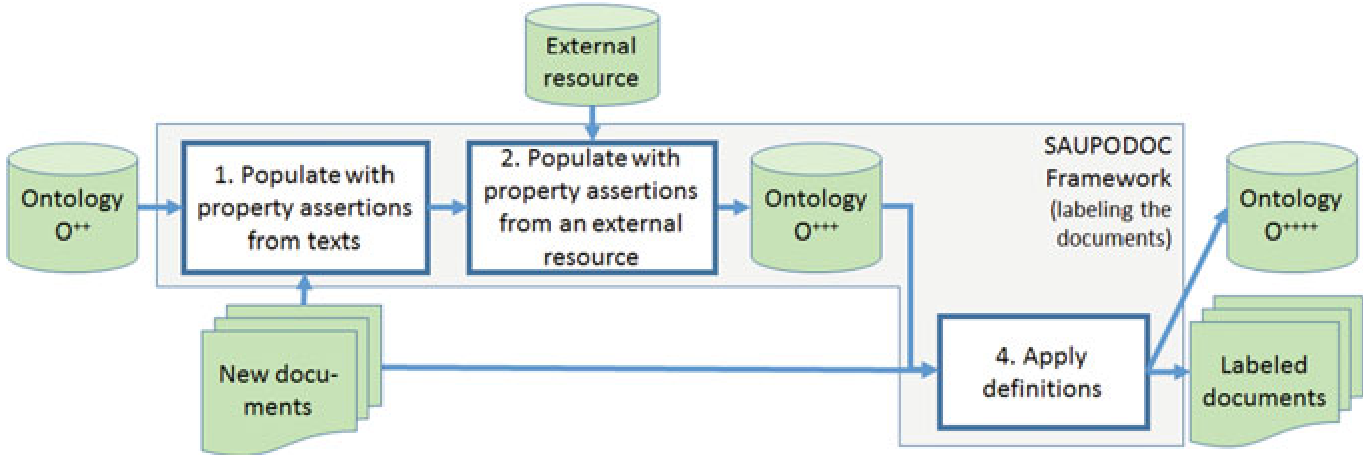
The genius of Saupodoc lies in its two-stage workflow: Learning and Application.
1. Population & Enrichment (The "How")
First, the system extracts what it can from text using GATE (General Architecture for Text Engineering). If the text mentions "diving," the ontology is populated with a hasActivity assertion.
Crucially, Task 2 triggers a SPARQL query generator to fetch missing values from DBpedia. If weather data is missing for a small island, the system intelligently searches the graph for "nearby" entities (like the nearest capital city) to approximate the value.
2. Induction via DL-Learner
Instead of a black-box neural net, Saupodoc uses DL-Learner to generate human-readable axioms. It looks at positive and negative examples and proposes a Description Logic definition:
DWW ≡ Destination ⊓ ∃hasActivity.Watersport ⊓ ≥2 (concernMonth ⊓ ∃hasSeason.MidWinter ⊓ ∃avgTemperatureC.>=23.0)
3. Reasoning with FaCT++
Once the definitions are learned, the system uses the FaCT++ reasoner to classify new documents. By simulating a Closed-World Assumption (CWA)—assuming that if a property isn't found, it doesn't exist—the system avoids the "forever-unknown" trap typical of standard Semantic Web reasoning (OWA).
Evidence of Performance
The researchers tested Saupodoc against SVM and Decision Trees across two distinct domains: Tourism and Films.
| Metric | Saupodoc | SVM | Decision Tree |
|---|---|---|---|
| F-measure (Destinations) | 72.23% | 54.14% | 63.22% |
| F-measure (Films) | 75.65% | 61.74% | 61.40% |
The "LOD" Advantage
A critical finding was the impact of Task 2 (External Data Enrichment). In the film domain, where textual descriptions are often ambiguous (e.g., does "French" mean the language or the country of origin?), fetching data directly from DBpedia improved the F-measure by 22.15%.
Critical Insights: Why Does It Win?
- Ontological Induction: Unlike bag-of-words, the ontology knows that "Jungle" and "Forest" are related. This allows the learner to find patterns even when specific keywords vary.
- Interpretable AI: Unlike a vector-based classifier, Saupodoc provides a formal definition. If a business needs to "loosen" a search (e.g., show destinations that are almost warm enough), the system can programmatically relax the DL axioms.
- Handling Incompleteness: The path-based exploration of the DBpedia graph effectively handles the "sparseness" problem of the Semantic Web.
Conclusion & Future Outlook
Saupodoc proves that symbolic AI and machine learning are better together. By using an ontology as a "unifying language," the authors have created a system that can "read between the lines" of a document and supplement it with world knowledge.
The next frontier? Applying this to dynamic domains like music and books, and using Large Language Models (LLMs) to automate the initial creation of the descriptive classes that currently require a manual system designer.
Takeaway: In the age of black-box models, Saupodoc reminds us that explicit knowledge and logical reasoning still hold the key to high-precision entity classification.