
Hybrid DES/SD Simulation: Optimizing Breast Cancer Screening for the Geriatric Population
Combined DES/SD simulaton model of breast cancer screening for older women: An overview
The paper presents a hybrid simulation framework, combining Discrete Event Simulation (DES) and System Dynamics (SD), to evaluate breast cancer screening policies for U.S. women aged 65+. The study identifies that annual screening from age 65 to 80 is the optimal policy for minimizing mortality and maximizing Quality-Adjusted Life-Years (QALYs).
TL;DR
Researchers have developed a sophisticated two-phase simulation framework that combines individual-level clinical progression (Discrete Event Simulation) with population-level behavioral dynamics (System Dynamics). By modeling over a million individualized risk profiles, the study concludes that annual screening for women aged 65 to 80 is the most effective policy for saving lives, bridging a critical gap where clinical trial data is historically absent.
Background & Motivation: The "Grey Hole" of Clinical Data
While breast cancer screening guidelines for middle-aged women are well-established, women over 65 represent a significant research gap. Most clinical trials exclude this demographic, leaving clinicians without a data-driven consensus. The challenge isn't just biological—it's systemic. Screening adherence depends on both individual health (comorbidities) and system factors (facility congestion, technology levels).
Methodology: The Hybrid Architecture
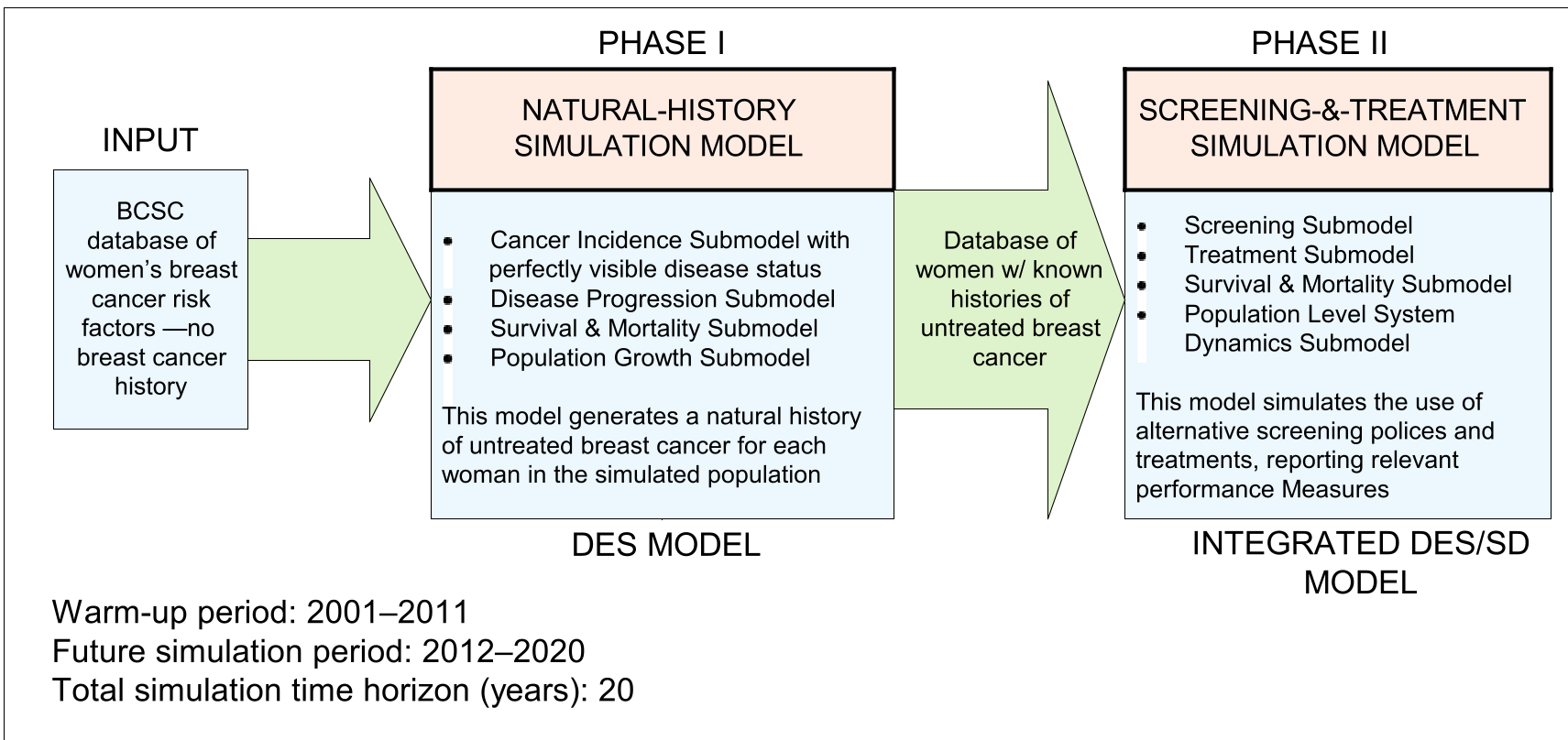
The researchers moved beyond traditional static models by implementing a Two-Phase Simulation Approach.
Phase I: The Natural History Model
This phase uses Discrete Event Simulation (DES) to create a database of untreated breast cancer progression.
- Individualized Risk: Utilizing BCSC data from 1M+ women to sample risk factors.
- Biology-First: Each woman is assigned a unique tumor growth trajectory based on a Gompertz equation, where growth is a function of age and stochastic variance.
- Stage Progression: A stochastic process determines the transition from local to regional and distant stages based on tumor diameter.
Phase II: The Screening-and-Treatment Model
This is where the paper introduces its most significant technical innovation: the integration of System Dynamics (SD).
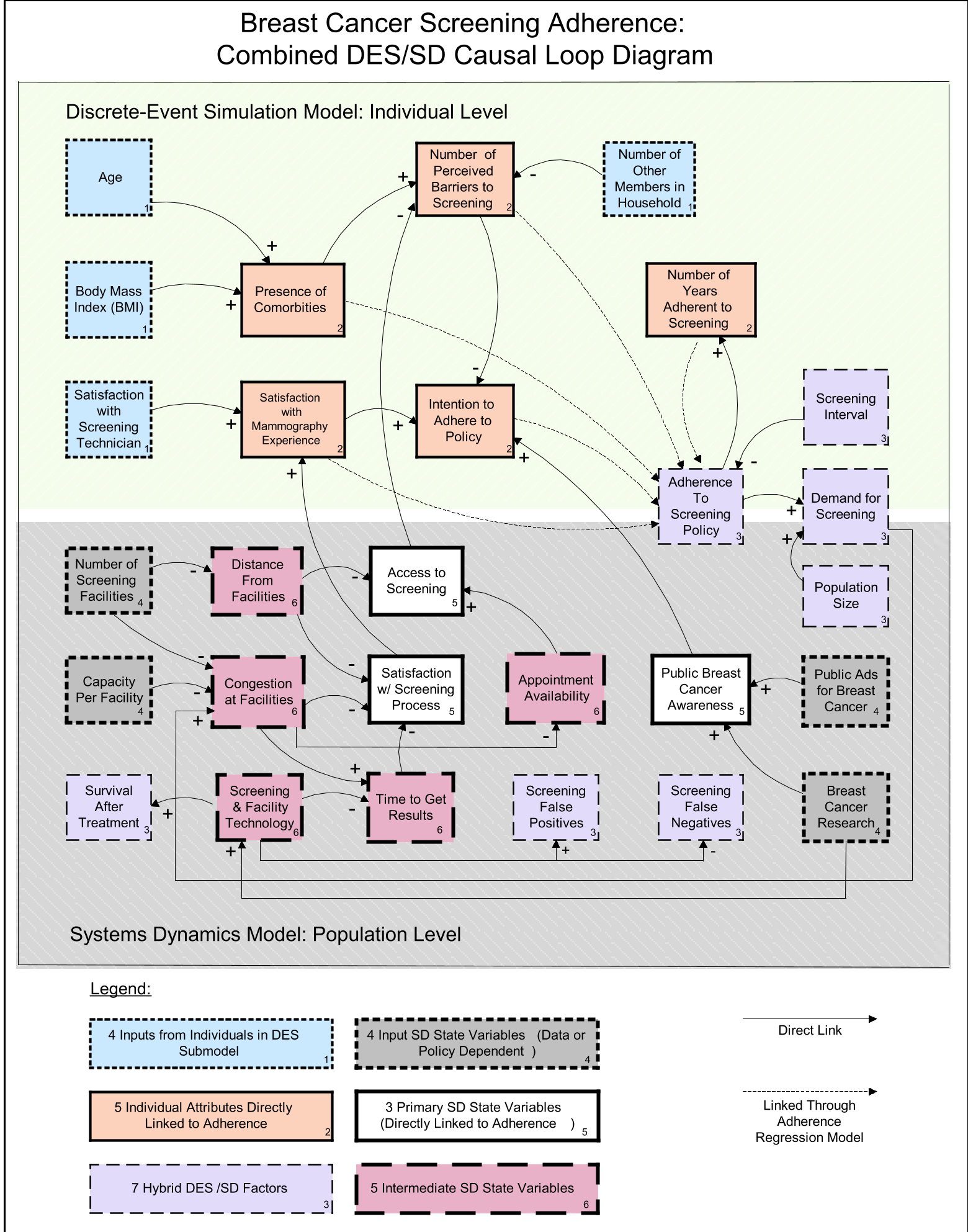
- The DES/SD Link: While DES handles the "events" (screening, biopsy, treatment), the SD submodel tracks "stocks and flows" at the population level.
- Adherence Logic: Adherence to screening isn't just a random coin flip; it's calculated via a logistic regression equation influenced by population-level congestion and individual attributes.
Experiments & SOTA Comparison
The model was validated against SEER data from 2001–2011 and then used to project outcomes for 2012–2020. They compared seven major policies, including those from the American Cancer Society (ACS) and the U.S. Preventive Services Task Force (USPSTF).
| Policy | Cancer Deaths | QALYs Saved | % Distant Stage | Cost/QALY |
|---|---|---|---|---|
| P1 (Annual to 80) | 538.4 | 1139.9 | 23.5% | $47,990 |
| USP (Biennial to 74) | 560.3 | 686.5 | 33.5% | $37,952 |
| ACS (Annual 65+) | 536.0 | 1227.2 | 18.3% | $60,402 |
Note: Table results are sampled for 0.1% of the population.
Critical Analysis:
- The Winner: Policy P1 (Annual screening until 80) emerged as the pragmatic "Goldilocks" choice. It saved significantly more lives than the restrictive USPSTF guidelines while remaining more cost-effective than the aggressive ACS unlimited annual screening.
- The Impact: Scaled to the U.S. population, P1 is estimated to avert 14,400 more deaths compared to biennial screening over the studied period.
Depth Insight: Why Hybridization Matters
The "magic" of this model lies in its ability to simulate feedback loops. In a pure DES model, we might overlook how a sudden influx of patients (due to a change in policy) increases facility congestion, which in turn lowers adherence and increases the percentage of "Distant Stage" diagnoses. By using SD to represent these macro-pressures, the authors provide a much more realistic stress test for healthcare policy.
Conclusion & Future Outlook
This paper serves as a template for Healthcare Systems Engineering. It successfully transitions from "one-size-fits-all" guidelines to a "factor-based" individualized risk approach.
Future Work: The authors identify the need for better modeling of comorbidities—as women age, other health issues often compete with cancer in terms of mortality risk. Refining how we calculate the "cost" of false positives (beyond just dollars, but in terms of psychological utility) remains a vital frontier for refined screening policy.