
Whale Optimization: A Breakthrough for Large-Scale Combined Heat and Power Dispatch
Combined heat and power economic dispatch problem solution by implementation of whale optimization method
This paper introduces the Whale Optimization Algorithm (WOA) to solve the Combined Heat and Power Economic Dispatch (CHPED) problem. The method leverages the bio-inspired bubble-net hunting behavior of humpback whales to minimize total fuel costs across power-only, cogeneration, and heat-only units while handling non-convex constraints like valve-point effects.
Executive Summary
Combined Heat and Power Economic Dispatch (CHPED) is one of the most persistent "hard" problems in power engineering. It requires balancing the simultaneous output of thermal and electrical energy so that total operational costs are minimized while satisfying complex equipment constraints.
In this study, a team of researchers has implemented the Whale Optimization Algorithm (WOA)—a relatively new meta-heuristic inspired by the social behavior of humpback whales—to solve this. The results are striking: not only did WOA beat previous SOTA results on medium systems, but it proved its scalability on newly proposed 84-unit and 96-unit systems, showing multi-million dollar annual savings potential.
The Pain Point: Non-Convexity and Mutual Dependency
Most optimization problems in power systems are difficult, but CHPED adds a layer of "mutual dependency." For a cogeneration unit, the amount of power it can produce is strictly tied to the amount of heat it is currently dispersing. This creates a feasible region that is not a simple rectangle but a complex 2D polygon.
Furthermore, the Valve-Point Effect introduces sinusoidal oscillations into the cost curves of thermal plants, turning a smooth quadratic problem into a jagged mountain range of local minima. Traditional gradient-based solvers "get stuck" almost immediately in these valleys.
Methodology: The Bubble-Net Hunting Strategy
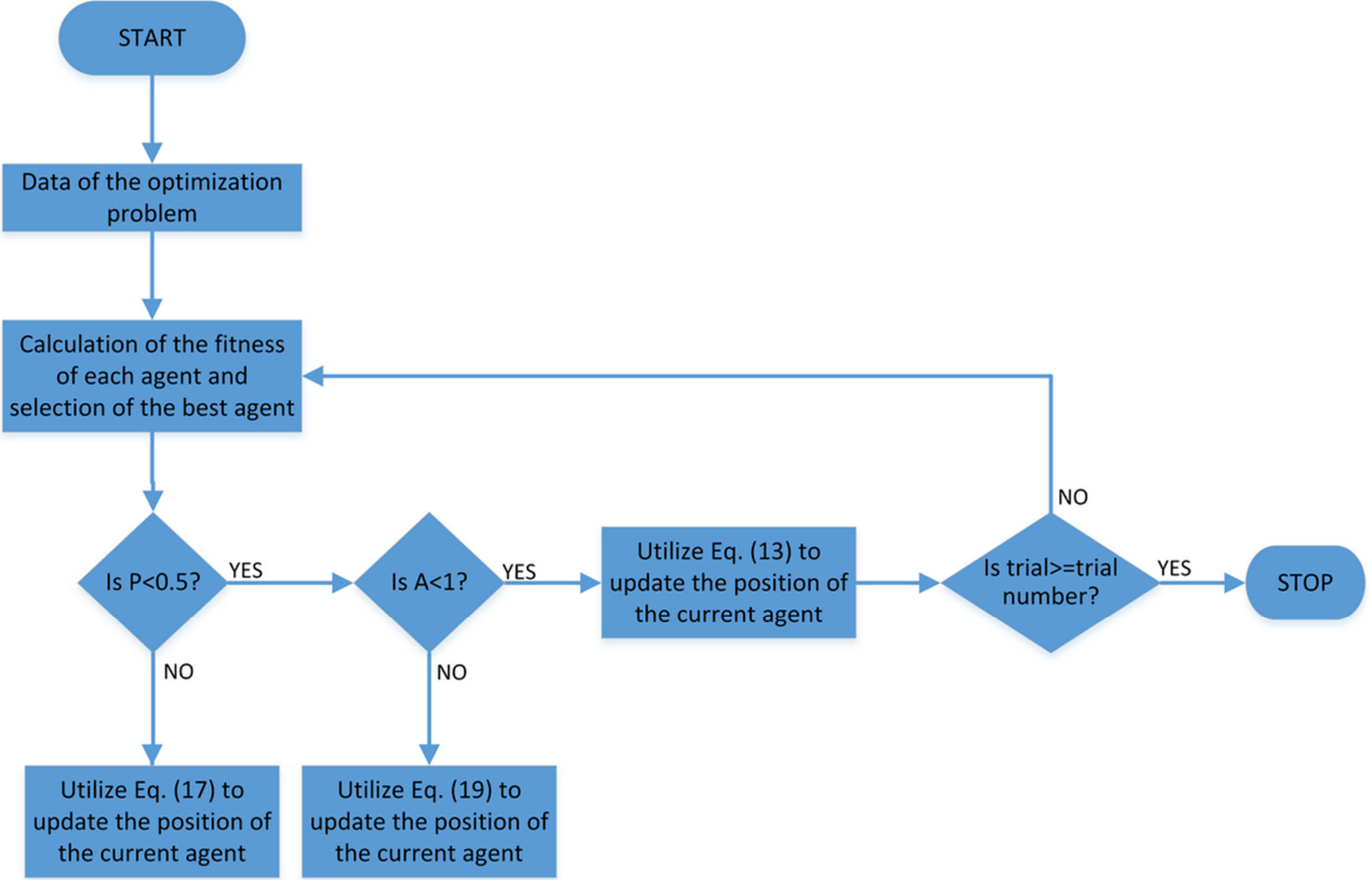
The Whale Optimization Algorithm mimics how whales trap schools of fish using bubbles. The authors translate this into a three-stage mathematical framework:
- Encircling Prey: Identifying the current best solution and closing in.
- Bubble-Net Attack (Exploitation): A dual-mode approach where whales move in a shrinking circle and a helix-shaped spiral simultaneously. This is modeled via a 50% probability switch:
- Shrinking Encircling: Decreasing a coefficient to narrow the search.
- Spiral Update: A logarithmic spiral equation that mimics the 3D movement of whales toward the goal.
- Search for Prey (Exploration): When the coefficient , the agents move toward a random peer instead of the current best, ensuring the algorithm doesn't converge too early on a sub-optimal solution.
Experimental Results: Dominating the Competition
The researchers tested WOA against classic heavyweights like Particle Swarm Optimization (PSO), Genetic Algorithms (GA), and Gray Wolf Optimization (GWO).
The 24-Unit Benchmark
In the standard test case, WOA achieved an hourly cost of **16.31/hr), it scales to over $142,000 in annual savings for a single medium-sized plant.
Scaling to "Mega-Systems" (84 and 96 Units)
The true value of WOA appeared in the large systems introduced in this paper.
- 84-Unit System: WOA saved $3,056 per hour compared to RCGA-IMM.
- 96-Unit System: WOA outperformed TVAC-PSO by $2,440 per hour.
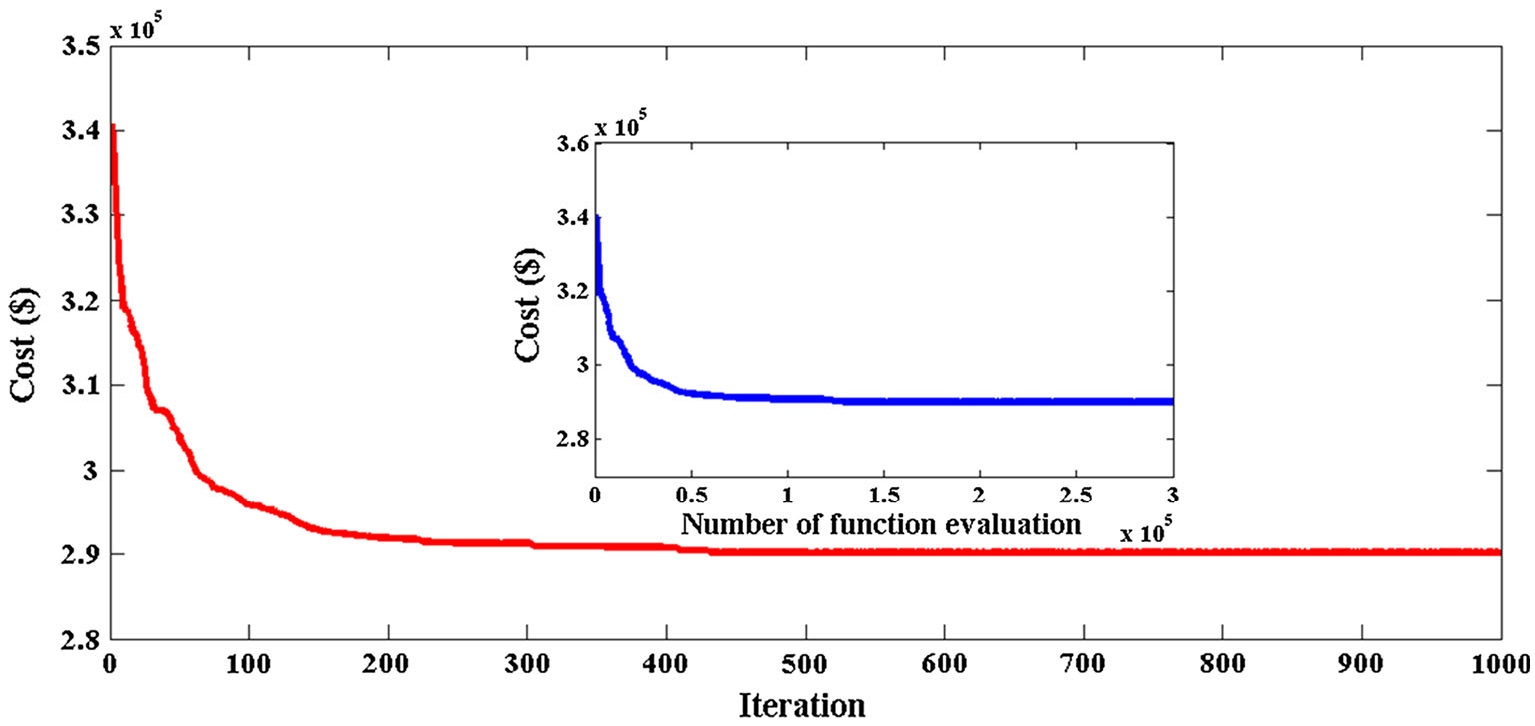
The convergence graphs (below) clearly show that while other algorithms (like TVAC-PSO and RCGA-IMM) plateau early, WOA continues to find deeper cost reductions throughout the iteration process.
Critical Insight & Conclusion
Why does WOA work better than PSO or GA here? The secret lies in the Spiral Updating Position. Many power system constraints (like the heat-power dependency) create narrow, curved feasible paths. The spiral motion of the "whale" agents allows the algorithm to navigate these curved boundaries more effectively than the linear "velocity" updates used in PSO.
Limitations & Future Work
The authors acknowledge that this is a deterministic study. In the real world, heat and power demands are uncertain. Future research should integrate Information Gap Decision Theory (IGDT) or Robust Optimization to handle the volatility of renewable energy and fluctuating consumer demand.
Final Takeaway: For grid operators looking to maximize efficiency in cogeneration plants, the Whale Optimization Algorithm offers a robust, scalable, and computationally efficient alternative to traditional heuristics.