
WOA: Orchestrating the Future of Combined Heat and Power Systems
6074_Combined heat and power economic dispatch problem solution by implementation of whale optimization method.
This paper presents the application of the Whale Optimization Algorithm (WOA) to solve the Combined Heat and Power Economic Dispatch (CHPED) problem. By mimicking the bubble-net hunting behavior of humpback whales, the study achieves superior scheduling of power-only, cogeneration, and heat-only units, attaining new SOTA results in fuel cost minimization.
TL;DR
Optimization in energy systems is no longer just about generating power; it’s about the synergy of heat and electricity. This paper explores the Whale Optimization Algorithm (WOA) to solve the notoriously difficult Combined Heat and Power Economic Dispatch (CHPED) problem. By applying bio-inspired hunting strategies, the researchers achieved record-breaking cost reductions in systems ranging from 24 to 96 units.
Context & Motivation
The transition to efficient energy systems relies heavily on CHP units, which can reach 90% efficiency by capturing waste heat. However, managing these systems is a mathematical nightmare.
- Non-Convexity: Valve-point loading effects introduce sinusoidal ripples into cost curves.
- Mutual Dependency: In CHP units, the capacity to produce electricity is physically tied to the current heat output, creating "feasible operation regions" rather than simple limits.
- Scalability: As the number of units grows, the search space expands exponentially, causing standard algorithms like GA or PSO to stagnate in local minima.
Methodology: The Bubble-Net Strategy
The Whale Optimization Algorithm (WOA) mimics the humpback whale's "bubble-net" feeding behavior. Unlike standard gradient-based solvers, it uses three distinct phases:
- Encircling Prey: Search agents update their positions toward the current best solution.
- Bubble-Net Attack: A dual-tactic approach where whales either shrink the circle or follow a Logarithmic Spiral path to the prey.
- Search for Prey (Exploration): Whales search randomly based on each other's positions to avoid local optima.
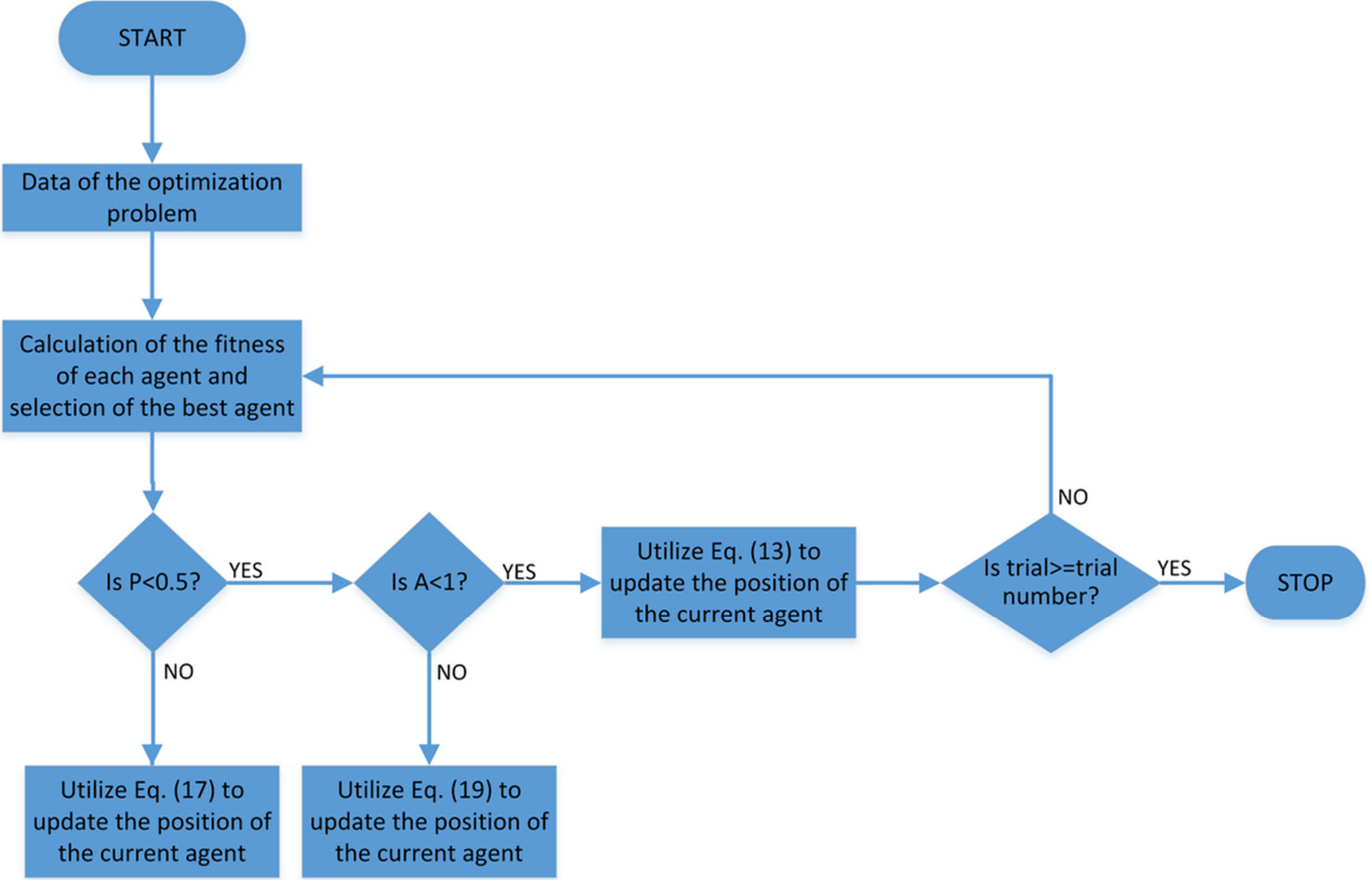
The paper emphasizes the use of a parameter that linearly decreases from 2 to 0, controlling the transition from exploration (searching the whole sea) to exploitation (tightening the net around the best solution).
Breaking the SOTA: Experiments and Results
The authors tested WOA against seasoned veterans like Grey Wolf Optimization (GWO) and Particle Swarm Optimization (PSO).
The 24-Unit Benchmark
In the medium-sized system, WOA found a solution with a minimum cost of 142,000.
Challenging Large-Scale Systems
The true highlight of this work is the introduction of the 84-unit and 96-unit systems. These models reflect real-world power grids more accurately.
- 84-Unit Results: WOA saved $3,056 per hour compared to the Real-Coded Genetic Algorithm (RCGA-IMM).
- 96-Unit Results: Convergence graphs show WOA reaching lower costs significantly faster than TVAC-PSO.
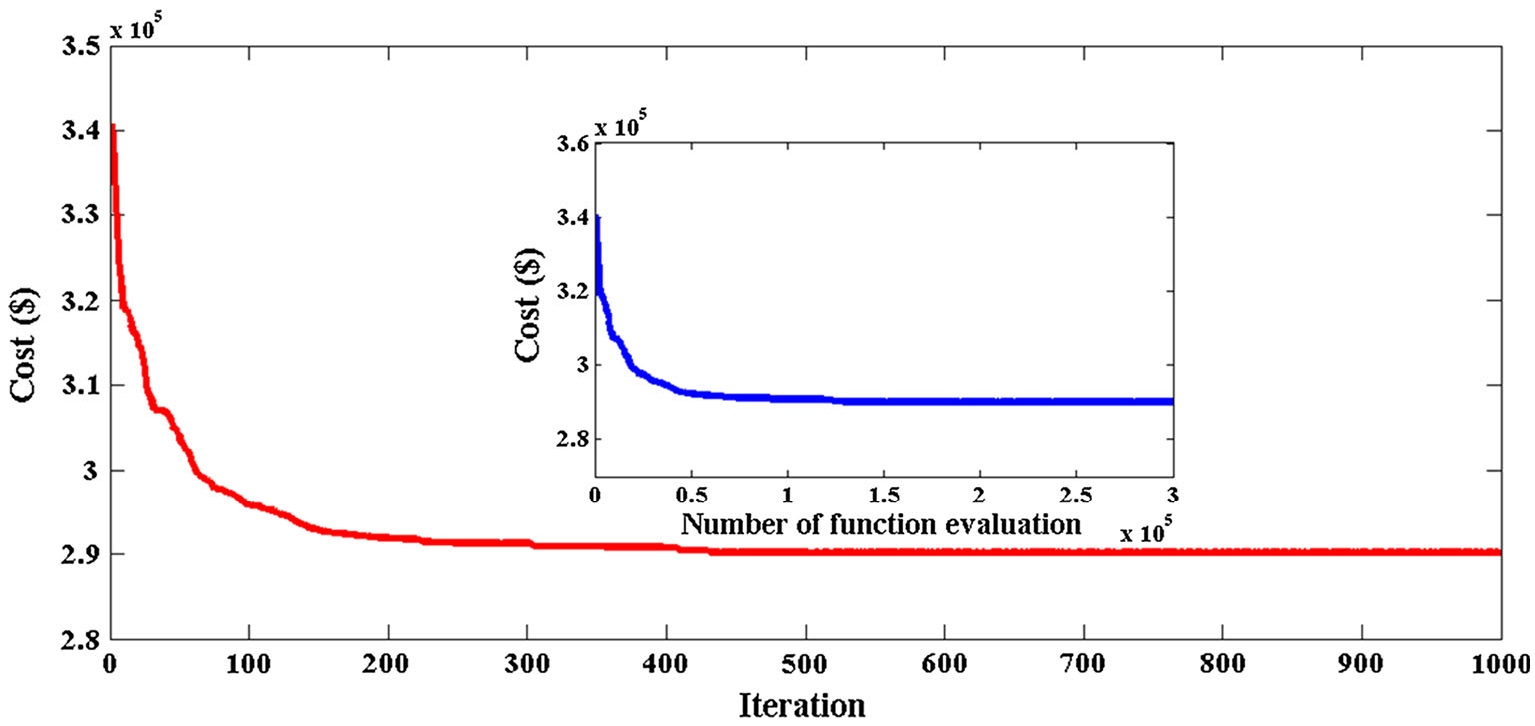 Figure: WOA (dashed line) demonstrates a superior descent rate and a lower final cost floor compared to competitors.
Critical Insight & Practical Value
The success of WOA in this domain stems from its Spiral Updating Position. In high-dimensional spaces like the 96-unit system, the spiral motion allows the algorithm to "wrap around" non-convex obstacles that would stop a linear solver.
Key Takeaways for Engineers:
- Algorithm Robustness: WOA is remarkably stable with a low standard deviation in results across multiple runs.
- Economic Impact: For large-scale utilities, switching to more advanced meta-heuristics can yield tens of millions in annual fuel savings.
- Future Frontiers: The authors accurately point out that the next step is incorporating uncertainty—modeling the fluctuating demand of heat and power using robust optimization or interval analysis.
Conclusion
By looking to the social intelligence of whales, this research provides a powerful tool for the energy sector. It proves that the CHPED problem, despite its non-convexity and scale, is solvable with high precision, paving the way for more cost-effective and environmentally friendly power generation scheduling.