
Subjective Logic in Social Sensing: Fusing Heterogeneous Evidence for Situation Detection
Combining Evidence for Social Situation Detection
This paper introduces a decentralized framework for Social Situation (SS) detection using Subjective Logic (SL) to fuse multi-modal sensor data. The core method utilizes SL opinions to handle uncertainty and subjectivity in agent-based social networking, achieving superior detection accuracy by combining geometry-of-interaction and audio-based evidence.
TL;DR
In the realm of Mobile Social Networking (MSN), detecting a "Social Situation" (SS) requires more than just raw data; it requires handling different perspectives and inherent uncertainty. This paper presents a decentralized architecture that uses Subjective Logic (SL) to fuse audio and geometric interaction data. By treating sensor outputs as "opinions," the system outperforms single-modality approaches, achieving a significant boost in classification accuracy and situation recovery.
Problem & Motivation: The Subjectivity Gap
Most Social Signal Processing (SSP) frameworks treat social context as an objective reality to be "solved" via centralized Bayesian Networks or Hidden Markov Models. However, in a decentralized MSN scenario—where each user has their own software agent—the environment is inherently subjective.
The authors identify two fatal flaws in previous approaches:
- The expressive bottleneck: Traditional Sensor Fusion (SF) methods like fuzzy sets don't handle "trust" or "uncertainty" in a way that reflects human social judgment.
- Computational overhead: While Bayesian Networks are powerful, they require vast amounts of labeled training data to model the "subjectivity" of every different user agent in a network.
The research intuition here is elegant: instead of trying to reach a perfect objective truth, agents should communicate based on their level of belief and degree of uncertainty.
Methodology: Subjective Logic as the Mediator
The core innovation is the application of Subjective Logic (SL). Unlike classical probability, an SL opinion is a tuple representing belief, disbelief, uncertainty, and base rate.
The Multi-Layer Architecture
The system is organized into three distinct layers:
- Layer I/Ib (Physical/Logical Sensors): Raw hardware data (microphones, gyroscopes) is processed into logical abstractions (e.g., "User is talking," "Current body angle").
- Layer II (Social Signal Level): Sub-symbolic models (Gaussian Mixture Models or HMMs) compute the probability of interaction.
- Layer III (Consensus Level): This is where SL shines. Agents use the Consensus Operator () to combine competitive or complementary opinions and the Discounting Operator () to weight information based on how much they "trust" the source.
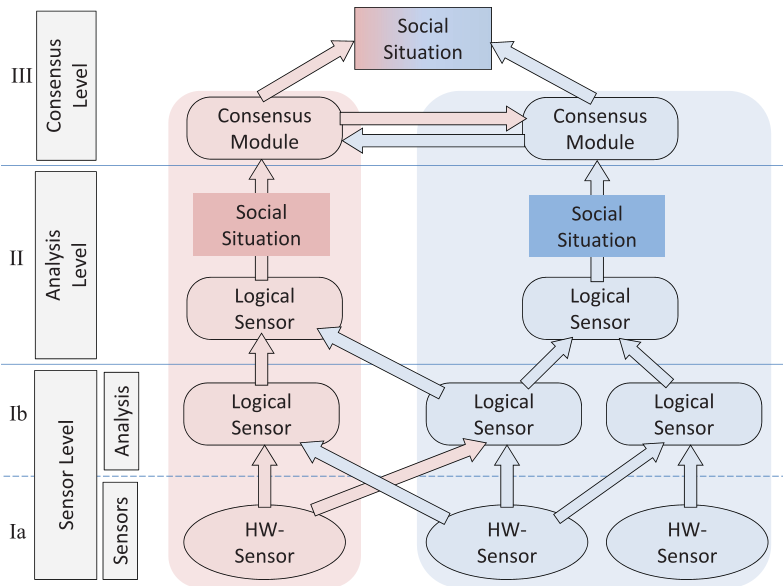 Figure 1: Architectural flow from raw sensors to social consensus.
Experiments & Results: The Power of Fusion
To validate the approach, the authors gathered data from a social experiment involving nine participants. They compared two primary sensor types:
- GEO: Interaction geometry (body angles and distance).
- AUDIO: Low-level audio feature correlations.
Performance Gains
The experimental results proved that "two heads (or sensors) are better than one." As shown in the classification table, fusing GEO and AUDIO data (using the SL V2 variant) reached an accuracy of 78.5%, outperforming the individual results of both.
 Table 1: Enhanced accuracy through multi-modal fusion.
Social Situation Recovery
By constructing a "situational social network" (a graph where edge weights are SL probability expectations), the agents used clustering algorithms to group people into social situations. Using the Adjusted Rand Index, they found that the combination of audio and geometry consistently provided the most accurate recovery of actual human group dynamics.
Critical Analysis & Conclusion
The Takeaway
The true value of this work lies in its scalability and pragmatism. By using Subjective Logic, the authors bypass the need for massive, centralized datasets. Each agent acts as a black box that exports an "opinion," allowing for a modular and privacy-preserving social network.
Limitations
While the fusion results are compelling, the "trust" mechanism—deciding which agents are reliable based on their distance from the consensus—was not fully evaluated in the experiment. In real-world adversarial settings (e.g., agents providing malicious data), the robustness of the SL Discounting operator would be the ultimate test.
Future Outlook
This methodology paves the way for "Inter-subjective" AI—systems that don't just process data but negotiate their "viewpoints" with others. We can expect similar SL-based fusion to appear in collaborative robotics and distributed IoT environments where uncertainty is the only certainty.