
CrowdSynth: Revolutionizing Galaxy Classification through Human-Machine Synthesis
Combining human and machine intelligence in large-scale crowdsourcing
The paper introduces CrowdSynth, a Bayesian framework that optimizes large-scale crowdsourcing by combining machine vision and human intelligence. Applied to the Galaxy Zoo project, it uses MDPs and Value of Information (VOI) to decide when to hire human workers versus relying on automated classifications, achieving SOTA accuracy with significantly fewer human interventions.
TL;DR
This seminal work from Microsoft Research and CMU presents CrowdSynth, a decision-theoretic architecture that treats crowdsourcing as an optimization problem. By combining machine vision features with Bayesian predictive models, the system intelligently decides when a galaxy's classification is "certain enough" or if it's worth the cost to hire another human worker. The result? A 53% reduction in human labor without any loss in accuracy.
Background & Positioning
In the early 2010s, crowdsourcing was largely "brute-forced." Projects like Galaxy Zoo relied on massive numbers of volunteers to provide multiple votes for every single celestial object to ensure consensus. This paper marks a shift from passive platforms to active agents, positioning the machine as a strategic manager that balances the precision of humans against the efficiency of algorithms.
The Core Challenge: The Cost of Consensus
"Consensus tasks"—identifying a hidden state (like a galaxy's shape) through noisy human reports—are expensive.
- Uncertainty: Is the galaxy truly elliptical, or are the workers just guessing?
- Ambiguity: Some tasks are "undecidable," meaning even 100 workers won't agree.
- Resource Management: Why pay for 40 votes if the machine vision features and the first 5 votes already provide 99% certainty?
Methodology: The Brain Behind the Crowd
The authors dismantle the problem using a three-pronged Bayesian approach:
1. The Predictive Powerhouses
CrowdSynth doesn't just look at votes; it looks at 453 SDSS image features and worker metadata (dwell time, history).
- Answer Models: Predict the final consensus using both image features and current vote distributions.
- Vote Models: Predict what the next worker is likely to say based on current task evidence.
2. Modeling the Process as an MDP
The system views the lifecycle of a task as a Markov Decision Process (MDP). At each step, the agent chooses between:
- H (Hire): Pay a cost, get a new vote, and transition to a new state of knowledge.
- ¬H (Terminate): Stop, save the cost, and submit the current best guess.
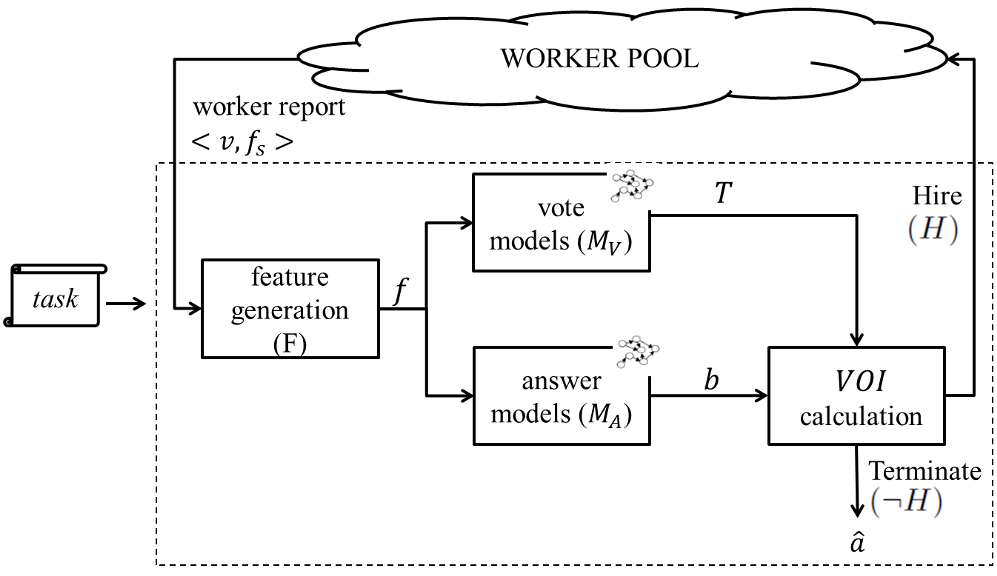 Figure 1: The CrowdSynth pipeline showing the flow from Task Features to Decision-Theoretic Planning.
3. Solving the Horizon Problem
Because Galaxy Zoo tasks can have long horizons (up to 90+ votes), exact solutions are intractable. The authors introduced Upper-Bound Sampling (UBS) and Lower-Bound Sampling (LBS). UBS, an optimistic approach, individualizes termination strategies for sampled execution paths, making it highly effective at identifying the "tipping point" where human effort becomes redundant.
Experimental Results: Doing More with Less
The evaluation utilized a massive dataset of 34 million reports. The findings were stark:
- Accuracy vs. Cost: In low-cost scenarios, UBS outperformed all baselines, including "Hire All."
- Efficiency: The system reached 95% accuracy by collecting only 23% of the available reports.
- Budget Optimization: When given a fixed "budget" of workers, the VOI-driven (Value of Information) models significantly outperformed random allocation, proving that not all galaxies are created equal in the eyes of an optimizer.
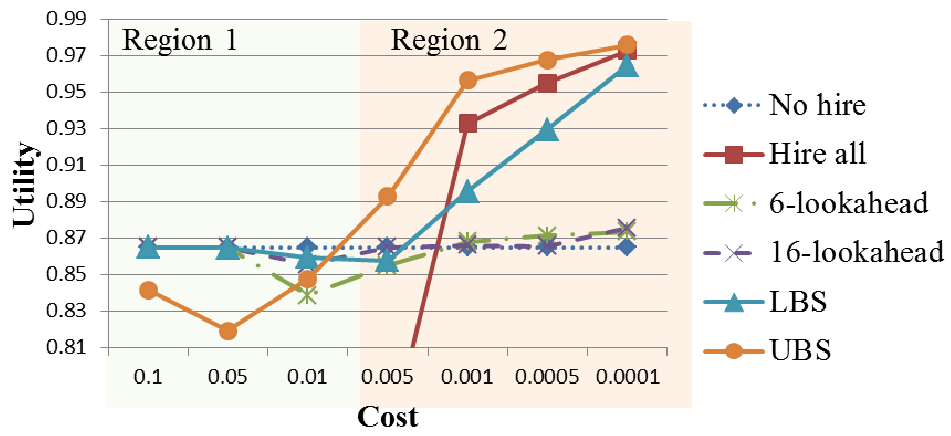 Figure 2: Accuracy vs. Worker Cost. Notice how UBS maintains high performance even as human resources are throttled.
Critical Analysis & Takeaways
The brilliance of this work lies in its Inductive Bias: the realization that machine vision and human vision are complementary. Machine vision can easily filter the "obvious" cases, leaving humans to tackle the nuanced, ambiguous objects.
Limitations:
- Model Noise: The "Direct Answer Models" were found to be nosier early in the process than simple priors, occasionally misleading the planner in high-cost environments.
- Static Workers: The paper assumes a somewhat homogeneous worker pool; it doesn't deeply model individual worker "expertise" in real-time, though it suggests this for future work.
Bottom Line: CrowdSynth is a masterclass in applying decision theory to real-world data. It laid the groundwork for modern active learning systems and remains a foundational text for anyone designing human-in-the-loop AI systems.