
Combining Local and Social Network Classifiers: A Hybrid Approach to Churn Prediction
Combining Local and Social Network Classifiers to Improve Churn Prediction
The paper introduces a hybrid ensemble approach that combines local customer attributes with social network features to improve churn prediction in the telecommunications industry. By integrating traditional binary classifiers with a Spreading Activation (SPA) relational learner, the authors achieve a superior Area Under the Curve (AUC) and higher lift in identifying potential churners.
TL;DR
Predicting which customers will leave a service is a multi-billion dollar challenge. This research demonstrates that customers don't just churn because of bad service (local attributes); they often leave because their friends do (social influence). The study proposes a Combined Model that merges traditional attribute-based machine learning with Social Network Analysis (SNA), outperforming siloed approaches and proving that "who you know" is just as predictive as "what you do."
Background & Positioning
In the saturated telecom market, acquiring a new customer is significantly more expensive than retaining an existing one. Current State-of-the-Art (SOTA) models typically focus on Local Features—usage patterns, billing data, and demographics. However, this paper positions itself at the intersection of psychology and data science, leveraging Homophily (the tendency of similar people to associate) to catch churners that traditional models miss.
The Core Conflict: Why Simple Integration Fails
Previous research noted a frustrating phenomenon: simply adding social features (like "number of friends who churned") into a standard logistic regression often yields negligible gains. The authors argue this is because:
- Distinct Subsets: People who churn for personal reasons (e.g., price) are behaviorally different from those who churn due to peer influence.
- Model Interference: The statistical signals from social networks can be "washed out" by the high dimensionality of usage data in a single-learner setup.
Methodology: The Spreading Activation (SPA) Engine
The paper’s technical "secret sauce" is the use of Spreading Activation.
1. The Relational Model
Instead of a standard classifier, the relational model treats the call network as a graph where energy (churn risk) flows from known churners to their contacts.
- Propagation: Known churners start with an energy of 1.0.
- Decay/Transfer: This energy spreads through neighbors based on "tie strength" (call duration), controlled by a spreading factor d.
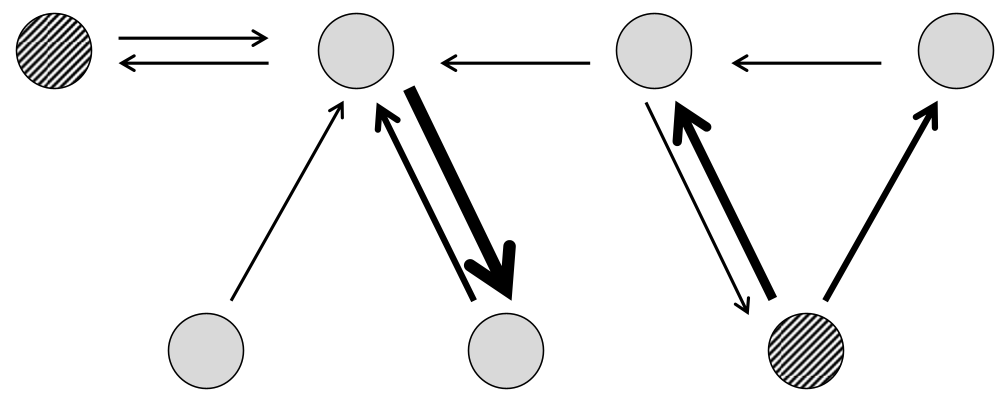 Fig 1: A visualization of the Call Network where Social Influence propagates through weighted edges.
2. The Combined Ensemble
The researchers found that the best results came from an ensemble. They trained a Local Model and a Relational Model independently, then used the resulting churn probabilities from both as the inputs for a final meta-classifier.
Experimental Insights & Results
The study used a real-life dataset of over 1 million prepaid mobile customers.
- Short-term vs. Long-term: Social features are hyper-effective at predicting immediate churn (within 1 month) but lose predictive power faster than local attributes over time.
- The Lift Advantage: In a business reality where call centers can only contact the top 5% of at-risk customers, the Relational Model proved highly competitive, achieving a significant "Lift" over random selection.
 Table 1: AUC performance over a 5-month horizon. The Combined Model (bottom row) consistently wins.
Critical Analysis: The Failure of Local Priors
An interesting finding was the failure of the "Relational model with local priors." Intuitively, one might think starting the graph propagation with local churn probabilities would help. Instead, it created an averaging effect, making everyone in the network look slightly risky and destroying the model's ability to distinguish the true "high-risk" nodes. This suggests that polarized seeds (knowing for sure who churned) are vital for social network learners.
Strategic Takeaways
- Don't Just Flatten Your Data: If you have network data, model it separately before combining it with tabular data.
- Time Sensitivity: Social influence in churn is a "fuse." Once a customer's friend leaves, the window to save that customer is very small.
- Missing Data is Data: 41% of clients had no call records. The authors found that "being invisible" in the network was itself a strong predictor of churn.
Future Work
The authors suggest incorporating "Negative Energy"—where loyal, highly-engaged customers spread positive influence, effectively "vaccinating" their social circle against churning.