
SD-BBN: Bridging the Gap Between Organizational Dynamics and Technical Risk
Combining System Dynamics and Bayesian Belief Networks for Socio-Technical Risk Analysis
This paper introduces a hybrid SD-BBN methodology that integrates System Dynamics (SD) and Bayesian Belief Networks (BBN) for socio-technical risk analysis. The approach is operationalized within the Socio-Technical Risk Analysis (SoTeRiA) framework, achieving a multi-layered predictive model for aviation safety by linking organizational factors to classical Probabilistic Risk Analysis (PRA).
Executive Summary
TL;DR: This paper presents a groundbreaking hybrid methodology—SD-BBN—which couples System Dynamics (SD) and Bayesian Belief Networks (BBN) to solve the long-standing problem of integrating "soft" organizational factors into rigorous technical risk assessments. By operationalizing the SoTeRiA framework, the researchers provide a way to predict how management decisions and financial pressures eventually translate into catastrophic technical failures.
Context: In the landscape of risk science, this work serves as a vital bridge. It moves beyond static Probabilistic Risk Analysis (PRA) by injecting the temporal complexity of human behavior and organizational feedback into the rigid structures of Fault and Event Trees.
The "Why": Why Static Models Fail in Socio-Technical Systems
Standard risk models (like Fault Trees) treat accidents as a linear chain of component failures. However, real-world disasters in aviation or nuclear power often result from latent organizational failures—such as budget cuts leading to hiring freezes, which eventually degrade maintenance quality.
The authors identify a critical technical gap:
- Prior Work (PRA/BBN): Excellent at handling uncertainty but struggles with feedback loops (e.g., how an accident increases safety awareness) and delays (e.g., the time it takes for a new training program to reduce error rates).
- System Dynamics (SD): Excellent at modeling flows and feedbacks but lacks the probabilistic rigor needed to handle the subjectivity and uncertainty of expert opinions on human "soft" factors.
Methodology: The SD-BBN Interface
The core innovation lies in the bidirectional data exchange between SD and BBN modules.
- SD Layer: Models the "deterministic" flows, such as the number of experienced vs. rookie technicians and the financial "Z-score."
- BBN Layer: Acts as the inference engine for "soft" variables. It takes SD outputs (like workload or technician experience level) and calculates the Human Error Probability based on conditional probability tables generated from expert judgment.
- The Bridge: The Omega Factor translates these human performance metrics into failure rates that can be plugged into standard Fault Trees.
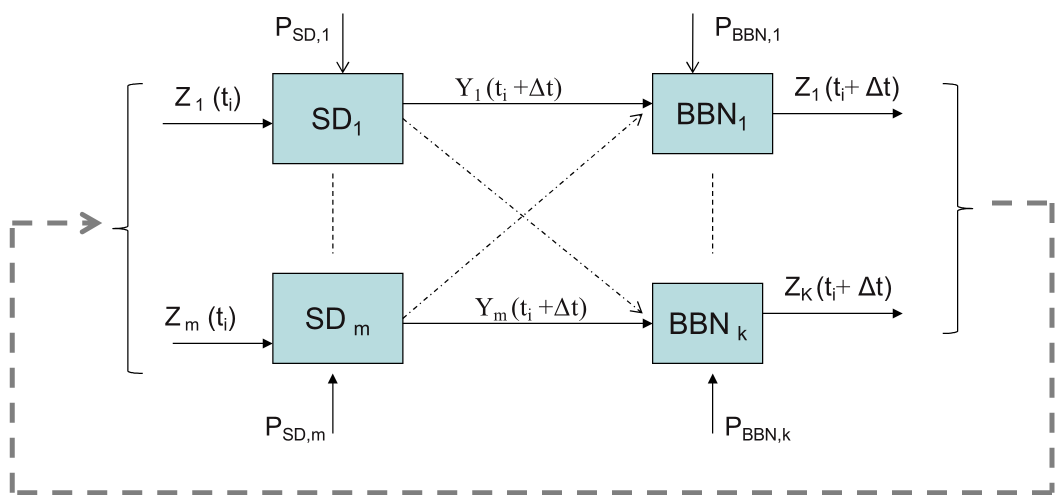 Fig 1: The cyclic process of exporting SD state variables to BBN and feeding probabilistic outcomes back into the system evolution.
Aviation Case Study: The "Risk Spike" Phenomenon
The authors applied this to airline maintenance. A particularly insightful part of the model is the Hiring and Training module (Fig 4). It accounts for the "quit rate" of senior technicians under workload pressure.
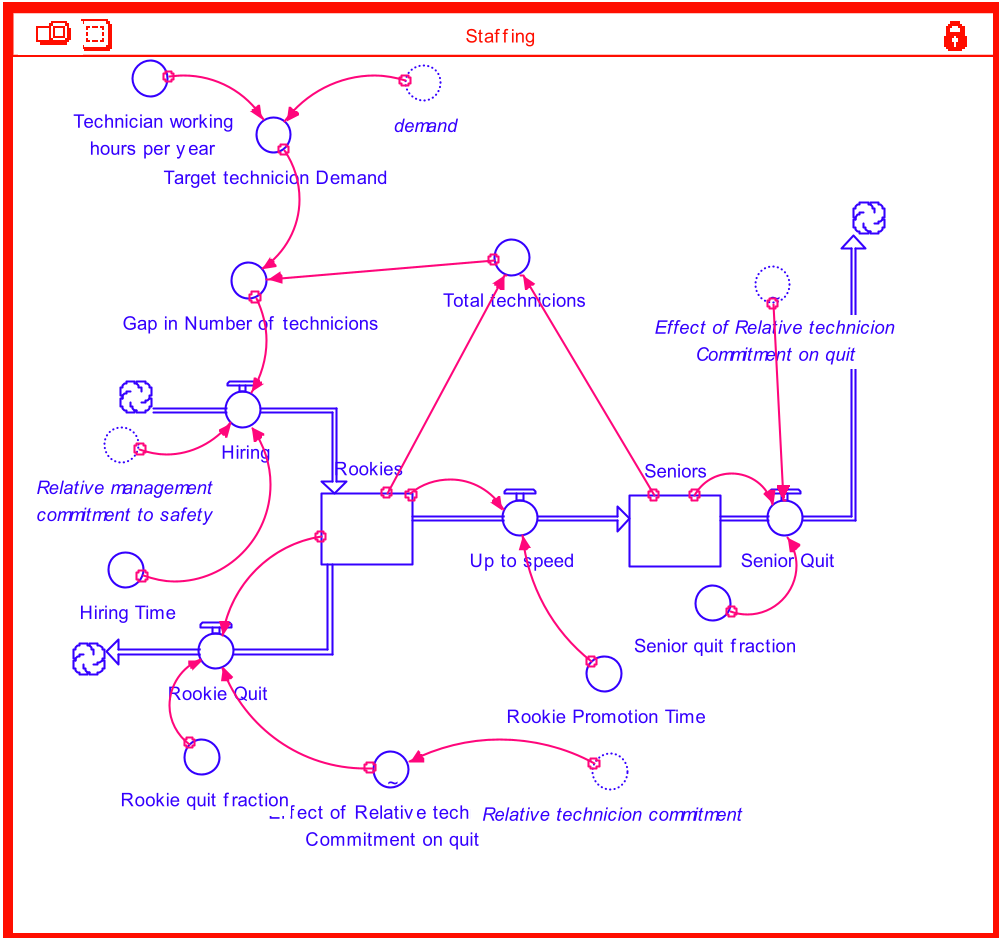 Fig 2: SD representation of tech-staffing dynamics, capturing the lag between hiring decisions and actual safety competency.
Key Findings from Experiments:
- Complacency Dynamics: The model shows that if error probabilities remain low for years, management commitment to safety often declines (the "sea anchor" effect). This eventually leads to a sudden, delayed spike in risk that static models would never predict.
- Financial Coupling: The study demonstrates how a financial downturn (e.g., post-9/11) triggers a decay in management commitment, causing technicians to adopt "risky behavior" to meet deadlines, creating a downward spiral of increasing risk and decreasing financial trust.
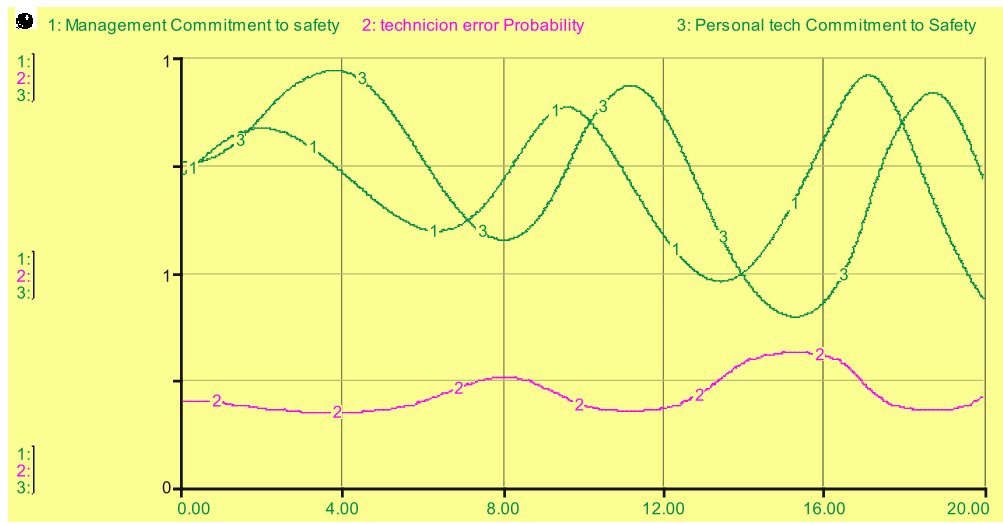 Fig 3: The interaction between financial distress (Z-score) and safety commitment, illustrating the gradual degradation of organizational safety culture.
Critical Analysis & Conclusion
Takeaway: The SD-BBN hybrid is more than a mathematical exercise; it is a decision-support tool. It allows managers to "play forward" the consequences of a budget cut or a change in training frequency over a 20-year horizon.
Limitations:
- Expert Bias: The BBN component relies heavily on expert opinion, which can introduce subjectivity.
- Computational Complexity: Maintaining synchronicity between a continuous-time SD model and a discrete-state BBN requires careful calibration of the time step ().
Future Outlook: As AI and real-time sensor data from IoT become more prevalent, the "expert opinion" in the BBN could be replaced by real-time data streams, turning SoTeRiA into a live "Digital Twin" of an organization's safety health.
This work stands as a cornerstone for anyone looking to understand why safe organizations suddenly fail, and how we can use hybrid modeling to see those failures coming years in advance.