
Specialized Indexing: Why Tags and Reviews Should Never Be Treated Equally in Social Search
Combining Tags and Reviews to Improve Social Book Search Performance
The paper introduces a specialized retrieval framework for Social Book Search (SBS) by treating user-generated tags and reviews as distinct information sources. By building separate indexes (TBM and RBM) and optimizing field-specific BM25 parameters, the authors achieved significant performance gains, outperforming official CLEF SBS baselines.
TL;DR
In the world of Social Book Search (SBS), not all user-generated content is created equal. This paper demonstrates that by splitting User Tags and Reviews into separate retrieval models with unique normalization parameters, we can boost search effectiveness (NDCG@10) by nearly 30%. The key takeaway? Don't penalize long tag lists like you would a verbose review.
The "One Index Fits All" Fallacy
Most Social Information Retrieval (SIR) systems treat a document as a "bag of words" gathered from everywhere—titles, summaries, tags, and reviews. However, this paper identifies a critical flaw in this logic:
- Tags are condensed, purposeful keywords. If a book has many tags, it usually signifies high user engagement and relevance, not "wordiness."
- Reviews are natural language. They are prone to redundancy and verbosity, requiring standard normalization to prevent long-winded reviews from unfairly dominating search results.
When you mix these in a single index, the BM25 algorithm applies a "middle-ground" normalization that satisfies neither, leading to diluted precision.
Methodology: The TBM vs. RBM Architecture
The authors proposed a specialized pipeline that treats different social signals as independent features:
- Tag Based Model (TBM): Optimized for short, high-entropy keywords.
- Review Based Model (RBM): Optimized for long-form natural language.
- Experimental Insight: The authors found that for TBM, the normalization parameter should be close to (no penalty for length), whereas RBM behaves like traditional IR with an optimal around .
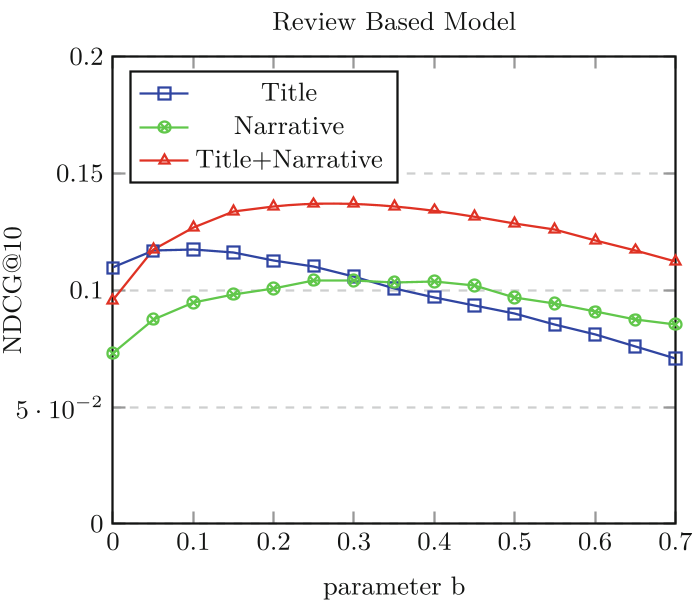 Figure 1: Notice how TBM performance (left) plummets as normalization increases, while RBM (right) remains relatively stable.
The Secret Sauce: Query Expansion and Re-ranking
Beyond indexing, the researchers utilized the "Example Books" field in user queries. By treating these as "perfect matches," they expanded the search terms via the Rocchio algorithm. Finally, they applied a non-textual "Social Proof" layer, re-ranking books based on the number of ratings they received—a proxy for book reputation.
Results: Breaking the SOTA
The results across six years of CLEF SBS data were conclusive. The differentiated indexing strategy consistently outperformed the "Single Index" baseline.
| Year | Single Index | Combined TBM + RBM | Improvement |
|---|---|---|---|
| 2012 | 0.1667 | 0.2425 | +45.4% |
| 2014 | 0.1436 | 0.1886 | +31.3% |
| All | 0.1619 | 0.2091 | +29.2% |
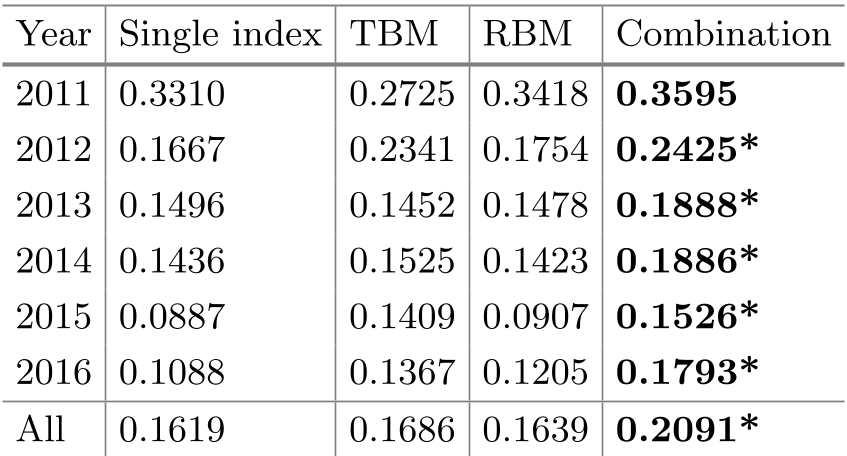 Figure 2: The "Combination" column demonstrates the clear superiority of the multi-model approach over single-index baselines.
Critical Insight: Why Does This Work?
The author’s analysis provides a brilliant physical intuition:
- In Reviews, a term might appear 10 times because the author is repetitive (Penalize!).
- In Tags, a term appears 10 times because 10 different users independently thought that keyword described the book (Reward!).
By setting for tags, the model honors the "wisdom of the crowd" without the damping effects of document length normalization.
Conclusion & Limitations
This work provides a robust blueprint for modern social search engines: Stop aggregating and start differentiating.
However, the study relies on BM25, a keyword-based model. The next frontier for this research would be applying this "multi-index" philosophy to Neural IR (Dense Retrieval). How should we weight a "Tag Embedding" vs. a "Review Embedding" in a vector space? While this paper provides the statistical foundation, the deep learning community has much to learn from this field-specific approach to normalization.