
CBSNA: Unveiling the Social Fabric of Hong Kong Pop Music via YouTube Comments
Commentary-based Social Network Analysis and Visualization of Hong Kong Singers
This paper introduces Commentary-Based Social Network Analysis (CBSNA), a methodology to map relationships among Hong Kong singers using YouTube user comments. By employing k-Nearest-Neighbors (kNN) for network pruning and specialized weighting schemes, the authors transform noisy public discourse into a structured, interpretable social graph.
TL;DR
Researchers have developed a Commentary-Based Social Network Analysis (CBSNA) method to map the intricate relationships between Hong Kong singers. By scraping YouTube comments and applying a robust k-Nearest-Neighbors (kNN) visualization technique combined with smart weighting schemes, they have successfully filtered out "fan noise" to reveal the true influential hierarchy and sub-communities of the Cantopop scene.
Background & Motivation: Beyond Expert Bias
Most social networks in the music industry are built on "official" data: who produced whose album, or who performed at the same concert. However, these datasets are often curated by a small group of experts and fail to capture the dynamic, public perception of a singer’s influence.
Web 2.0—specifically YouTube—offers a goldmine of "collaborative intelligence." When a user mentions Singer B in the comments of a video by Singer A, they are establishing a latent link. The challenge? This data is incredibly dense and noisy. Fans might spam a singer's name thousands of times, skewing traditional metrics.
Methodology: The Art of Network Shrinking
The core innovation lies in how the authors handle the "Hairball Effect" (the mess of lines in a dense network).
1. Network Construction
The researchers crawled comments for 64 Hong Kong singers. A directed arc was drawn from Singer A to Singer B if B was mentioned in A's comment section.
2. The 3-NN Visualization
Instead of using traditional "thresholding" (which deletes weak edges and often leaves nodes isolated), the authors adopted k-Nearest-Neighbors (kNN). By keeping only the top 3 strongest outgoing links for each singer, they reduced the clutter while ensuring every singer remained connected to their most relevant peers.
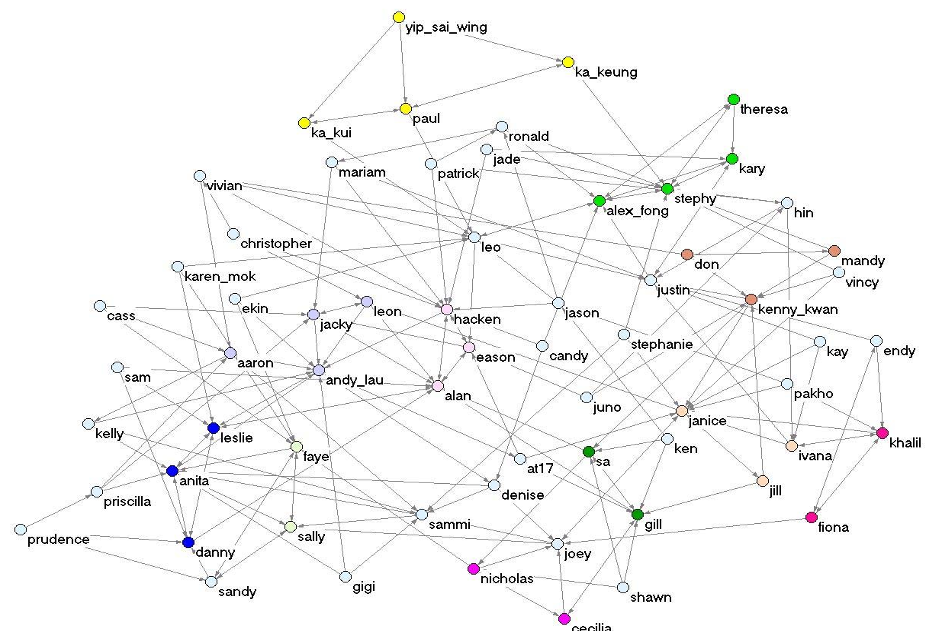 Figure 1: The simplified 3-NN network reveals clear clusters such as the "Passed Away" legends (Anita, Danny, Leslie) and the "Ten Idols" groups.
3. Fighting Noise with Math
To prevent "fan spamming" from dominating the rankings:
- Binary Weighting: In the 3-NN network, all edges are treated as 1. This prevents a single obsessed fan from making a singer appear more important than they are.
- Logarithm Weighting: In the full network, taking the log of the edge weights scales down extreme values, providing a "tempered" view of influence.
Experiments & Results: Real-World Validation
The authors validated their rankings against GoogleHits, a proxy for general popularity.
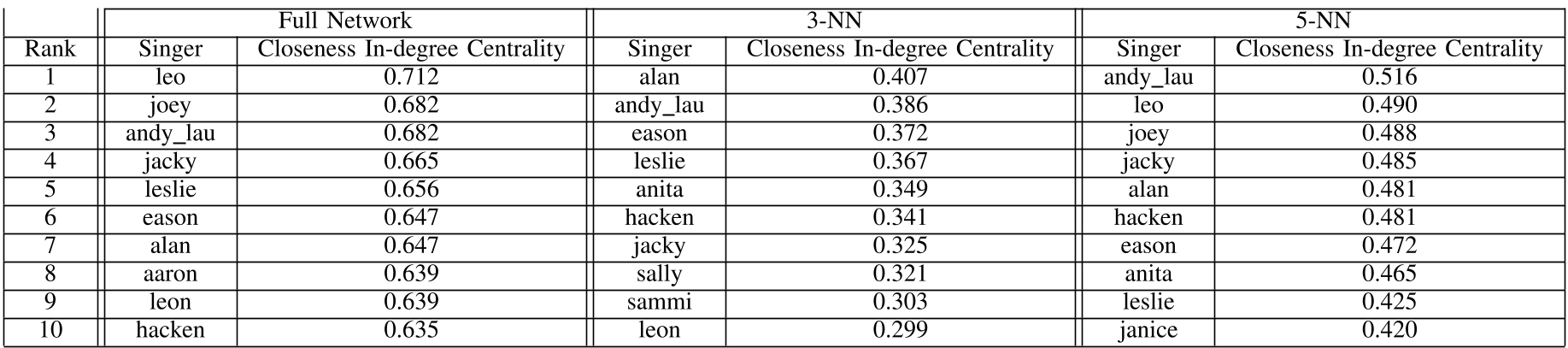
The results were striking:
- Accuracy: The 3-NN network with binary weighting produced the most realistic Top 10 list, featuring legends like Alan Tam and Jacky Cheung, while successfully filtering out "instant" idols like Stephy Tang and Janice Vidal who previously dominated the noisy, unweighted data.
- Community Detection: The graph perfectly identified long-standing industry clusters, such as the "Big 4 Stars" and band members of "Beyond."
Critical Insight: Why kNN Matters
The study proves that in social network analysis, less is often more. By constraining the "attention" of each node to its k-nearest neighbors, we reveal the local backbone of the network. This is far more effective for identifying sub-cultures than a global threshold which might cut off emerging or niche artists entirely.
Conclusion
This paper provides a blueprint for turning chaotic social media chatter into actionable sociological data. Whether for concert organizers looking for the perfect "pair" of singers to boost ticket sales, or for sociologists tracking the evolution of culture, CBSNA offers a robust, public-driven alternative to traditional musicology.
Future Work: Integrating Natural Language Processing (NLP) to distinguish between positive comparisons and negative critiques would further refine the fidelity of these singer relationships.