
2COMM4JADE: Reifying Social Commitments to Decouple MAS Interaction
A Commitment-Based Infrastructure for Programming Socio-Technical Systems
The paper introduces 2COMM4JADE, a commitment-based infrastructure for programming Socio-Technical Systems (STS). It leverages Multi-Agent Systems (MAS) and the Agents & Artifacts (A&A) metamodel to reify social relationships as first-class entities, achieving SOTA-level decoupling between agent behavior and interaction logic.
TL;DR
The paper "A Commitment-Based Infrastructure for Programming Socio-Technical Systems" addresses a structural flaw in current Multi-Agent Systems: the hard-coding of social norms into agent brains. The authors introduce 2COMM4JADE, a framework that uses the Agents & Artifacts (A&A) model to turn social protocols into external, inspectable "Artifacts." This allows agents to remain truly autonomous, making decisions based on observable social commitments rather than pre-defined procedural flows.
Problem: The "Hard-Coded" Society
In modern distributed computing, specifically Socio-Technical Systems (STS), we deal with autonomous actors across different organizations. The standard approach in platforms like JADE or Jason is to implement interaction protocols (like the FIPA Contract Net) by splitting the logic across agent behaviors.
The Pain Point: This creates a tight coupling. If the "rules of the game" change (e.g., a deadline moves or a role is added), every single agent participating in the system must be reprogrammed. This violates the Minimal Critical Specification principle: specifying "how" to interact instead of "what" the normative relationships are.
Methodology: Social Relationships as First-Class Resources
The core insight of the authors is to treat the Society Layer of an STS as a third architectural pillar, distinct from the Infrastructure and Functionalities.
1. The Commitment Paradigm
Instead of a flowchart, interaction is modeled as a set of Commitments —meaning agent commits to agent to bring about condition if is met. This provides a "social semantics" that is purely observational.
2. The 2COMM4JADE Architecture
The authors bridge the gap between JADE (the mind) and CArtAgO (the environment/body).
- Protocol Artifacts (PA): These are digital resources that maintain the Social State. They track which commitments are active, discharged, or violated.
- Roles as Powers: Agents "enact" roles within these artifacts. Enacting a role grants the agent "powers" (actions) to modify the social state (e.g., the power to
cfporpropose).
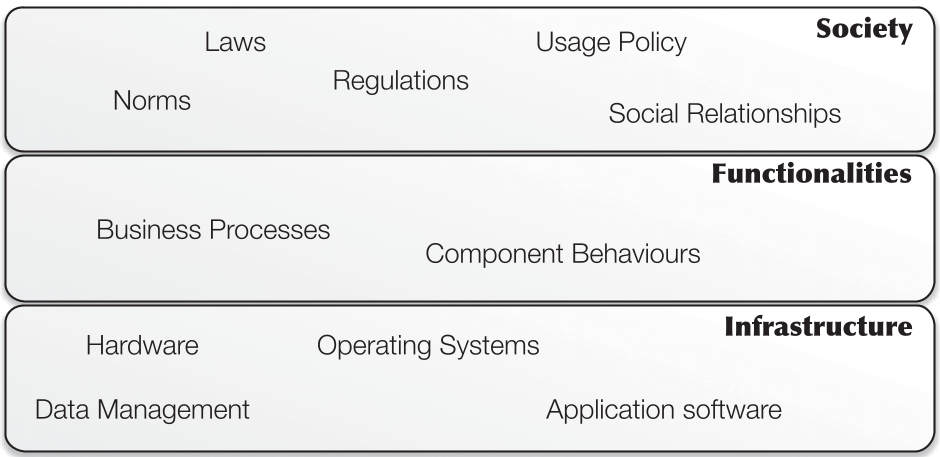 Figure 1: The architectural layers of Socio-Technical Systems, highlighting the Society layer implemented via commitments.
Experimental Evidence: The FinancialMAS Case Study
To prove the power of decoupling, the authors implemented a financial stake-holding system (Investors, Promoters, Banks).
They compared two versions of a Contract Net Protocol (CNP):
- Version A: The protocol triggers a commitment once a specific number of proposals are received.
- Version B: The protocol triggers based on a temporal deadline.
In 2COMM4JADE, this change was implemented entirely within the Artifact. Because the agents were programmed to watch for the "Commitment" event rather than a specific message or timer, the agent code remained 100% unchanged between versions.
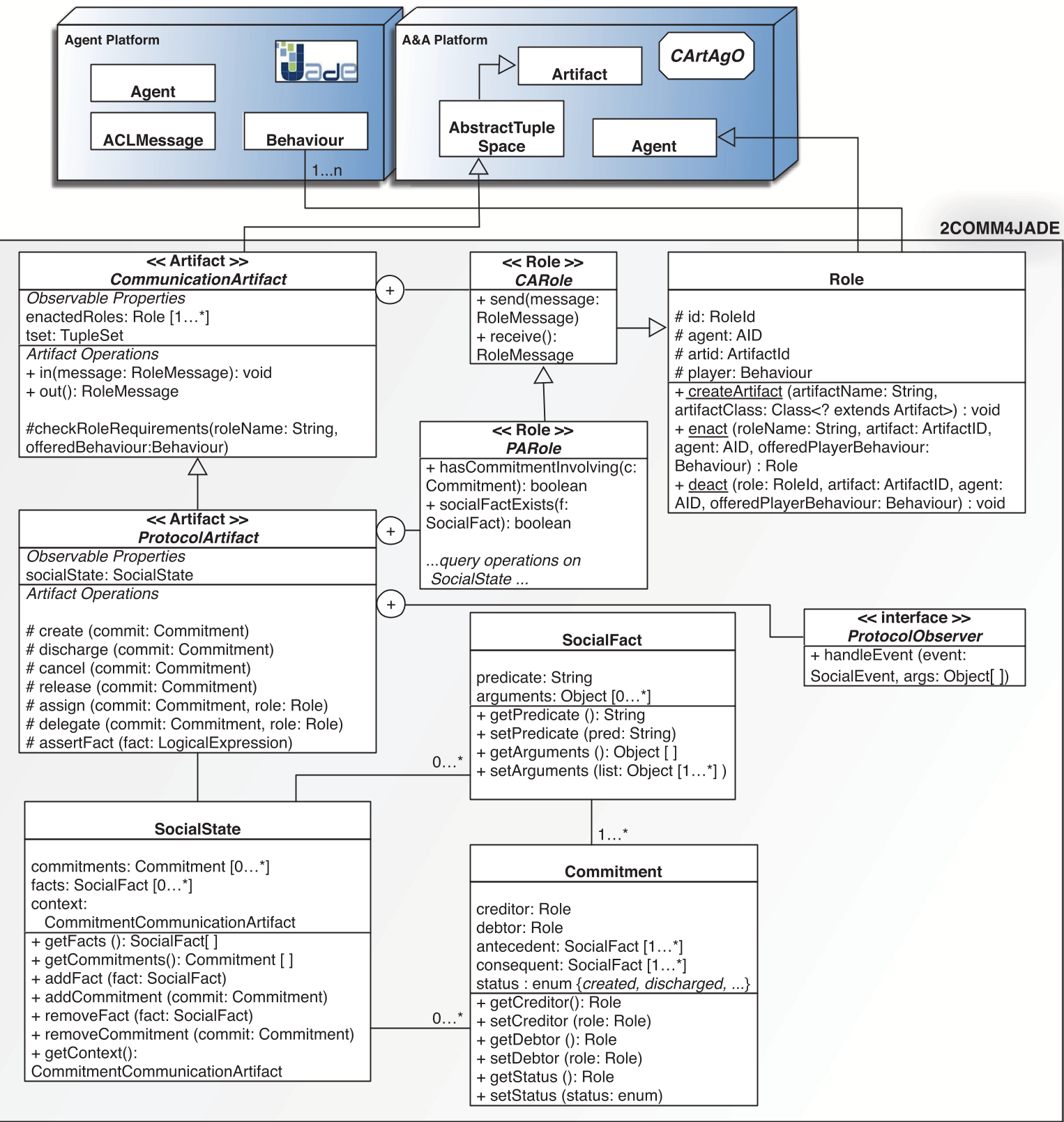 Figure 2: UML diagram of 2COMM4JADE showing the relationship between JADE agents and CArtAgO artifacts.
Critical Analysis & Future Outlook
The beauty of this approach is that it transforms coordination from a "black box" inside the agent to a shared "white box" in the environment. This is essential for:
- Scalability: New agents can join and understand the state of play by inspecting artifacts.
- Monitoring: Since the social state is in an artifact, a system-level monitor can detect violations without peeking into agent private states.
Limitations
While 2COMM4JADE excels at decoupling, it assumes that all parties trust the artifact to manage the state. In truly adversarial cross-organizational settings, the artifact itself would likely need to be implemented via a distributed ledger (Blockchain) to ensure its integrity.
Conclusion
2COMM4JADE represents a significant step toward "socially-aware" computing. By reifying protocol logic into artifacts, the authors have provided a blueprint for building systems where agents are not just programmed to follow a script, but are empowered to navigate a web of social obligations and expectations.