
Harmonizing Industry Standards with Pedagogy: The CIF in HCI Education
Common Industry Format: Meeting Educational Objectives and Student Needs?
This paper investigates the adaptation of the Common Industry Format (CIF)—an ANSI standard for reporting usability test results—into an introductory Human-Computer Interaction (HCI) university course. The authors modified the CIF to align with educational objectives and evaluated its effectiveness through student surveys and report audits.
TL;DR
Can an industry-standard reporting format improve the way students learn usability testing? This study examines the implementation of the Common Industry Format (CIF) in an undergraduate HCI course. While the standard helps align academic work with professional expectations, students (especially those with English as a second language) find the technical complexity and rigid structure a significant hurdle that requires more than just a template to overcome.
Context: Why Standardize Usability Reporting?
The National Institute of Standards and Technology (NIST) introduced the CIF to bridge the communication gap between usability practitioners and procurement decision-makers. In the professional world, a standardized report ensures that "usability" is not just a vague subjective claim but a quantifiable, replicable metric.
The authors argue that introducing students to the CIF early accomplishes three goals:
- Industry Alignment: Students graduate familiar with professional standards.
- Replicability: It teaches the scientific rigor required in UX research.
- Process Awareness: The structure forces students to consider participant selection and context of use—details often overlooked by novices.
Methodology: Adapting the "Summative" for the "Formative"
The core challenge is that the CIF is inherently summative (designed for final product testing), whereas education is often formative (focused on finding and fixing problems). To address this, the researchers customized the CIF for two different assignments: Heuristic Evaluation and User-Based Evaluation.
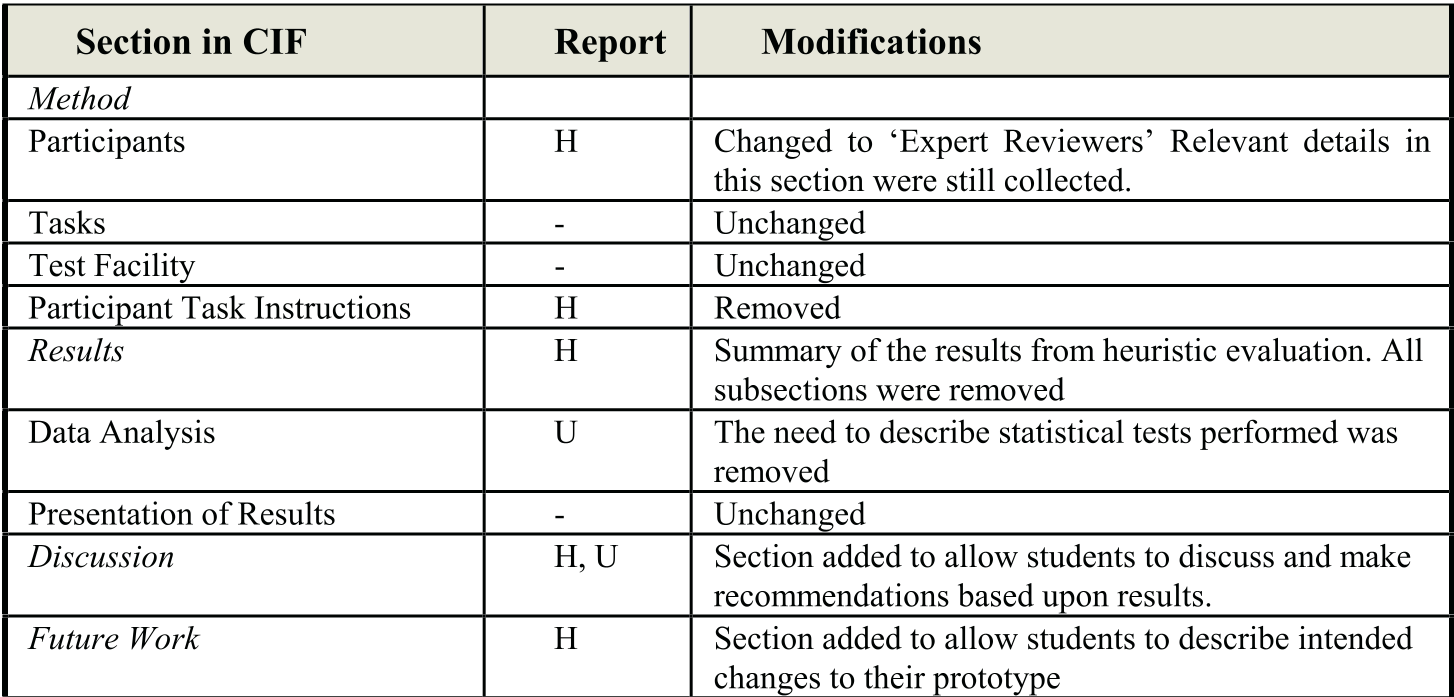 Table 1: Key modifications made to the CIF to fit educational objectives, including the addition of 'Discussion' and 'Future Work' sections.
The ESL Barrier: A Subtle Ease-of-Use Gap
A critical aspect of this study was the differentiation between English as a First Language (EFL) and English as a Second Language (ESL) students. In a globalized IT industry, a standard is only as good as its accessibility.
The data revealed a telling trend: while both groups found the CIF equally "useful" (M ≈ 3.7), the ESL students rated it as consistently more difficult to use. Qualitative comments suggested that the "industry-speak" and technical terminology within the NIST guidelines were barriers to entry.
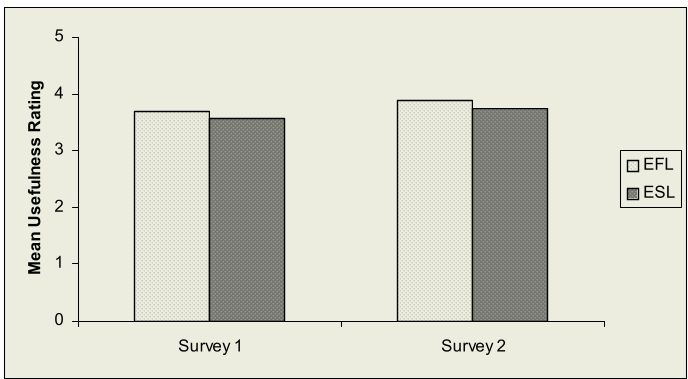 Figure 2: Students generally perceived the CIF as more useful by the second assignment (Survey 2) as familiarity increased.
Performance vs. Perception
Interestingly, there was a disconnect between how students felt and how they performed:
- Perception: Students were "under-whelmed" and neutral about the tool's ease of use.
- Compliance: Students only hit about 55% of the CIF's specific reporting requirements.
- Outcome: Despite low compliance with the specific format, the overall quality of reports improved compared to previous years when the CIF wasn't used.
Tutors noted that the "Results" and "Data Analysis" sections remained the primary pain points, where students struggled to move from raw data to the structured statistical reporting the CIF demands.
Deep Insight: Documentation is Not Training
The most significant takeaway for educators and industry leaders is that a template is not a teacher. The authors initially hoped the CIF documentation would "stand alone." They found the opposite:
- Terminology Support: Complex terms like "context of use" or "statistical significance" need explicit instruction in an educational context.
- The Second-Time Charm: Ratings for both usefulness and ease of use improved in the second survey, suggesting that the "learning curve" for standardized reporting is steep but manageable with repetition.
Conclusion
The study concludes that while the CIF is a "bit technical or industry-based" for introductory students, it successfully imposes a professional discipline that elevates the quality of their work. For future implementations, the authors suggest shifting away from providing just a template toward providing active training and contextual examples to bridge the gap between academic learning and professional execution.
Keywords: CIF, Human-Computer Interaction, Usability Testing, Standardized Reporting, ESL in HCI.