
Efficient Multiparty Profile Matching in Mobile D2D Social Networks
On common profile matching among multiparty users in mobile D2D social networks
This paper introduces a framework for Common Profile Matching (CPM) in Mobile Device-to-Device (D2D) Social Networks, enabling physical neighbors to identify shared attributes. It proposes the Iterative Bloom Filter (IBF) method to efficiently solve three matching paradigms: all-common, β-common, and top-γ-popular, achieving significantly lower communication overhead than raw string exchange.
TL;DR
When a group of people meet at a social event, identifying shared interests—like common hobbies or mutual friends—can be a social "icebreaker." This paper presents an efficient way for smartphones to perform this "Common Profile Matching" (CPM) via Device-to-Device (D2D) communication. By using Iterative Bloom Filters (IBF), the system identifies commonalities among multiple users while minimizing battery-draining data transmission and protecting privacy.
Context: Moving Beyond One-to-One Socializing
Most existing Mobile Social Network (MSN) research focuses on one-to-one interactions (e.g., "Do you and I have a common friend?"). However, real-world social scenarios are often multiparty. Imagine a classroom of students wanting to find a common free time or a tour group looking for the top three most-visited countries among them.
The challenge lies in the communication-efficiency tradeoff: sending full lists of attributes is too slow and data-heavy, while simple hashing doesn't easily support "fuzzy" or "threshold" matching (like finding what at least 5 out of 10 people like).
The Core Mechanism: Bloom Filters & Iterative Voting
The authors propose three versions of the CPM problem:
- All-Common: Items shared by every single member.
- β-Common: Items shared by at least members.
- Top-γ-Popular: The most frequently occurring items.
Why Bloom Filters?
A Bloom Filter is a space-efficient probabilistic data structure. Instead of sending "Tennis, Coding, Travel," a device sends a bit-array where specific positions are set to 1 based on hash functions. This offers:
- Compression: Drastically smaller than raw text.
- Privacy: It’s a one-way transformation; an eavesdropper cannot easily reconstruct the original list without the "key."
The Iterative Insight
The "Iterative" part of IBF is the secret sauce. In the first round, users exchange a small, "noisy" (higher false-positive) filter. In the second round, they only exchange information about the elements that survived the first round.
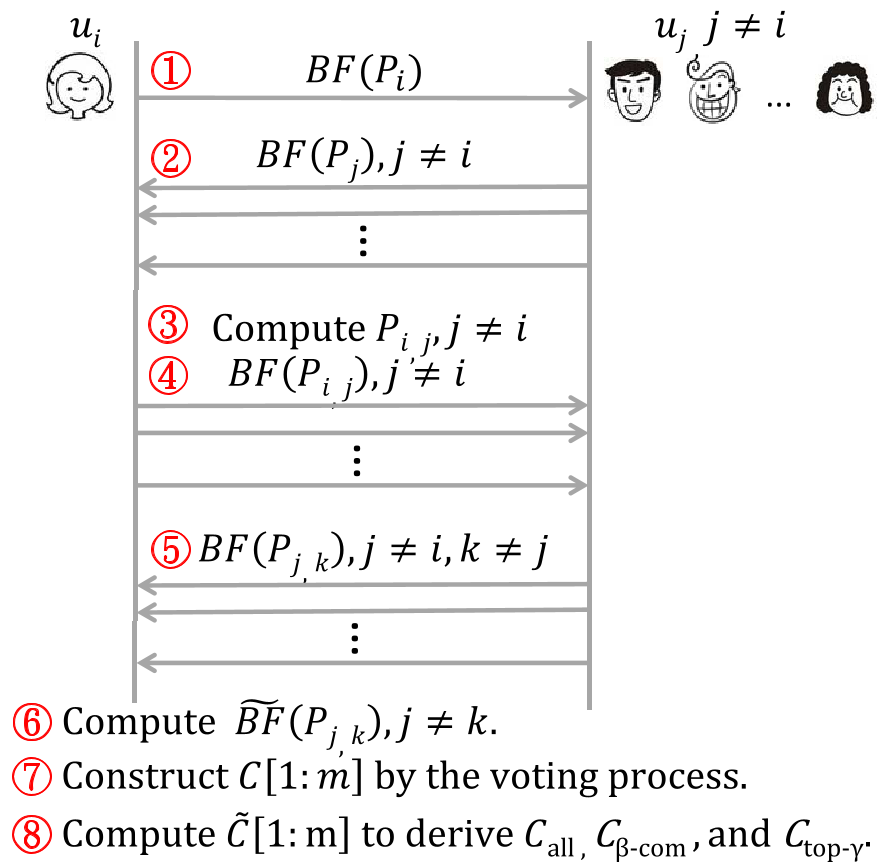 Fig 1. Workflow of the Basic Bloom Filter solution vs the multi-step IBF logic.
The paper introduces a Voting Process:
Users perform a bit-wise AND operation on received filters. If a specific bit is set to 1 across multiple users' filters, it indicates a high probability that an attribute exists in that group. High-frequency bits "win" the vote to be included in the -common or top- results.
Experimental Validation
The researchers built an Android prototype using WiFi Hotspot technology to create a local MDSN. They tested the system using four Google Nexus 4 devices.
Key Findings:
- Scalability: As the number of attributes () grows from 200 to 1000, the execution time for the Baseline (raw strings) spikes, while Bloom Filter methods remain nearly flat.
- Message Efficiency: The IBF solution consistently uses less bandwidth than the Basic approach because the second-iteration filters are highly optimized for the subset of potentially matching items.
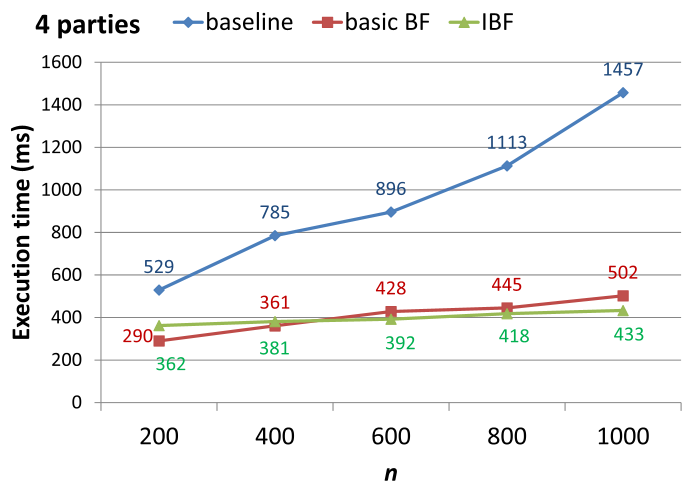 Fig 2. Execution time comparison: BF-based methods scale significantly better than the baseline as profile density increases.
Critical Analysis & Takeaways
The beauty of this work is its physical intuition: it mirrors how humans socialize by gradually revealing more detail as commonalities are found.
Limitations:
- The current model assumes a fully connected network (everyone can hear everyone). In larger venues with signal blockage, multi-hop routing would be required, which would complicate the voting logic.
- While Bloom Filters provide "one-way" protection, a determined attacker with a dictionary of all possible attributes could still perform a brute-force membership test.
Future Outlook: This framework is highly applicable to the growing field of Proximity-Based Services (PBS). As technologies like WiFi Aware (Neighbor Awareness Networking) become standard in Android and iOS, the IBF approach could enable "passive social discovery" where your phone identifies potential collaborators or friends in a coffee shop without ever hitting the cloud.
Conclusion
By moving the "intelligence" of social matching to the edge (the device itself) and using probabilistic data structures, the authors have demonstrated a viable path for real-time, multiparty social interaction that is both fast and light on resources.