
Commoner Privacy: Maximizing Utility in Long-Tailed Network Data
Commoner Privacy And A Study On Network Traces
The paper introduces Commoner Privacy, a novel privacy framework tailored for long-tailed and large-value-range datasets like network traces. It proposes the interactive k-anonymity mechanism and a system called Patrol, which preserves significantly higher research utility than Differential Privacy and Crowd-blending Privacy by only fuzzing data points that are statistical outliers.
TL;DR
Researchers from USC/ISI have introduced Commoner Privacy, a liberalized privacy standard that bridges the gap between the rigid protections of Differential Privacy (DP) and the practical needs of data scientists. By focusing on hiding outliers rather than adding noise to every data point, their system, Patrol, achieves up to 49x better utility than previous state-of-the-art methods while remaining resilient to tracker attacks.
The "Long Tail" Problem: Why DP Fails Network Research
In the world of network security and traffic analysis, data is inherently "unbalanced." A single high-traffic Web server might generate millions of packets, while a typical user generates a few thousand.
If you apply Differential Privacy, the "Global Sensitivity" (the maximum possible change one person can cause) is tethered to that high-volume server. Consequently, the Laplace noise added to the data is so massive that it "drowns out" the actual research signal, rendering the dataset useless. Crowd-blending Privacy attempted to fix this by only allowing data to be shared if people had identical contributions, but in network traces—where packet counts and timestamps are unique—hardly anyone "blends" perfectly.
Methodology: The Logic of the "Commoner"
The authors propose a shift in perspective. Instead of forcing everyone to look identical, why not just focus on the people who stand out?
1. Interactive k-Anonymity
An individual is protected if their data point is a "commoner"—meaning it is not a statistical outlier within a crowd of size .
- The Mechanism: Points with contributions from identities are checked for outliers (using Standard Deviation or Median Absolute Deviation).
- The Action: Outliers are fuzzed or removed. If the remaining contributor set is still , the aggregate output is released without noise.
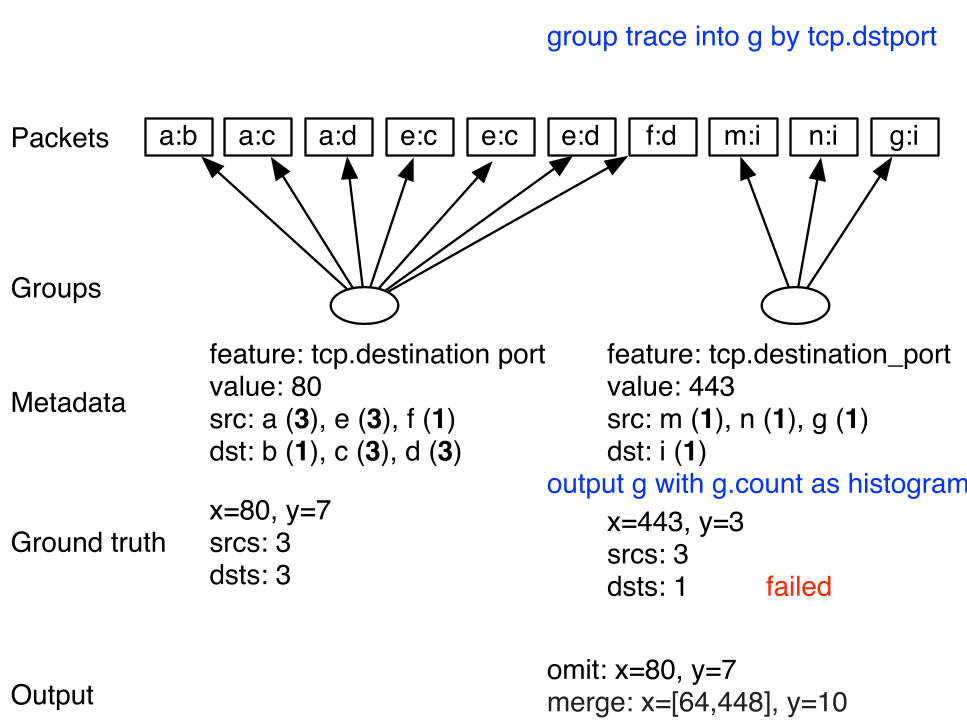 In the figure above, the system checks if a specific port's traffic is dominated by one user. If so, that point is fuzzed (red circle).
2. Defeating Tracker Attacks via Query Introspection
A major criticism of k-anonymity is the Tracker Attack, where an adversary combines multiple innocent-looking queries to isolate an individual. Patrol solves this through Query Introspection. It maintains a history of all queries a researcher has asked and performs "Cross-query checking." If a new query, when combined with a previous one (via set difference or union), would reveal an individual, the system rejects the query or fuzzes the result.
Experimental Results: A Utility Breakthrough
The researchers tested Patrol on the MAWI Trans-Pacific link trace. They compared common counting and volume queries ().
- Utility Loss: Measured by Normalized Error ().
- Differential Privacy: Error levels in the 100s or 1,000s.
- Commoner Privacy: Error levels consistently below 1.0.
- Fuzzing Rate: As shown in the comparison below, Commoner Privacy (STDEV/MAD) consistently fuzzes fewer points than Crowd-blending (CB).
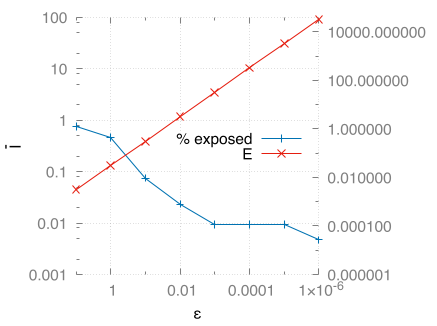 Figure: Commoner Privacy (STDEV/MAD) maintains high coverage across different query types (source ports, destination ports).
Critical Insight & Future Outlook
The core genius of Commoner Privacy is its Inductive Bias toward the "Realistic Adversary." While DP protects against an "All-but-one" adversary (someone who knows everything about everyone else), Commoner Privacy protects against an Interactive Adversary (someone using the system to fish for info).
By accepting a slightly lower privacy guarantee for "common" behaviors, researchers gain access to high-fidelity data that was previously locked away. This approach is highly relevant for today's MLOps and Telemetry systems, where understanding the "typical" behavior of millions of users is more valuable than perfectly masking every individual's non-sensitive metadata.
Limitations
- All-but-one Adversary: If an attacker truly knows all other participants, they can leak an individual's data.
- Computational Overhead: Query introspection grows linearly-to-exponentially with the number of related queries, necessitating future optimizations in multi-threading.
Conclusion
Commoner Privacy proves that we don't always need to add noise to achieve safety. Sometimes, simply ensuring that no one "sticks out" is enough to protect the crowd while letting the data speak for itself.