
Beyond Features: The Sociotechnical Engine of Co-innovation Networks
Communication in Co-innovation Networks - A Moderated Mediation Model of Social Affordances, Social Experience, and Desire for Learning
This study investigates the drivers of communication in co-innovation networks, proposing an integrative model that links platform socio-technical affordances to continuous communication intention. Using PLS-SEM on data from Quirky.com, the authors demonstrate that "socio-professional experience" acts as a critical mediator, significantly enhanced by an individual’s personal desire for learning.
TL;DR
Why do some innovation platforms buzz with activity while others remain ghost towns despite having the same features? This paper argues that the secret lies in Socio-professional Experience. By analyzing the platform Quirky, the researchers found that technology affordances only lead to continuous communication when they are filtered through a positive social experience, a process that is significantly supercharged by a user's Desire for Learning.
Background: The Communication Gap in Co-innovation
Co-innovation—where firms engage external actors to co-create value—is the backbone of modern R&D. However, there is a recurring pain point: Communication does not develop naturally. Even if a platform offers chat, forums, and profiles, users might not engage.
The authors shift the focus from "What features does the platform have?" to "What does the platform afford the user to do?" and, more importantly, "How does the user experience those possibilities?"
Methodology: The Moderated Mediation Model
The core of this research is a sophisticated moderated mediation model that looks at the "Human-in-the-loop" within a sociotechnical system.
1. Social Affordances (The Potential)
These aren't just buttons; they are perceived opportunities for action—like the ability to solicit support for an idea or network with experts.
2. Socio-professional Experience (The Catalyst)
The authors define this as a hybrid experience: neither purely social nor purely professional. It is the sense of belonging and self-actualization gained through expert interaction.
3. Desire for Learning (The Filter)
This is the "Moderator." The researchers hypothesized that if a user doesn't care about learning, even the best social experience won't make them want to keep communicating.
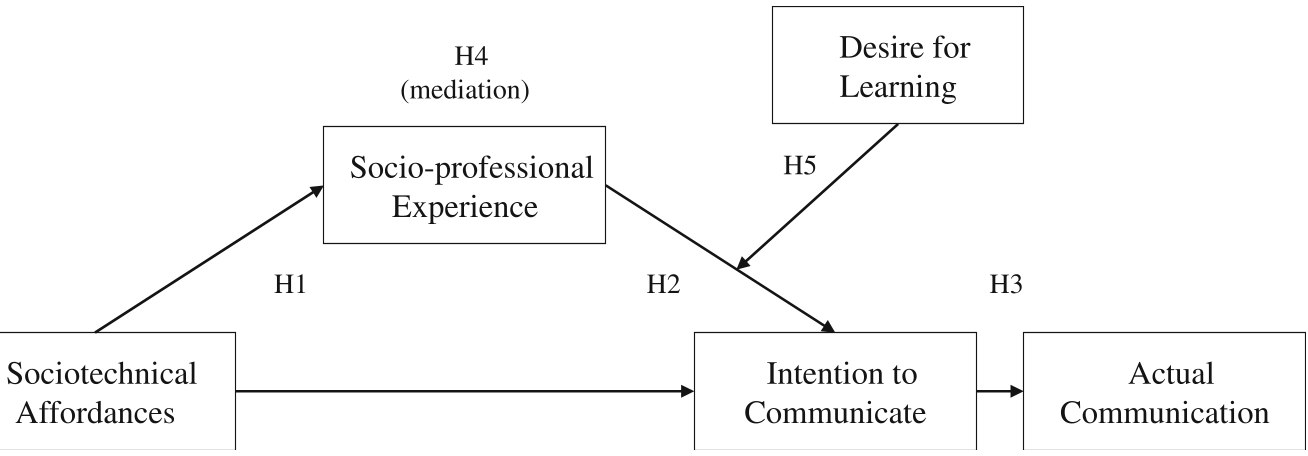 Figure 1: The hypothesized relationships between Affordances, Experience, and Intention.
Experimental Results & Insights
The study utilized a field survey of 229 members of Quirky.com, a real-world social product development network.
Key Findings:
- The Experience Bridge: Social affordances alone don't drive communication. They must first create a positive Socio-professional Experience (H1 & H4: Partial Mediation).
- The Intention-Behavior Link: A high continuous intention to communicate accurately predicts actual communication behavior (H3: β = 0.30).
- The Learning Factor: For users with a Low Desire for Learning, the impact of social affordances on their experience was significantly weakened. This suggests that "passive" users who just want monetary rewards are harder to retain in a communication-driven network.
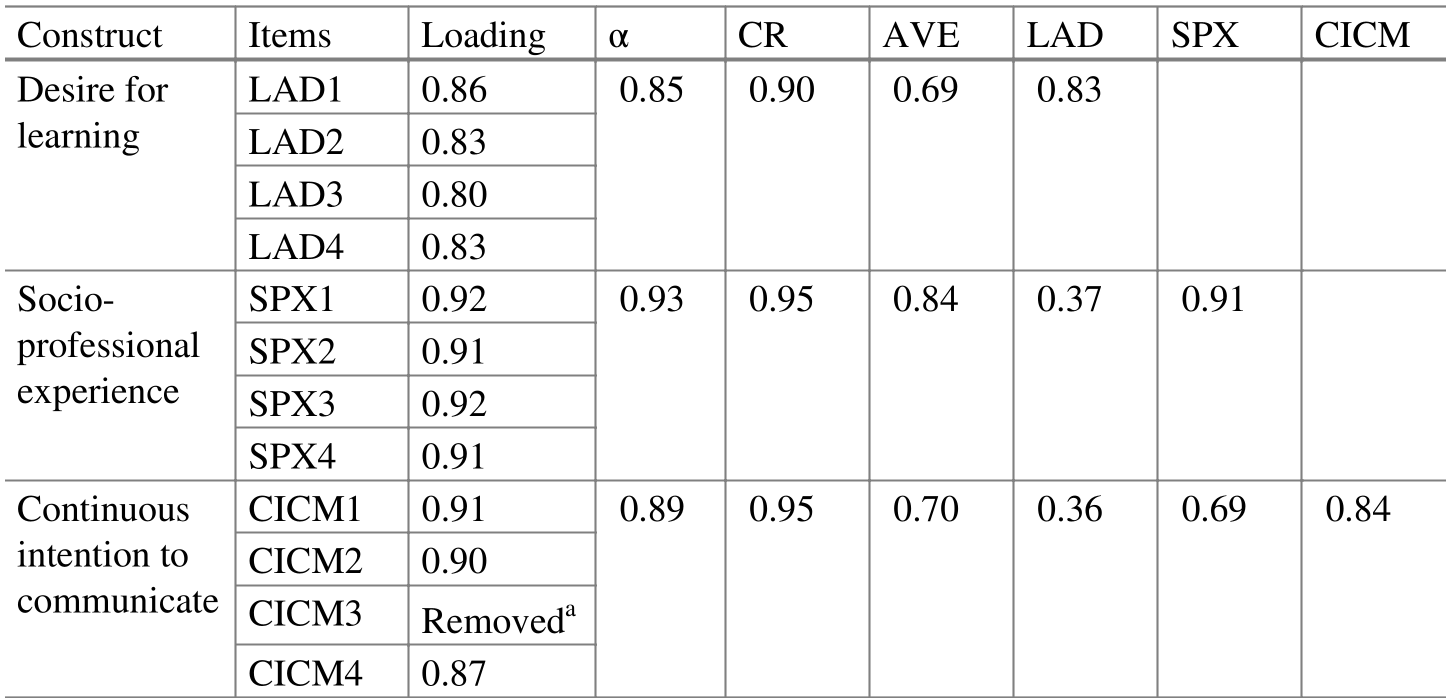 Table 1: Evaluation of Reflective Measurements showing high reliability (Alpha > 0.8) and validity.
Critical Insight: Why This Matters
This paper provides a crucial "Academic Reality Check" for platform designers.
Professional communities are not just Facebook for work. In a co-innovation network, the "social" aspect is inseparable from the "professional" goal. If the platform fails to facilitate growth and learning, the social tools become overhead rather than an asset. The Desire for Learning acts as the primary intrinsic motivator that makes the "work" of communicating feel like a "benefit."
Summary and Future Outlook
The study concludes that to sustain a co-innovation ecosystem, managers must:
- Monitor Experience: Don't just track clicks; track the sense of "belonging" and "networking value."
- Filter for Learners: Design onboarding processes that attract individuals looking to sharpen their creative or professional skills.
- Optimize for Affordances: Design features that explicitly afford "knowledge sharing" and "identity building" rather than just generic messaging.
Limitations: The study is based on a single platform (Quirky). Future work should examine if these dynamics hold true in non-incentivized or purely academic co-innovation networks.