
The Durability of Transnational Social Fields: Why Migrant Networks Don’t Just Fade Away
Communication flows and the durability of a transnational social field
This study utilizes unique bi-national social network data to examine communication flows between Mexican migrants and their origin communities. Using the Network Survey of Immigration and Transnationalism (NSIT), the authors analyze how cross-border ties evolve over time, finding that while specific tie strength attenuates (supporting Assimilation theory), a robust Transnational Social Field remains structurally cohesive via frequent communication and return visits.
TL;DR
Conventional wisdom suggests that as migrants spend more time in a new country, they "assimilate"—cutting ties with home to blend into the destination. This study challenges that binary by mapping a massive bi-national social network between Mexico and the US. Using sophisticated network analysis, the authors prove that cross-border communication remains strikingly durable, creating a "Transnational Social Field" that survives even as individual ties undergo structural shifts.
Problem & Motivation: Beyond the "Transmigrant" Myth
For decades, the debate in sociology was split:
- Assimilationists argued that incorporation is a one-way street where origin ties inevitably wither.
- Transnationalists argued that modern tech allows for "dual lives."
However, critics often dismissed transnationalism as a niche phenomenon practiced only by a few "transmigrants" who send money and travel constantly. The authors of this paper argue that this misses the forest for the trees. By looking only at individuals, we miss the network. Even if a specific migrant speaks to their family less often, the collective network—the "Transnational Social Field"—might still be robust enough to pass information, culture, and support across borders.
Methodology: Mapping the Bi-National Web
To test this, the researchers conducted the Network Survey of Immigration and Transnationalism (NSIT). They started with "seeds" in North Carolina and traced their contacts back to Guanajuato, Mexico, and Houston, Texas.
The Network Architecture
The study mapped 8,769 ties among 5,236 individuals. They didn't just ask "Who do you know?" but "How often do you talk?" This allowed them to measure bandwidth—the intensity of the connection.
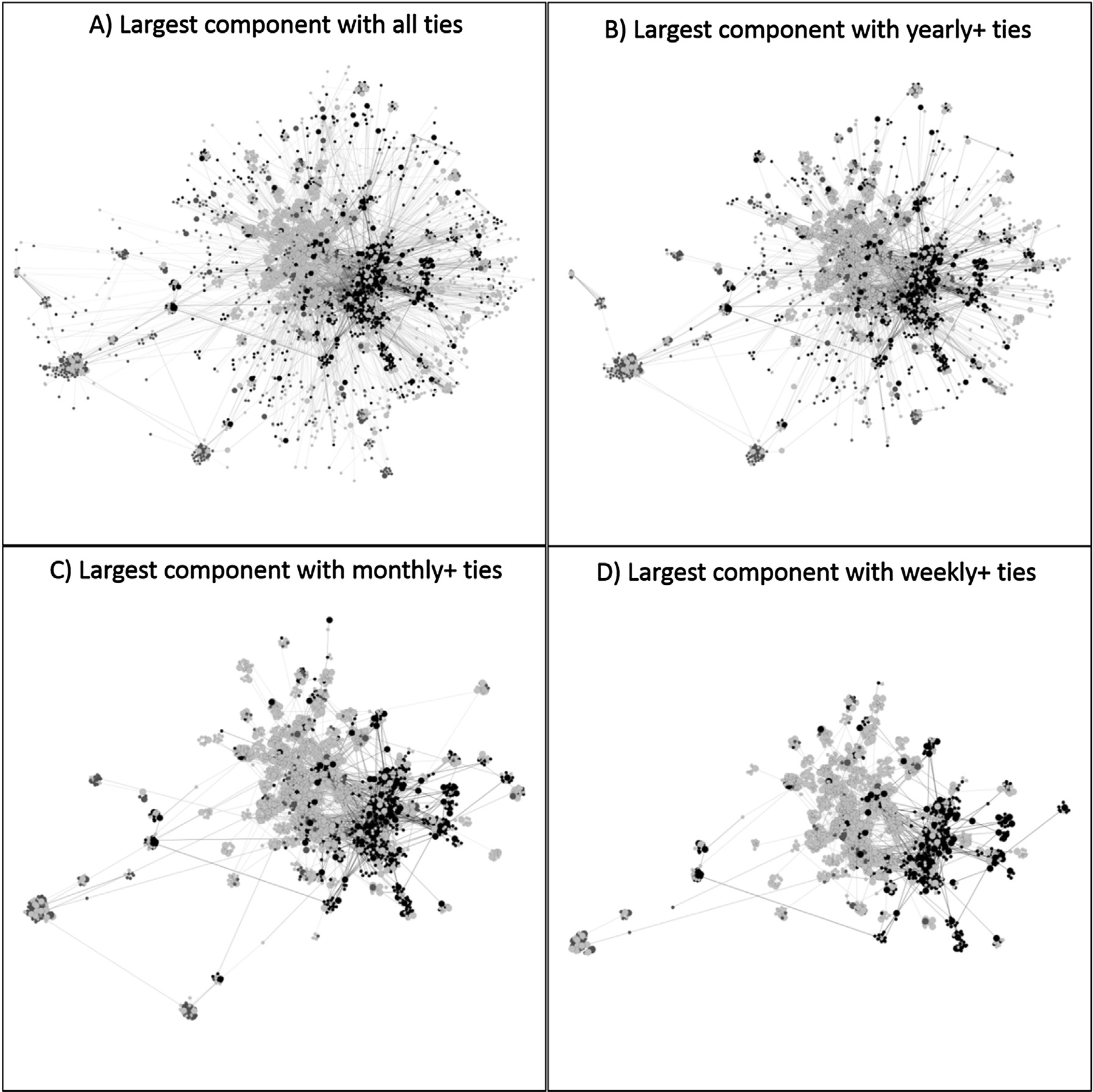 Figure: The "Giant Component" of the network remains connected across the border even when filtering for weekly or monthly communication.
The authors used Censored Poisson Models to count ties and Ordered Probit Models to analyze communication frequency, adjusting for "network autocorrelation"—the idea that your communication habits are influenced by the habits of your peers.
Key Insights: The Anatomy of Persistence
1. The "Bandwidth" vs. "Count" Trade-off
The most striking finding is that "Time in the US" affects the frequency of communication much more than the number of ties. Migrants don't necessarily lose their friends back home; they just talk to them less often. However, the connectivity of the network is saved by Return Visits. A single trip home in the last four years acts as a "network recharge," boosted communication frequency significantly.
2. Failure of the "Native-Born" Assimilation
The classic assimilation model predicts that migrants will eventually form ties with "native-born" residents. The data says otherwise. Instead of "melting" into the US mainstream, migrants formed ties with a broader pan-Mexican community. They aren't just staying local to their village; they are becoming part of a wider ethnic enclave.
3. Structural Robustness
Using a simulation of "Cross-border Diffusion Capacity," the authors showed that even after 10 years in the US, the network remains highly cohesive.
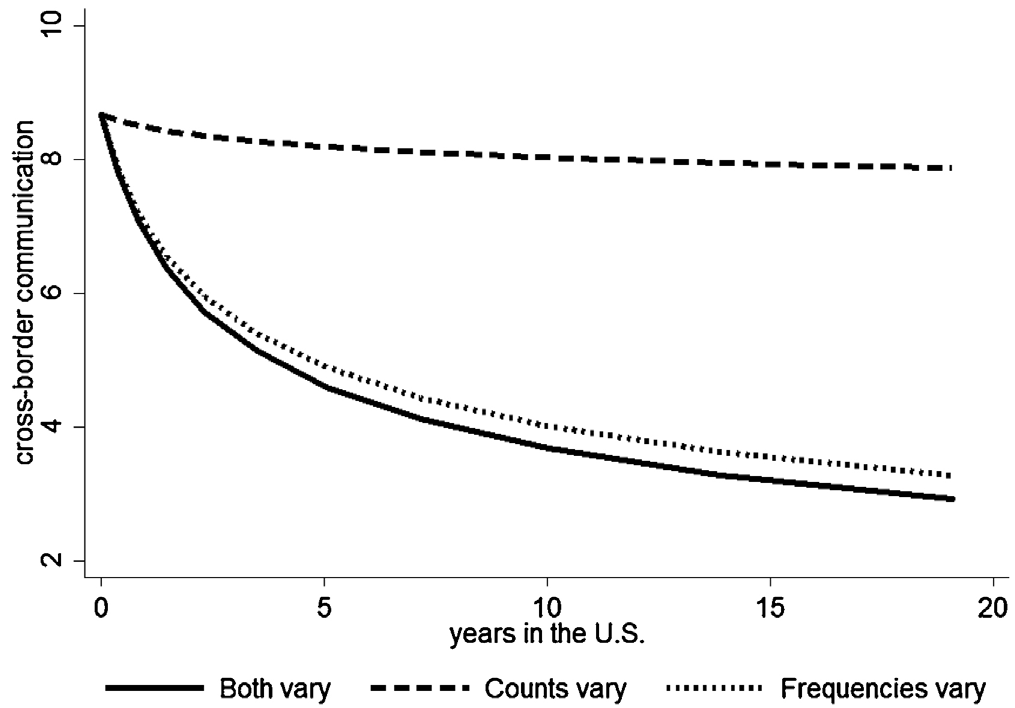 Figure shows how communication events per month decline over time, but remain non-zero, supported primarily by the persistence of the underlying social field.
Critical Analysis & Conclusion
The value of this work lies in its structuralist approach. It proves that the "durability" of a social field doesn't require every member to be a hyper-active "transmigrant." As long as a cohesive core remains, information (or "social remittances") can flow freely across borders.
Limitations:
- The study focuses on the Mexico-US corridor, which has unique geographic proximity.
- It relies on self-reported communication frequency, which can be subject to recall bias.
Future Outlook: As digital communication (WhatsApp, social media) becomes even cheaper, the "cost" of maintaining these fields will continue to drop. This research suggests that future migration policy shouldn't just look at how migrants "blend in," but how they remain "bridges" between two nations, facilitating an ongoing exchange of ideas and economic support.
Takeaway: Diversity and assimilation are not mutually exclusive; they are woven into the same durable, cross-border fabric.