
Beyond Optimization: Modeling Particle Swarms as Social Consensus Machines
Communication, Leadership, Publicity and Group Formation in Particle Swarms
This paper introduces an abstract consensus-based model for Particle Swarm Optimization (PSO) that shifts focus from specific particle dynamics to the macro-behavior of social networks. By modeling swarm interactions as a stochastic interpolation process, it explores how communication structures, leadership styles, and external "publicity" influence group formation and convergence.
TL;DR
Standard Particle Swarm Optimization (PSO) is often viewed as a mathematical optimizer, but this paper re-imagines it as a social consensus system. By abstracting away the physics-like dynamics (velocity, inertia), the authors reveal how social network structures and external "publicity" signals can steer a swarm toward sub-optimal "agreements," providing deep insights into the fragility of collective intelligence.
Background: The Social Gap in PSO
In a standard PSO, a particle is a "perfect" social animal: it immediately knows the best state of its neighbor and is instantly influenced by it. This is a deterministic broadcast—a phenomenon rarely seen in nature. In a real shoal of fish or flock of birds, information propagates through one-to-one interactions, more like a stochastic diffusion process.
The authors argue that we must understand the behavior of the swarm—how it reaches a consensus on where to search—before we can judge its performance.
Methodology: Abstracting the Swarm
The authors simplify particle movement into a state transition model. Instead of tracking complicated trajectories, they focus on the "center of sampling" ().
The Stochastic Interpolation
Social interaction is modeled as a stochastic interpolation between a particle's current state and a neighbor's state: where is a random variable. This captures the physical intuition that a particle will eventually search "somewhere in between" its own history and the swarm's success.
1. Leadership and Selection
- Standard PSO: Uses "Global Best" or "Local Best" (Deterministic). The best individual is a dictator whose state is always broadcasted.
- Proposed Model: Introduces Binary Tournaments. Two neighbors are picked, and the better one is followed. This "Democratic" approach means a leader can be ignored, allowing for more fluid (and potentially deceptive) group dynamics.
2. The Power of "Publicity"
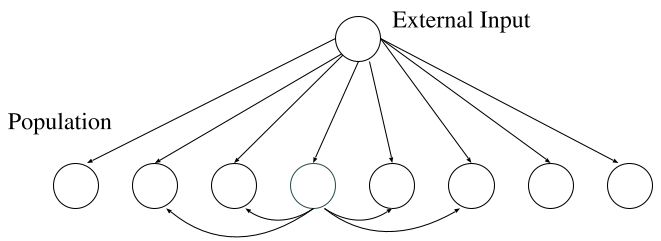
The model introduces an external input () with a probability . This simulates "advertisements" or external noise that influences the swarm regardless of the actual fitness landscape.
Experiments: When the Swarm is Deceived
The researchers tested these models across 600,000 runs on various 1D landscapes (Flat, Linear, Two-peaks, Trap).
Key Findings:
- Implicit Bias: Even on a perfectly flat landscape, the act of social interaction creates an inherent bias toward the average state.
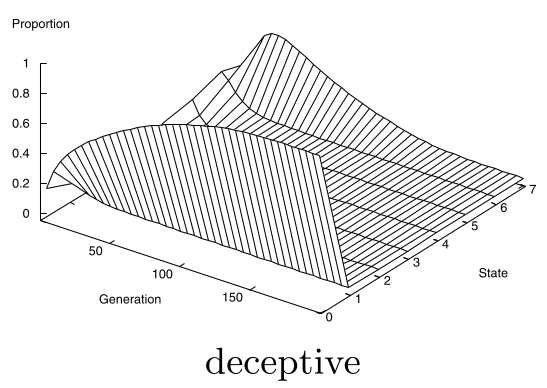
- The Price of Democracy: While probabilistic selection (tournaments) is more "natural," it makes the swarm highly vulnerable to Deception. In landscapes with trap functions, the democratic swarm frequently converged to local optima that a standard PSO might have escaped.
- Publicity Wins: Perhaps most strikingly, even a very weak external signal () could completely hijack the swarm’s consensus, leading them away from the global optimum toward whatever "product" the external source was "advertising."
Depth Insight: Why This Matters
The value of this paper isn't in providing a faster optimizer, but in showing that communication topology and selection pressure are the "steering wheel" of the swarm.
In traditional PSO research, we focus on the "engine" (the update equations). This work reminds us that if the "steering" (social network) is poorly designed, even the most powerful engine will drive the swarm off a cliff—either into the arms of a local optimum or under the influence of external noise.
Conclusion
By treating PSOs as "consensus machines," Poli et al. bridge the gap between evolutionary computation and social sciences. The findings serve as a cautionary tale for designing autonomous swarms: collective intelligence is only as robust as its communication protocols. Too much "democracy" or "publicity" can lead to a collective failure to find the truth (the global optimum).
Future Work: This framework opens the door to studying "Information Warfare" in swarms—how adversarial agents might inject false information to lead a searching swarm astray.