
Simulating the Social Engine: How Communication Patterns Shape Organizational Networks
Communication and organizational social networks: a simulation model
This paper introduces a multi-agent simulation model designed to explore the growth of organizational social networks and the impact of communication patterns on their structure. By integrating mechanisms for formal/informal and intra/inter-group communication, the model successfully replicates the statistical properties (clustering, assortativity, and degree distribution) of empirical data collected from two high-tech firms.
TL;DR
Can we predict the "health" of an organization by simulating its communication flow? This study proposes a multi-agent model that mimics how employees form relationships. By validating the model against real-world engineering firms, the researchers prove that "siloed" management practices don't just feel restrictive—they mathematically degrade network density and resilience, making the organization more vulnerable to losing key talent.
Context: Beyond the Snapshot
In the world of management science, Social Network Analysis (SNA) has long been the gold standard for understanding who talks to whom. However, SNA has a "static" problem: it usually captures a single moment in time. To understand how networks grow, researchers usually have to spend years collecting longitudinal data.
This paper shifts the paradigm by using Multi-Agent Systems (MAS). Instead of just observing, the authors built a digital laboratory to simulate the evolution of a firm’s social fabric from the ground up, focusing on the friction between formal hierarchies and informal coffee-machine chats.
The Problem: The High Cost of Silos
Why does this matter? Previous research shows that network density (how many people are connected) and diversity (connecting across departments) are direct predictors of performance. Yet, many managers inadvertently create "organizational silos." The authors identify a gap: we know silos are bad, but we don't know the exact mechanisms by which management discourages communication and how that systematically re-wires the social network.
Methodology: The Rules of Connection
The model operates on a grid where physical distance matters (Euclidean distance). It simulates the "growth" of a firm by adding one employee at a time based on three specific behaviors:
- Preferential Attachment: New hires are more likely to connect with "popular" employees (high degree) who are physically nearby.
- Saturation (The β Factor): Employees have limited energy. The parameter represents management friction. As increases, employees with many friends become less likely to seek new ones, stifling intra-group density.
- The Project Mechanism (The P Factor): Inter-group cross-pollination happens through projects. If is high, only the "most experienced" (formal leaders) get to participate, leaving the rest of the staff isolated in their own departments.
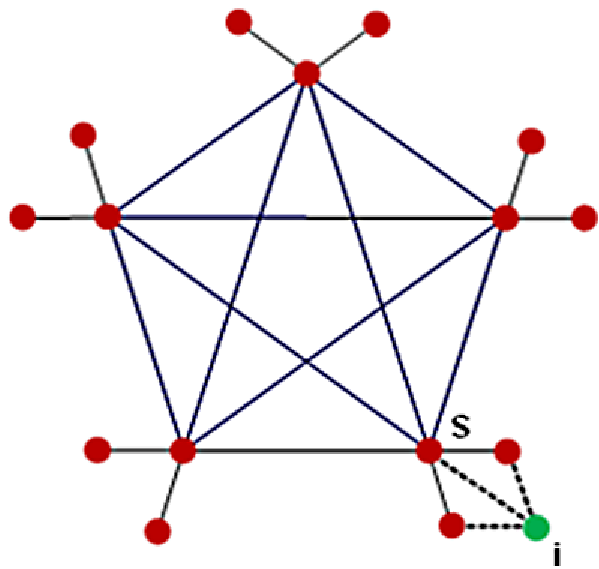 Figure 1: Illustration of a new hire forming local ties vs. broader organizational ties.
Experiments & Real-World Validation
To ensure this wasn't just "toy math," the authors tested the model against two real high-tech R&D firms. The results were striking: the simulation results for Clustering Coefficients and Assortativity (the tendency to stick with one’s own kind) almost perfectly mirrored the empirical data.
| Metric | Firm A (Real) | Simulation |
|---|---|---|
| Avg Degree ⟨k⟩ | 4.81 | 5.02 |
| Scalar Assortativity | -0.2125 | -0.1953 |
| Discrete Assortativity | 0.6163 | 0.6163 |
The simulation revealed two critical insights:
- Management Discouragement (): Increasing (discouraging internal talk) leads to a disassortative network where connections are sparse and inefficient.
- The Power of Informal Projects (Low ): When projects allow random (informal) members to join rather than just "vets," the discrete assortativity drops, meaning the "silos" begin to dissolve, and knowledge flows more freely.
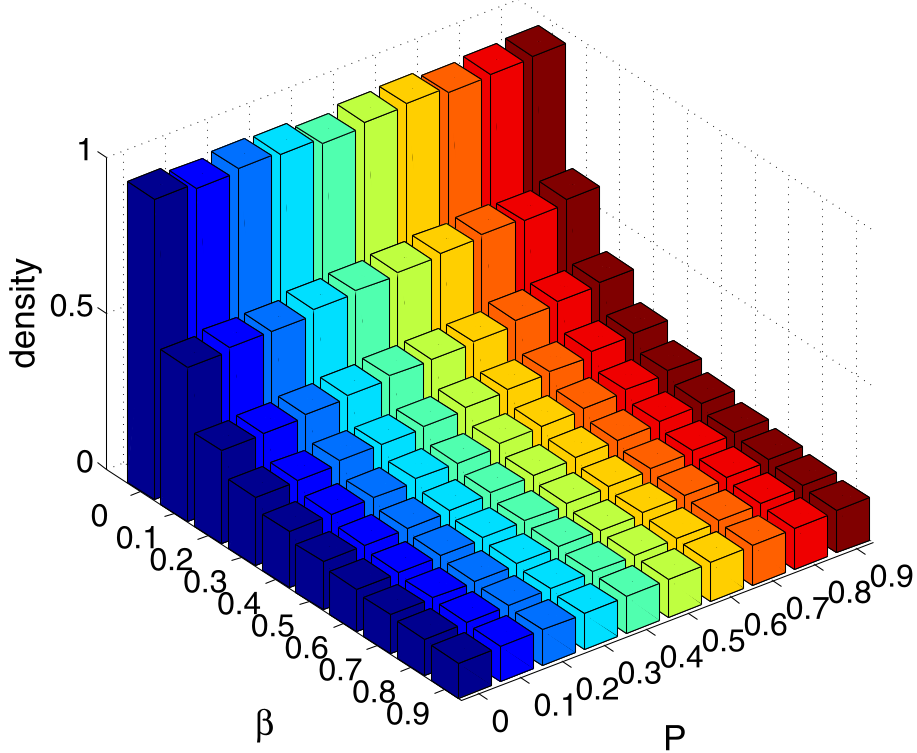 Figure 2: The sharp decline in network health as management discouragement (β and P) increases.
Critical Insight: Vulnerability to Turnover
One of the most profound takeaways is the link between Assortative Mixing and Resilience. In networks where similar people (in terms of popularity) connect (assortative), the network remains robust even if a "super-connector" leaves. By discouraging informal communication, management creates "disassortative" networks that are fragile; if a key engineer leaves, the whole department’s information flow might collapse.
Conclusion
This study provides a computational backing for what many have felt intuitively: Silos kill resilience.
- Takeaway for Leaders: Management practices that limit inter-group interaction to "senior leaders only" are mathematically proven to reduce the adaptive capacity of the workforce.
- Limitations: The model currently ignores employee departures (churn) and primarily focuses on size-based growth. Future iterations could integrate "homophily" (the 'birds of a feather' effect) further to see how diversity initiatives might change the simulation outcomes.
In the age of hybrid work, understanding these "growth rules" is no longer optional—it's the key to building a resilient, high-performing social engine.