
Unmasking the Invisible Office: Discovering Communication Structures via Information Asymmetry
Communication Structure Discovery via Information Asymmetry in an Organizational Social Network
This paper introduces a method to discover the "Communication Structure" in organizational social networks by mapping interactions between typed labels (e.g., job titles). It leverages the concept of Information Asymmetry through Random Walk with Restart (RWR) to identify core-periphery relationships, achieving a precision of 0.867 on the Enron email dataset.
TL;DR
In any company, the "official" org chart is often a lie. Reality happens in the "Communication Structure"—the hidden web of who actually talks to whom to get things done. This paper presents a novel unsupervised method to map these structures by measuring Information Asymmetry using Random Walks. By analyzing the flow imbalance between job titles, the authors can reconstruct an organization's true power map with over 86% precision.
The "Title" Trap: Why Formal Hierarchies Fail
Traditional organizational studies rely on formal titles like "CEO" or "Manager." However, research shows these are static and often disconnected from daily operations. A "Director" might be a bottleneck, while a "Senior Staff" member might be the actual information hub.
The authors argue that previous attempts to fix this—like clustering similar titles—miss the point. Just because two people are "Managers" doesn't mean they interact. To find the truth, we must look at the asymmetry of influence: in a core-periphery structure, information flows more easily (and more often) from the core to the periphery than vice-versa.
The Core Insight: Information Asymmetry
Borrowing from economic theory, the authors define information asymmetry as an imbalance in communication volume.
- The Hypothesis: Core positions (Leaders) have a high probability of reaching peripheral ones (Followers), while the reverse path is structurally discouraged or less frequent.
To measure this, they define Pairwise Proximity Asymmetry. If type can reach type easily, but struggles to reach , then is likely 's superior in the communication structure.
Methodology: Random Walks as Information Flow
The authors use Random Walk with Restart (RWR) to simulate how a "command" or "rumor" spreads through the office network. They compare two distinct approaches:
- Separated Random Walk: Calculates the average proximity between all individuals of Type A and Type B.
- Grouped Random Walk: Merges all individuals of a specific job title into a single "Supernode." This captures the "integral authority" of a group, reflecting how the entire "VP" layer interacts with the "Manager" layer.
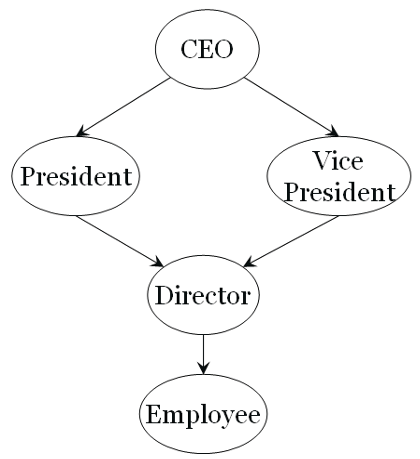
The algorithm then ranks these asymmetries (RPLPP) and greedily constructs a Directed Acyclic Graph (DAG), ensuring no logical cycles (e.g., A leads B, B leads C, C leads A) exist in the final communication map.
Proving it with Enron
The infamous Enron email dataset served as the ultimate stress test. After cleaning 151 employee nodes and 516 communication edges, the model attempted to recreate the Enron hierarchy.
Key Results:
- Precision and Recall: The Grouped Random Walk reached 86.7% precision.
- Heuristic Overperformance: It crushed simpler metrics like "Mutual Sent" count. Why? Because simply counting emails doesn't account for network position. A single email to a highly connected "connector" node is worth more than ten emails to an isolated one.
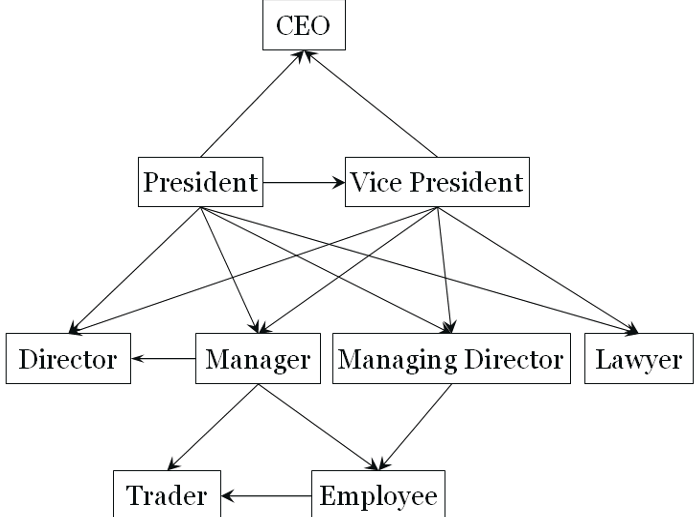
Critical Perspective: The Supernode Advantage
The most interesting takeaway is the superiority of the Grouped Random Walk. In organizational dynamics, influence isn't just about individual relationships; it's about the collective accessibility of a role. By treating a job title as a "Supernode," the algorithm recognizes that the "Director" position acts as a unified gateway for information, regardless of which specific Director is acting.
Limitations & Future Work
While robust, the model currently assumes a static network. Organizational structures are fluid—shifting during crises or project cycles. Furthermore, the reliance on "job titles" as labels assumes the labels themselves are accurate, even if the hierarchy isn't. Future iterations could benefit from Temporal Graph Analysis to see how communication structures evolve in real-time.
Conclusion
This paper provides a mathematically grounded framework for identifying who holds the "Real Power" in a network. By focusing on the imbalance of flow rather than just the volume of talk, it offers a sophisticated tool for organizational audits and social network analysis.