
Beyond Clusters: Navigating the Evolution of Community Detection in Social Networks
Communities' Detection in Social Networks: State of the art and perspectives
This paper provides a comprehensive survey and comparative analysis of community detection algorithms in social networks (1970–2018). It categorizes methods into static vs. dynamic and overlapping vs. non-overlapping architectures, evaluating SOTA approaches like Louvain, Girvan-Newman, and LICOD.
TL;DR
Social networks are defined by how nodes pull together. This paper surveys nearly 50 years of community detection research, dismantling the "Strong" vs. "Weak" definitions of communities and benchmarking SOTA algorithms like Louvain and Girvan-Newman. It highlights a critical flaw in current industry standards: Algorithmic Instability.
Background Positioning
In the landscape of Network Science, community detection is the equivalent of "unsupervised segmentation" in CV. While the Louvain method currently dominates the modularity-optimization space, this paper acts as a critical anchor, reminding us that we are still struggling to balance mathematical elegance (Modularity) with sociological reality (Stability and Information Flow).
The Core Conflict: Strong vs. Weak Sense
Why is it so hard to define a "community"? The authors break it down into two physical intuitions:
- Strong Sense: Every single node must have more internal connections than external ones. It's an "all-for-one" elite club.
- Weak Sense: The sum of internal degrees exceeds external degrees. This allows for "stragglers"—nodes that are better connected to outsiders but are carried by the group's collective density.
The motivation for this paper is that most algorithms fail at the boundaries. If a node is equally tied to two groups, current SOTA often crashes into undecidability or non-deterministic assignment.
Methodology: The Landscape of Detection
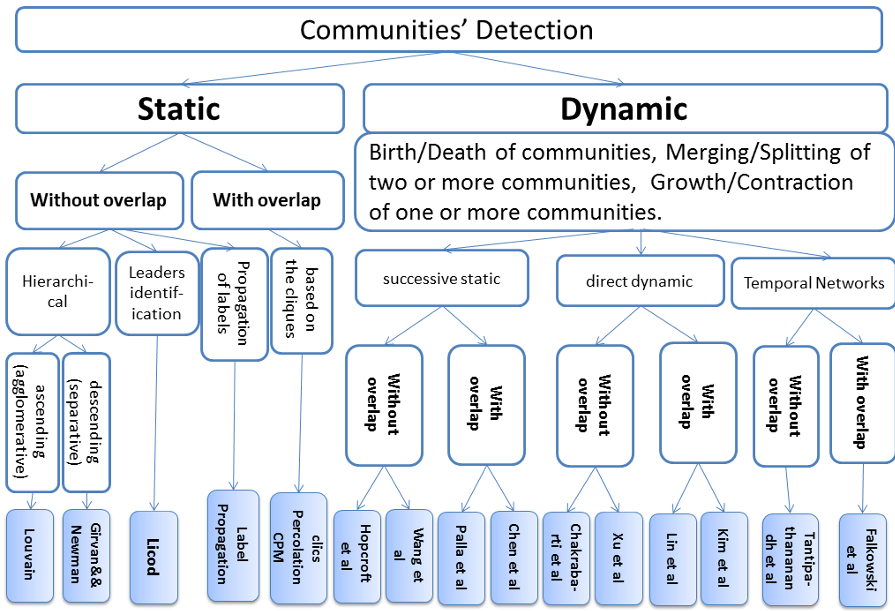
The authors categorize the research into a taxonomy that separates the nature of the graph from the algorithm's behavior.
The Stability Problem
A central insight is the critique of the Louvain Algorithm. Despite its speed, it is inherently unstable. Because it scans nodes randomly to calculate modularity gain, the resulting community structure can change every time you run the code.
- The Fix: The paper argues for deterministic tie-breaking rules and fixed evaluation orders to ensure reproducibility in production environments.
Experiments & Benchmarking
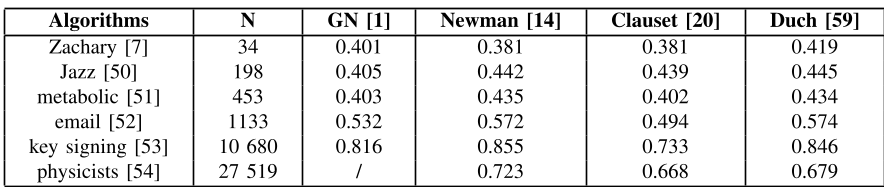
The paper compiles performance metrics across classic datasets (Zachary’s Karate Club, Jazz, Email networks).
Modularity Performance (The "Gold Standard")
Modularity () remains the primary metric. The authors show that while the Girvan-Newman () algorithm provided the foundation, newer methods like Clauset's Fast Greedy or Duch's Extremal Optimization have pushed values significantly higher, especially in large-scale networks like the "Physicists" collaboration graph.
Community Count Stability
A striking result is shown in the comparison between Louvain and LICOD. In the "Glass" dataset, Louvain detects 10 communities, whereas LICOD detects only 2. This suggests that modularity optimization often "over-segments" networks into fragments that lack sociological meaning.
Critical Analysis & Future Outlook
The paper concludes that we are moving toward Dynamic Overlapping models.
- The Takeaway: Most existing SOTA works only in a "vacuum" (static, non-oriented). Real-world data is messy—it has weights, directions, and changes by the millisecond.
- Limitations: The paper acknowledges that maximizing modularity is an NP-hard problem, meaning our best tools are still just "good enough" heuristics.
- Future Vision: The authors propose a "Third Sense" of community—a middle ground where node degrees are weighed against individual neighboring communities rather than a binary "In vs. Out" calculation. This could pave the way for more nuanced recommendation engines and cybersecurity "central actor" identification.
Conclusion
Community detection is graduating from static graph partitioning to dynamic flow analysis. For researchers, the challenge is no longer just "finding the clusters," but ensuring those clusters remain stable and meaningful as the network breathes and grows.