
Deciphering Viral Seeds: How SR-Community Structures Predict Social Influence
Community analysis of influential nodes for information diffusion on a social network
This paper investigates influential node identification for information diffusion in social networks under the Independent Cascade (IC) model. It focuses on correlating the results of the submodular Greedy algorithm with the "SR-community" structure, demonstrating that this specific topological feature reflects influence potential better than traditional probabilistic mixture models.
TL;DR
Why does certain information go viral? While the Greedy Algorithm is the gold standard for finding influential nodes in social networks, it is a "black box" regarding why specific nodes are chosen. This paper reveals that influential nodes are not randomly distributed; they are deeply embedded in SR-Community structures—tightly knit clusters that maximize link density. By analyzing large-scale blog and Wikipedia data, the authors prove that these dense structural cores are significantly more predictive of influence than traditional probabilistic community models.
The Motivation: Moving Beyond Discrete Greed
The Influence Maximization (IM) problem asks: "If you can pick people to start a trend, who should they be to reach the most people?" Under the Independent Cascade (IC) model, we know the Greedy algorithm works well, but it is incredibly slow because it requires massive Monte Carlo simulations.
The authors argue that to build faster algorithms, we must understand the topology of influence. They hypothesize that the "SR-community" (Successive Relaxation) is the missing link—a structural feature that defines the boundaries of word-of-mouth propagation.
Methodology: The Geometry of a Community
The authors define the SR-community structure () as a sequence of node sets that maximize the average number of internal links.
1. The Optimization Problem
To find these communities, they solve a relaxation problem. Instead of a discrete search, they use the Rayleigh-Ritz theorem, proving that the principal eigenvector of the network's adjacency matrix points toward the densest cluster.
2. The Algorithmic Flow
- Relaxation: Compute the principal eigenvector using power iteration.
- Quantization: Rank nodes by their eigenvector components and find the "cut-off" point that maximizes average internal degree.
- Iteration: Remove the links within the found community and repeat to find the next one.
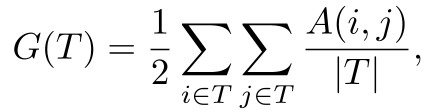 (Equation 1: The objective function representing link density within a set T)
Experimental Validation: Real-World Social Graphs
The study tested two massive datasets:
- Blog Network: A trackback network from Japanese blogs (~12k nodes).
- Wikipedia Network: Co-occurrence of people in Wikipedia articles (~9k nodes).
The authors compared their SR-community approach against the Newman-Leicht (NL) model—a popular baseline that uses expectation-maximization (EM) to find communities based on node types.
Key Finding: Stronger Correlation
Using an F-measure to compare the "Influence Set" of a node (where its message actually travels) with the community it belongs to, the results were clear: Influential nodes "belong" to their SR-communities.
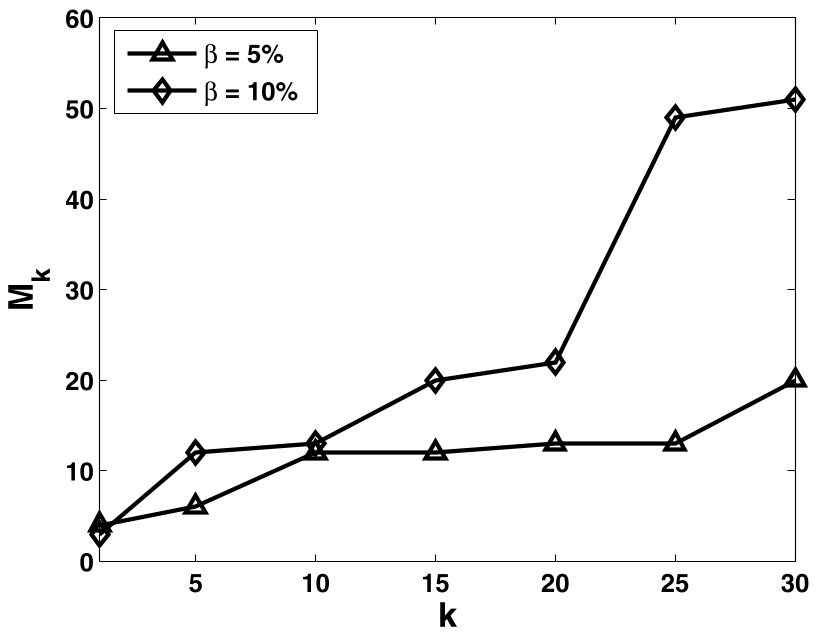 Fig 3. Strength of correlation (F-measure) on the blog network. Notice the 'SR' (circles) consistently staying above 'NL' (squares).
As shown in the figures, as the number of target seeds () increases, the SR-community structure maintains a high correlation with the greedy solution, specifically when the propagation probability () is low (common in real-world "viral marketing" scenarios).
Critical Analysis & Takeaways
Why does this work?
Traditional community detection (like NL or Modularity) often looks for "partitions." However, information diffusion is driven by density. The SR-community captures the "core" of the network where bonds are strongest, making it a natural container for a cascade. If a seed node is placed inside an SR-community, the high density ensures the message "saturates" the cluster before attempting to jump to the next one.
Limitations
- Hyperparameter Sensitivity: The study focuses on relatively small propagation probabilities (). If is very high, the network becomes a "giant component," and community boundaries matter less.
- Bidirectional Assumption: The authors treated blog trackbacks as undirected links; in reality, social influence is often highly directional.
Conclusion
This research provides a structural justification for why localized influence happens. For practitioners, it suggests a shortcut: Instead of running expensive global simulations to find influencers, look for the eigenvectors of the network density. The most influential nodes aren't just those with the most friends; they are the anchors of the network's densest structural cores.