
CAOR: Achieving Optimal Routing in Mobile Social Networks via Home-Aware Communities
Community-Aware Opportunistic Routing in Mobile Social Networks
This paper introduces the Community-Aware Opportunistic Routing (CAOR) algorithm for Mobile Social Networks (MSNs). By proposing a "home-aware community model," the authors simplify high-dimensional node mobility into a graph of community "homes" and utilize a reverse Dijkstra algorithm to achieve optimal opportunistic routing performance.
TL;DR
Mobile Social Networks (MSNs) are notoriously difficult to route due to intermittent connectivity. The Community-Aware Opportunistic Routing (CAOR) algorithm solves this by shifting the focus from individual nodes to "community homes"—frequently visited locations equipped with real or virtual buffers. By mathematically proving an optimal opportunistic routing rule and using a reverse Dijkstra approach, CAOR achieves theoretical minimum delivery delays while reducing computational overhead by orders of magnitude.
Problem & Motivation: The Trap of Local Optimality
Traditional routing in Delay Tolerant Networks (DTNs) often relies on flooding or simple probability. Recent "social-aware" algorithms like Bubble Rap or SimBet improved this by using social metrics such as centrality. However, these methods suffer from a locally optimal trap: they forward messages to nodes that look good "right now" or "locally," but don't necessarily lead to the shortest end-to-end path.
Moreover, real MSNs like campus Wi-Fi networks (e.g., the Dartmouth trace) involve thousands of nodes. Managing the contact probabilities between every pair of nodes is a scaling nightmare. The authors' insight is simple: Humans are creatures of habit. We don't meet randomly; we meet at "homes"—classrooms, offices, or coffee shops.
Methodology: The Power of Social "Homes"
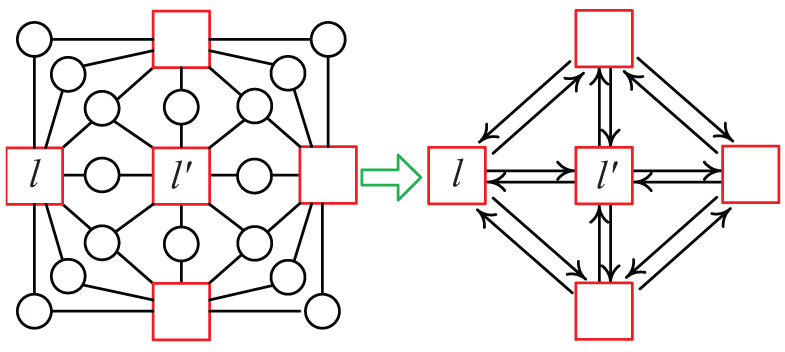
The core of CAOR is the Home-Aware Community Model. Instead of modeling a massive node-to-node graph, the paper models a community-to-community graph.
1. Simplified Network Architecture
The MSN is converted into a network of "community homes." Each home is assumed to have a Throwbox (a storage device). If a physical throwbox doesn't exist, a "virtual" one is created using the node with the highest intra-community centrality (the most frequent visitor).
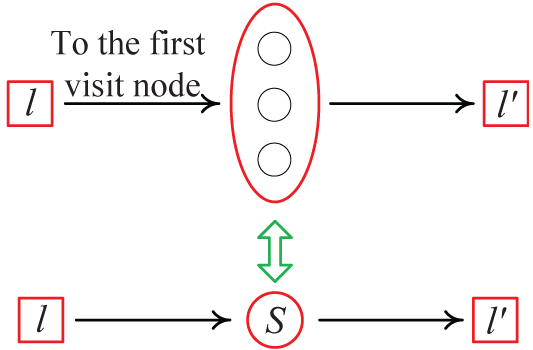
2. The Optimal Opportunistic Routing Rule
The paper derives a critical theorem: A relay should only be used by sender if its expected delay to the destination is strictly less than the sender's own delay ().
3. The Reverse Dijkstra Algorithm
To find these values, the authors use a modified Dijkstra algorithm that runs "backwards" from the destination. It iteratively calculates the minimum expected delay for each home. Since the number of communities is much smaller than the number of nodes, this calculation is lightning-fast.
Experiments: Superiority in Action
The authors tested CAOR against SimBet and Bubble Rap using the Dartmouth campus dataset (over 6,000 users).
- Delivery Ratio: CAOR maintains a consistently higher delivery ratio even as time-to-live (TTL) increases.
- Efficiency: The number of communities remains small (around 50-100) even as the number of nodes scales to 1,400, proving the scalability of the model.
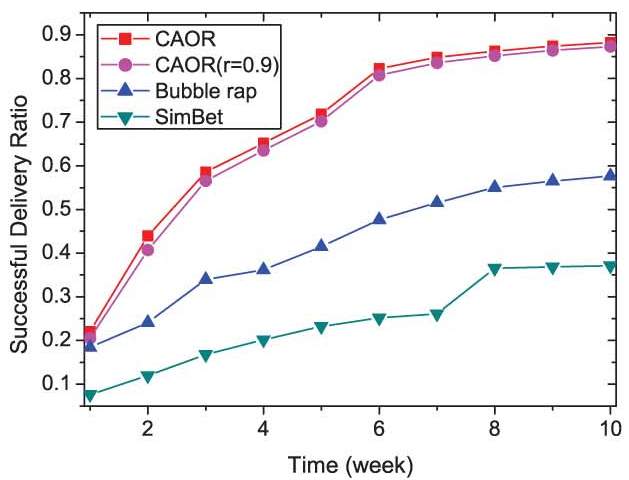
The results show that CAOR doesn't just "bubble" messages up blindly; it calculates the mathematically optimal path through the social structure.
Critical Insight & Conclusion
The brilliance of CAOR lies in its Inductive Bias: it assumes social stability. While individual node movements are chaotic, social "communities" and their preferred meeting spots ("homes") are remarkably stable over long periods.
Takeaway: By mapping a dynamic, mobile problem onto a static, structural graph, CAOR proves that we don't need to track every node to achieve optimal routing. This has massive implications for future low-power IoT and D2D networks where maintaining massive routing tables is impossible.
Limitations: The model assumes Poisson arrival processes at homes. In reality, human schedules are often non-Poisson (bursty). Future work could explore how periodic or bursty schedules affect the "optimality" of the reverse Dijkstra approach.