
Scaling Multiagent Systems: A Community-Aware Approach to Task Allocation
Community-Aware Task Allocation for Social Networked Multiagent Systems
This paper introduces a novel community-aware task allocation model for Social Networked Multiagent Systems (SN-MASs). It proposes an efficient heuristic algorithm to maximize system profit and minimize communication costs by constraining agent negotiations within their social communities.
TL;DR
As Social Networked Multiagent Systems (SN-MASs) grow in scale, traditional task allocation methods face a "complexity wall." This paper breaks that wall by introducing a Community-Aware Task Allocation Model. By shifting from global negotiation to community-constrained interaction, the proposed heuristic achieves near-optimal results with a staggering 100,000x reduction in runtime compared to standard greedy algorithms.
Background & Motivation: Why Communities Matter
In a typical SN-MAS, agents aren't just isolated nodes; they are clustered into communities—groups with dense internal connections and sparse external ones (think of departments in a university or regional branches of a shipping company).
Prior works generally fell into two traps:
- Global-Aware Models: Every agent can theoretically talk to every other agent. This is computationally expensive (-hard) and creates a communication nightmare.
- Local Neighbor-Aware Models: Agents only talk to direct neighbors. While fast, this ignores the richness of community resources, often leaving complex tasks unfulfilled.
The authors' core insight is that community boundaries represent the natural limit of efficient cooperation.
Methodology: The Three-Phase Heuristic
The paper formalizes the problem as one of maximizing "Social Welfare" (total task payments) under resource and community constraints. Since the problem is proven to be -hard via a reduction to 3-SAT, the authors propose a clever three-phase heuristic.
1. Task Selection (Significance Ranking)
Tasks are not created equal. The algorithm ranks them using a Significance () metric:
- Profitability (): Payment divided by resource requirements.
- Fitness: A measure of how well the community's available resources match the task's needs.
2. Community Allocation
If a task is initiated within a community, the system first attempts to satisfy it using redundant resources without jeopardizing other local tasks.
3. Agent-Level Negotiation (NAF & BF)
To minimize communication, the model uses:
- Nonoverlap Agent-First (NAF): Prioritizes agents that belong to only one community to keep overlapping agents free for cross-community coordination.
- Breadth-First (BF) Search: Initiators negotiate with nearby agents first to keep "social distance" (and thus communication cost) low.
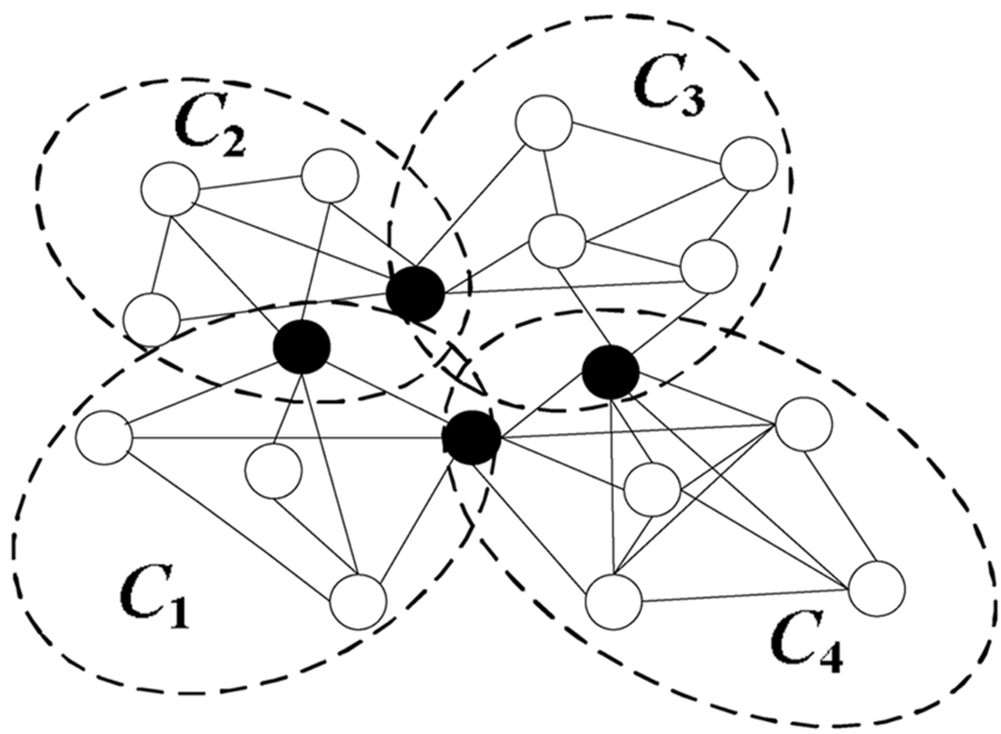 Figure 1: Illustration of agents embedded in overlapping community structures.
Experiments & Results
The authors tested their model against a Global Greedy approach and an Optimal Brute-Force algorithm using both synthetic and real-world datasets (a scientist co-authorship network).
Performance vs. Efficiency
The results are impressive. In a large-scale scenario with 500 tasks:
- Social Welfare: The Heuristic achieved 99.53% of the welfare generated by the Greedy algorithm.
- Computational Load: The Greedy algorithm took 7,642 seconds, while the Heuristic finished in just 0.066 seconds.
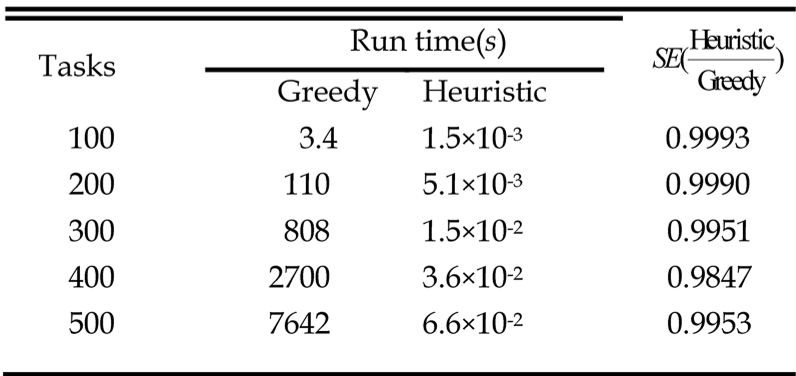 Table 1: Scalability comparison showing the massive speedup of the Heuristic.
Communication Costs
By restricting negotiation to communities, the model drastically reduces the "distance" messages travel, outperforming Global-Aware models consistently as the network degree increases.
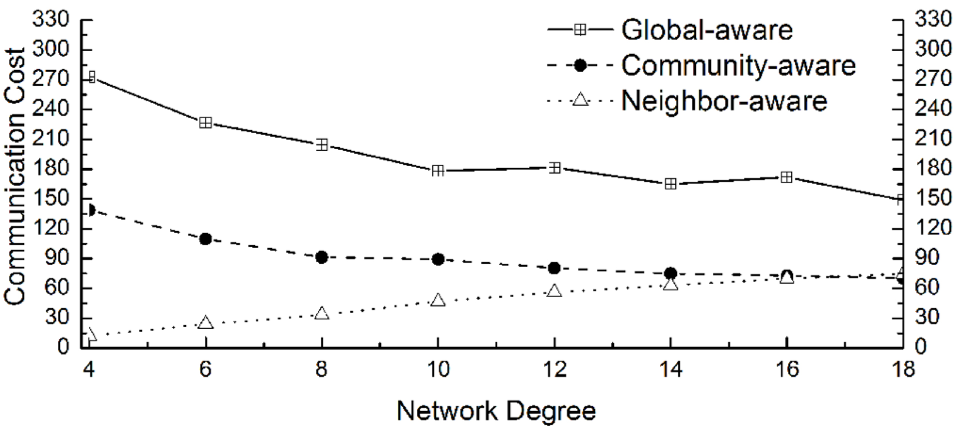 Figure 2: Community-aware allocation maintains low communication overhead compared to global methods.
Critical Insight & Future Outlook
This work highlights a fundamental truth in distributed AI: Constraints are a feature, not a bug. By "limiting" an agent's world to its community, we can solve global problems much faster.
Limitations: The current model assumes agents are "altruistic" (collaborate whenever possible). In real-world economics, agents are selfish. The next frontier for this research involves integrating Game Theory to account for agents that might hide resources to maximize their own utility. Additionally, as communities are often dynamic, adapting these heuristics to evolving graphs is an open challenge.
Conclusion
The Community-Aware Task Allocation model provides a scalable, efficient, and robust framework for managing complex tasks in massive networks. It proves that we don't need global knowledge to achieve near-global optimality.