
Elevating Academic Social Networks: Leveraging Virtual Communities for Smarter Collaboration
Community Awareness in Academic Social Networks
The paper proposes an innovative system architecture centered on "Community Awareness" to enhance Academic Social Networks (ASNs). It introduces a framework that leverages Virtual Communities (VCs) and Machine Learning to provide personalized researcher collaboration recommendations and conference suggestions.
TL;DR
Current academic platforms act more like repositories than active social networks. This paper introduces a specialized system architecture that uses Virtual Communities (VCs) and Machine Learning Engines (MLE) to transform how researchers find collaborators and relevant events, moving beyond static profiles to dynamic, interest-based networking.
The Motivation: Why Academic Networks are "Stuck"
While we see sophisticated recommendation algorithms on LinkedIn or Facebook, Academic Social Networks (ASNs) like ResearchGate or Mendeley remain relatively fragmented. The core difficulty lies in the domain complexity: research interests shift, affiliations change, and identifying a "perfect" co-author requires more than just matching keywords—it requires understanding the researcher’s active community and future trajectory (e.g., upcoming conference attendance).
Methodology: The Community-Aware Framework
The authors move away from simple search-and-retrieval. Instead, they propose a multi-layered architecture designed to foster "Community Awareness."
1. Unified Profiling and Event Tracking
The system aggregates data from two primary channels:
- Researcher Options: Not just publications, but past collaborations and historical affiliations.
- Conferences and Events: Real-time tracking of technical committees, dates, and research areas to predict where the "active" nodes of a community will be in the near future.
2. The Machine Learning Engine (MLE) Training
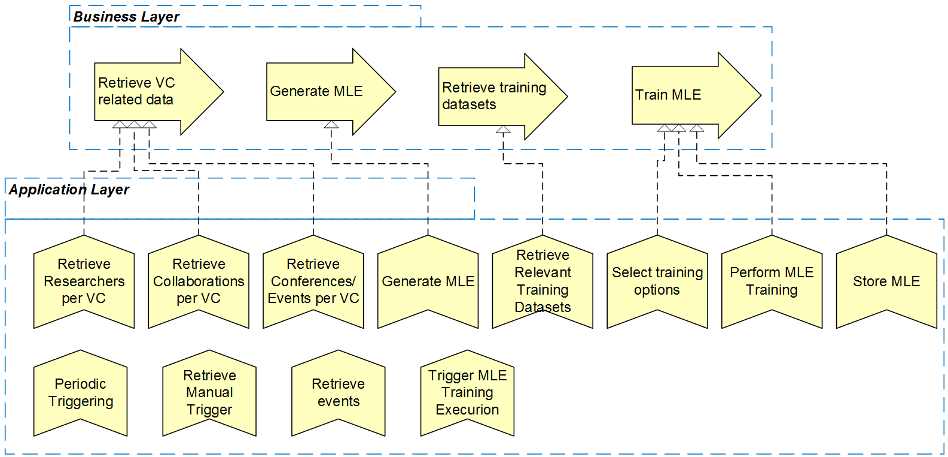
Central to this architecture is a dedicated MLE training scheduler. It doesn't just look at global data; it looks at Collaborations per VC. By training on specific sub-communities, the engine learns the unique "language" and collaborative patterns of different scientific fields.

Core Components: Architecture in Action
The architecture is mapped using the ArchiMate® standard, ensuring a clear distinction between the business logic (finding a partner) and the application functions (retrieving DBLP data/executing MLE training).
- VC Suggestions Service: Acts as a matchmaker by estimating which Virtual Communities a user should join based on their current trajectory.
- Collaborations Recommender: The final output layer that generates a ranked list of researchers for potential joint ventures.
Critical Analysis & Future Outlook
The strength of this work lies in its structural clarity. By defining specific services for "MLE Training" vs. "VC Suggestions," the authors provide a blueprint that is agnostic to the specific ML algorithm used (e.g., one could swap a Random Forest with a Transformer-based model without changing the architecture).
Limitations/Future Work:
- Cold Start Problem: The paper relies heavily on existing collaboration data; new researchers may struggle to get accurate VC suggestions initially.
- Real-world Testing: The next logical step, as noted by the authors, is the full-scale implementation to validate if these community-aware suggestions actually result in higher-quality academic outputs.
Conclusion
By treating academia not as a collection of papers, but as a dynamic organism of Virtual Communities, this architecture paves the way for a more connected and pervasive research ecosystem.