
APM: Precision Marketing via Community-Based Acceptance Maximization
Community-Based Acceptance Probability Maximization for Target Users on Social Networks
The paper introduces the Acceptance Probability Maximization (APM) problem, which aims to select an optimal seed set to maximize the total activation probability of a specific set of target users. Under the Independent Cascade (IC) model, the authors propose a Pipage Rounding Algorithm (PRA) that leverages social network community structures to achieve a (1 - 1/e) approximation ratio.
TL;DR
In the world of viral marketing, not all users are created equal. This paper tackles the Acceptance Probability Maximization (APM) problem—selecting a limited seed set to ensure "VIP" or target users adopt a product. By shifting the focus from global reach to local community structures and employing a Pipage Rounding Algorithm, the researchers achieved a (1 - 1/e) approximation ratio, significantly outperforming traditional greedy approaches in both speed and accuracy.
Problem & Motivation: The "Target User" Dilemma
Conventional Influence Maximization (IM) research typically tries to maximize the total number of influenced nodes. However, for companies targeting high-value individuals (industry experts, specific demographics), global influence is the wrong metric.
The authors identify two fatal flaws in intuitive seed selection:
- Distance Decay: Global "super-spreaders" might be too far from your target users to be relevant.
- Budget Constraints: You cannot simply pick all immediate neighbors of target users as seeds if your budget is small.
The technical heart of the challenge lies in the fact that calculating the exact acceptance probability for a set of targets is #P-hard, making standard exact solutions impossible for large-scale social networks.
Methodology: From Communities to Hitting Sets
The researchers' core insight is that social influence is often "trapped" or concentrated within communities. To solve APM, they followed a sophisticated transformation pipeline:
1. MAPT Construction
Instead of calculating influence across the whole graph, they build Maximum Acceptance Probability Trees (MAPT) for each target user within their respective communities. This uses a threshold to prune low-probability paths, simplifying the complex graph into a tree of "Maximum Influence Paths" (MIP).
2. The MWHS Transformation
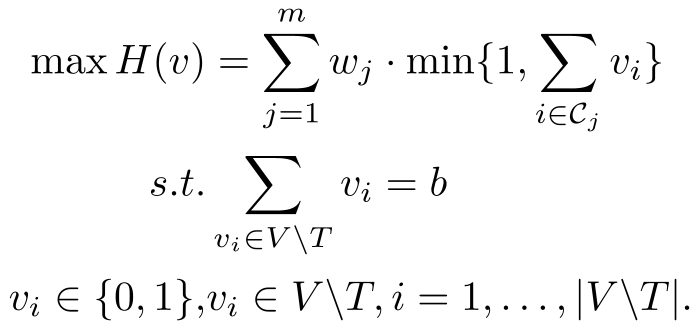
By viewing seed selection as a way to "hit" influential paths within a community, they transform APM into a Maximum Weight Hitting Set (MWHS) problem.
3. Pipage Rounding Algorithm (PRA)
Since the resulting objective function is submodular and monotone, they solve a relaxed version (allowing fractional seeds) and then use "Pipage Rounding." This technique iteratively shifts weights between fractional components until an integer solution is reached without decreasing the objective value.
Experiments & Results
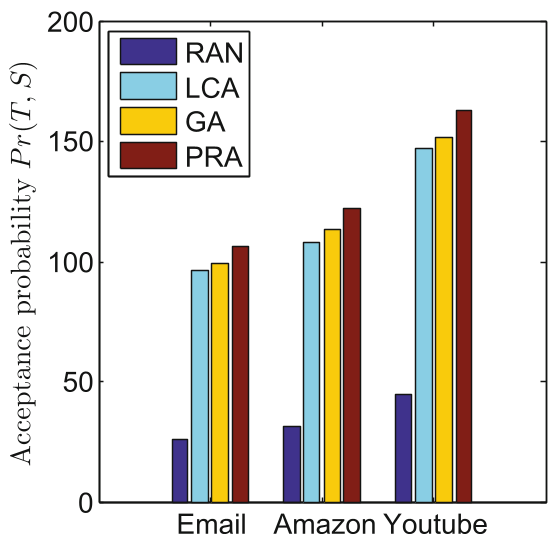
The authors validated PRA on datasets ranging from the small E-mail (1K nodes) to the massive Youtube (1.1M nodes).
Performance Gains
PRA consistently yielded higher acceptance probabilities than the standard Greedy Algorithm (GA) and Local Cascade Algorithm (LCA). As shown in the comparison, PRA provides an 8% to 13% boost over GA, which is often considered the "gold standard" for submodular optimization.
The Law of Diminishing Returns
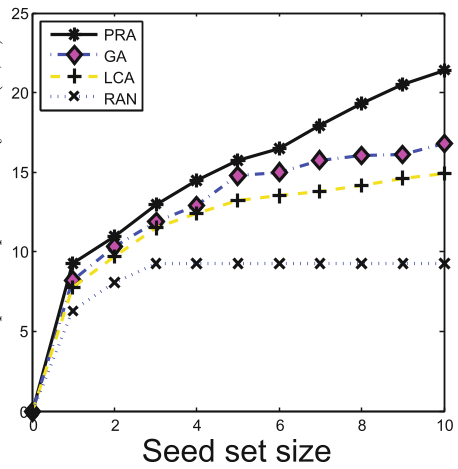
The study confirmed that acceptance probability follows the submodularity property—the first few seeds provide the most significant boost, with marginal gains decreasing as the seed set grows.
Critical Insight & Conclusion
The true value of this work is the realization that Local is the new Global. By restricting the computation of maximum influence paths to communities, the authors bypassed the computational nightmare of global probability estimation without sacrificing the quality of the result.
Limitations: The model assumes that influence scales independently within communities. In reality, cross-community edges might provide "weak ties" that enhance influence. Future research could integrate these inter-community dynamics into the PRA framework to further refine the probability estimation.
Industry Takeaway: For targeted advertising, don't waste budget on global celebrities; find the "local heroes" within the specific community clusters where your target customers reside.