
ConSVD: Leveraging Community Conformity to Solve the Social Recommendation Puzzle
A Community-Based Collaborative Filtering Method for Social Recommender Systems
The paper introduces ConSVD, a social recommendation framework that leverages overlapping community structures to enhance collaborative filtering. By integrating community-level preferences directly into the latent factor prediction rule, it achieves state-of-the-art accuracy on multiple real-world datasets.
TL;DR
Researchers have developed ConSVD, a novel recommendation framework that moves beyond simple user-to-user social links. By identifying overlapping communities and integrating "community preferences" directly into the rating prediction formula, ConSVD significantly improves accuracy and mitigates the data sparsity issue that plagues traditional collaborative filtering.
The "Friendship" Fallacy in Social Recommendation
In the world of social recommender systems, the prevailing logic has often been: "If User A is friends with User B, they must like the same things."
However, human behavior is more nuanced. As the authors illustrate, you might have a friend you discuss politics with (Community A) and another you play sports with (Community B). Your preference for a "War Movie" might stem from your military history community, while your friend—despite being connected to you—belongs to a "Romantic Drama" circle.
The Problem: Most prior works (like SoReg or SoDimRec) either treat social groups as flat regularizers or ignore the fact that users belong to multiple, overlapping groups. This leads to models that are too rigid or fail to capture the "conformity pressure" we feel within specific social contexts.
Methodology: From Individual Interests to Community Conformity
The core innovation of ConSVD lies in its two-stage architecture that mimics social psychology's "Conformity Theory."
1. Detecting Overlapping Social Circles
The framework first employs BigCLAM, an overlapping community detection algorithm. Unlike k-means which forces a user into one bucket, BigCLAM allows a user to have a "propensity" for multiple communities.
2. The ConSVD Prediction Rule
Instead of just using a latent vector for a user, the authors redefine the user representation by adding a community influence component. The prediction is calculated as:
- : The user’s inherent, independent interest.
- : The aggregate preference of community .
- : How much the user conforms to that specific community’s taste.
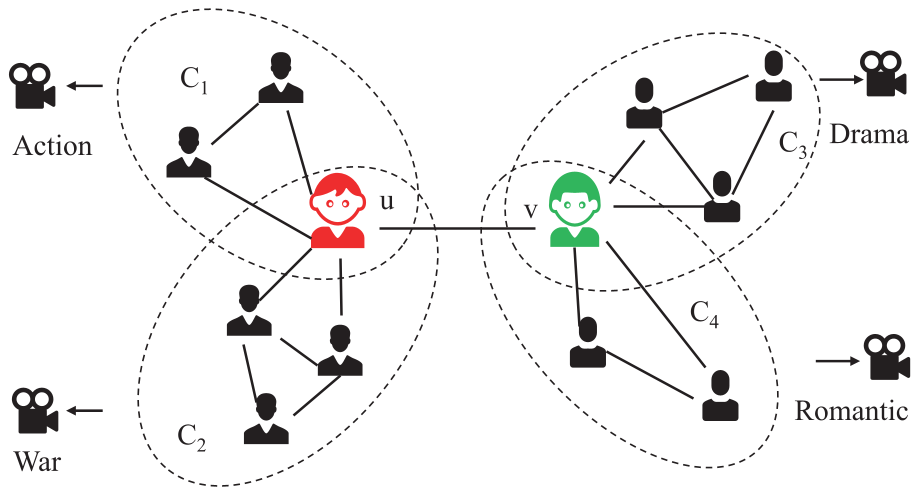 Figure 1: Users u and v are friends, but their community memberships (e.g., Action vs. Drama) define their individual ratings more accurately than their direct link.
Experimental Results: SOTA Performance and Robustness
The authors tested ConSVD against a massive lineup of baselines including TrustSVD and SoDimRec across four major datasets.
Key Breakthroughs:
- Superior Accuracy: In the "All" view (general recommendation), ConSVD achieved the lowest RMSE and MAE in almost every category.
- Cold Start Excellence: For users with fewer than five ratings—the most difficult scenario for AI—ConSVD provided significantly better "guesses" by relying on the community's known preferences.
- Stability: Unlike TrustSVD, which often overfits as the number of latent factors () increases, ConSVD remains stable. This is because community preferences act as a specialized form of "parameter pruning"—the model learns fewer, more meaningful community vectors instead of millions of noisy user-friend interactions.
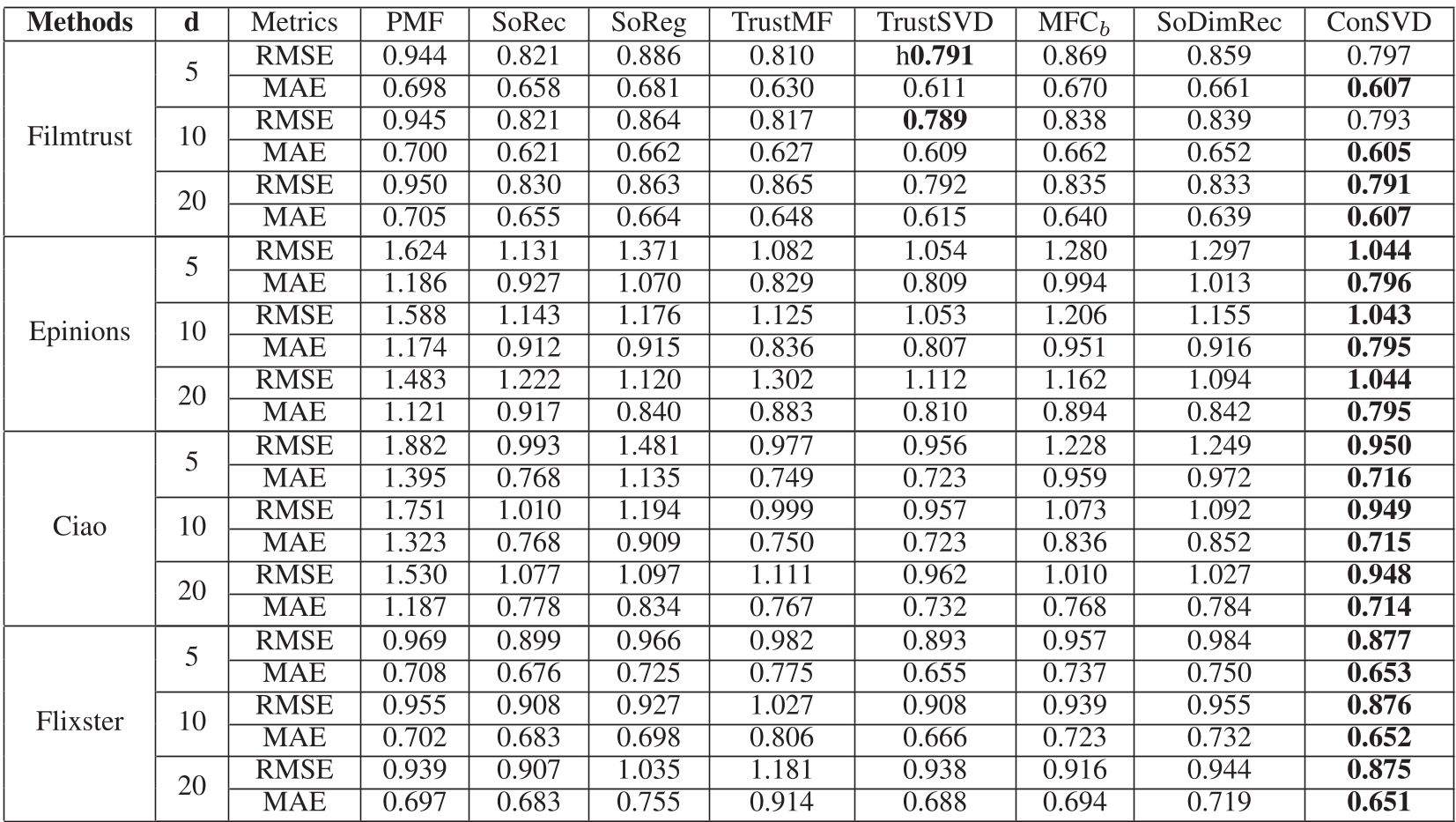 Table: Performance comparison across Filmtrust, Epinions, Ciao, and Flixster. Note ConSVD's consistent lead in Epinions and Flixster.
Critical Insight: Why This Matters
The fundamental "Aha!" moment in this paper is the shift from Local Social Links (individual friends) to Global Community Patterns.
By treating a community as a "latent factor bridge," ConSVD reduces the noise inherent in social networks. People choose their friends for many reasons, but they follow their communities for specific tastes. By modeling this "conformity," the researchers have provided a more mathematically sound and psychologically accurate way to fix the sparsity of user-item ratings.
Conclusion
ConSVD proves that in social recommendation, the "group" is often more informative than the "individual friend." Moving forward, this work opens the door for even more complex group dynamics, such as temporal community shifts where a user's conformity to a group changes over time.
Takeaway for Practitioners: When building social features for your product, look for clusters and communities rather than just 1-to-1 follow links; the "wisdom of the crowd" within a specific sub-culture is your best weapon against data sparsity.