
Engaging the Silent Majority: Why the Best Influencers for Lurkers Live Next Door
Community-based delurking in social networks
The paper introduces a community-based analysis framework for "delurking" in social networks, utilizing the DEvOTION algorithm for Targeted Influence Maximization (TIM). It characterizes lurkers—silent users who consume but do not produce content—within a community structure to identify the most effective influencers to engage them.
TL;DR
Lurkers—users who watch, read, and listen without ever posting—make up the vast majority of online social networks. This paper explores the "delurking" process: turning these silent observers into active contributors. By analyzing community structures in GooglePlus and Instagram, the authors discovered a counter-intuitive truth: the best people to pull a lurker out of their shell aren't their close community peers, but "bridge" users from adjacent communities.
The Problem: The Hidden Value of Lurkers
In almost every social platform, there is a massive "participation inequality." While a few "super contributors" drive the content, the "silent crowd" possesses significant untapped social capital. They acquire knowledge and form opinions but rarely share them.
The challenge isn't just knowing who the lurkers are (algorithms like LurkerRank already do that), but understanding their social topography. If you want to encourage a lurker to post, who should send the message? A friend in their clique? Or someone from the "outside"?
Methodology: Boundary Spanning and DEvOTION
The researchers combined Boundary Spanning Theory with a Targeted Influence Maximization (TIM) algorithm called DEvOTION.
- Community Detection: They used the Infomap algorithm to segment networks into communities based on information flow.
- Defining Bridges: They identified "in-bridge" nodes (users who receive info from other communities) and "out-bridge" nodes (users who push info out).
- Expansion Workflows: They tested four ways to find influencers:
- WF1 (Internal Only): Searching only within the lurker's community.
- WF2 & WF3 (Weakly/Tightly-knit): Including adjacent communities linked by bridges.
- WF4 (Recursive): Including a broader multi-hop neighborhood of communities.
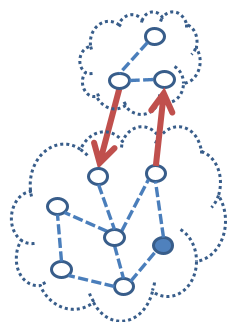 Figure: Visualizing the expansion from a target's core community to adjacent weakly-knit and tightly-knit clusters.
Key Insights: Lurkers as Information Sinks
The study's first major finding is that lurkers are professional "In-Bridges." Across all datasets (Instagram, FriendFeed, GooglePlus), over 85% of top-ranked lurkers acted as in-bridge nodes. This confirms the "Boundary Spanning" intuition: lurkers aren't just sitting in a corner; they are actively absorbing information from diverse sources outside their immediate social circle, but they lack the "out-bridge" connections to pass that info along.
Results: The Power of the "Adjacent" Seed
When the authors ran the DEvOTION algorithm to find the best "seeds" (influencers) to activate these lurkers, the results were a blowout for external influences.
- Seed Overlap: There was a massive difference between seeds found within a community (WF1) and those found through expansion (WF2/WF4).
- Delurking Capital: The total "lurking score" activated (Delurking Capital) was significantly higher when seeds were chosen from adjacent communities.
- Activation Probability: Using external seeds significantly increased the probability that a lurker would actually be "activated" into participation.
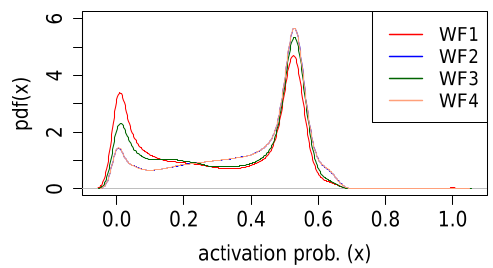 Figure: Comparison of workflows showing that expanding the search to external communities (WF2, WF4) yields much higher engagement (Delurking Capital) than staying internal (WF1).
Critical Analysis & Conclusion
Why does this work?
In social science, there is a concept called "The Strength of Weak Ties." Lurkers are already specialized in receiving information from outside. Therefore, an influencer who "spans the boundary" from an adjacent community likely carries more Novelty or Authority to the lurker than a peer within their own "echo chamber."
Limitations
- The "Nudge" Definition: The paper focuses on the topological path of influence. It doesn't account for the content of the message (e.g., does a reward work better than a welcome statement?).
- Computational Cost: Global community detection on massive networks is expensive, though the authors suggest local community detection as a future fix.
Takeaway for Platform Designers
If you want to increase engagement, don't just show users more of what their current friends are doing. Identify the "bridges" in adjacent clusters—these are the users who have the natural topological leverage to turn a silent observer into an active participant.
The future of social growth isn't just and "inner circle" task; it’s a boundary-spanning one.