
CDMS: Accelerating Information Diffusion in Mobile Social Networks via Spectral Mobility Clustering
Community-based diffusion scheme using Markov chain and spectral clustering for mobile social networks
This paper introduces CDMS (Community-based Diffusion scheme using Markov chain and Spectral clustering), a novel framework for identifying the top-k influential nodes to minimize information diffusion time in Mobile Social Networks (MSNs). By combining Markov-based mobility prediction with spectral clustering, the method achieves superior spreading efficiency compared to non-community-based approaches.
TL;DR
To solve the "diffusion minimization problem" in Mobile Social Networks (MSNs), researchers have developed CDMS. This scheme uses Markov Chains to predict human mobility patterns and Spectral Clustering to group users into communities. By picking influential seeds within these communities rather than across the whole network, CDMS significantly cuts down the time required for information to reach every node.
Background: The Challenge of Human Mobility
In the era of tablets and smartwatches, MSNs function as Delay Tolerant Networks (DTNs) where messages are "stored, carried, and forwarded." Traditional "Influence Maximization" in online social networks (like Facebook) doesn't work here because the topology changes every second as people move.
The core problem is finding the top-k influential nodes that can spread a message to the entire network in the shortest time possible. Mathematically, this is an asymmetric k-center problem—it's NP-hard and typically ignored the fact that humans are "creatures of habit" who move between regular spots like home and the office.
Methodology: From Movement to Math
The CDMS framework operates in three sophisticated stages:
1. Markovian Mobility Prediction
Instead of just looking at who a node bumps into, CDMS analyzes where a node goes. It partitions the map into sections (Spots) and builds a Transition Probability Matrix .
- The Intuition: If we know the probability of a user moving from Spot A to Spot B, we can calculate their Steady-State Vector. This vector represents the long-term probability distribution of where that user will be at any given time.
2. Spectral Clustering for Community Detection
High-dimensional mobility data is notoriously difficult for traditional algorithms like K-Means. CDMS employs Spectral Clustering, which uses the eigenvalues of a Laplacian matrix derived from a similarity graph.
- Architecture Insight: This allows the system to find clusters of users who share similar geographic "regularities" even if they don't meet frequently.
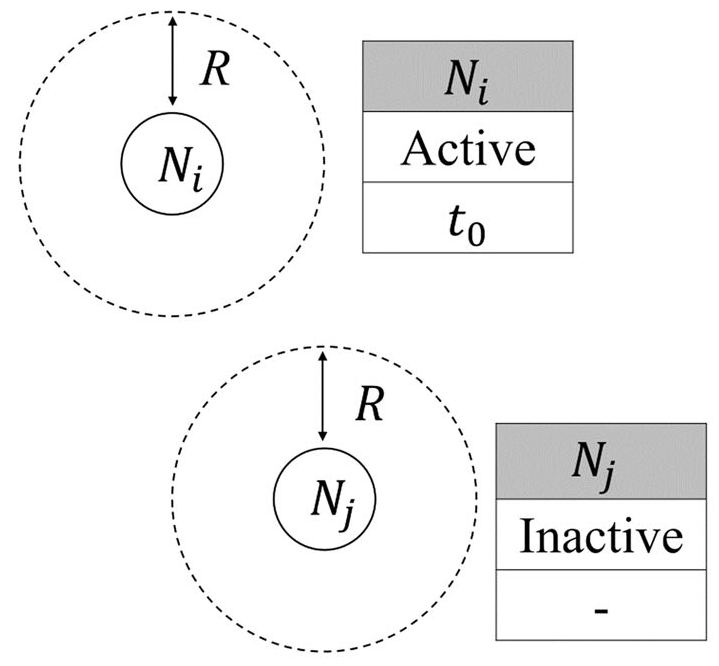 Figure: The process of partitioning the network into sections (Spots) to track geographic regularity.
3. Seed Selection
In each detected community, the node whose steady-state vector is closest to the community's centroid (via Euclidean distance) is chosen as a seed. These nodes are the "anchors" of their respective geographic communities.
Experiments & Results
The researchers tested CDMS against three baselines: RAND (random), K-CENTER (graph-based), and CDMK (K-Means based).
- Effect of Density: In sparse networks (where nodes are far apart), community-based schemes like CDMS showed a massive advantage. They were able to find "critical nodes" in isolated clusters that global algorithms missed.
- Performance Gain: CDMS outperformed K-CENTER by roughly 10% in diffusion speed as the number of nodes increased from 40 to 90.
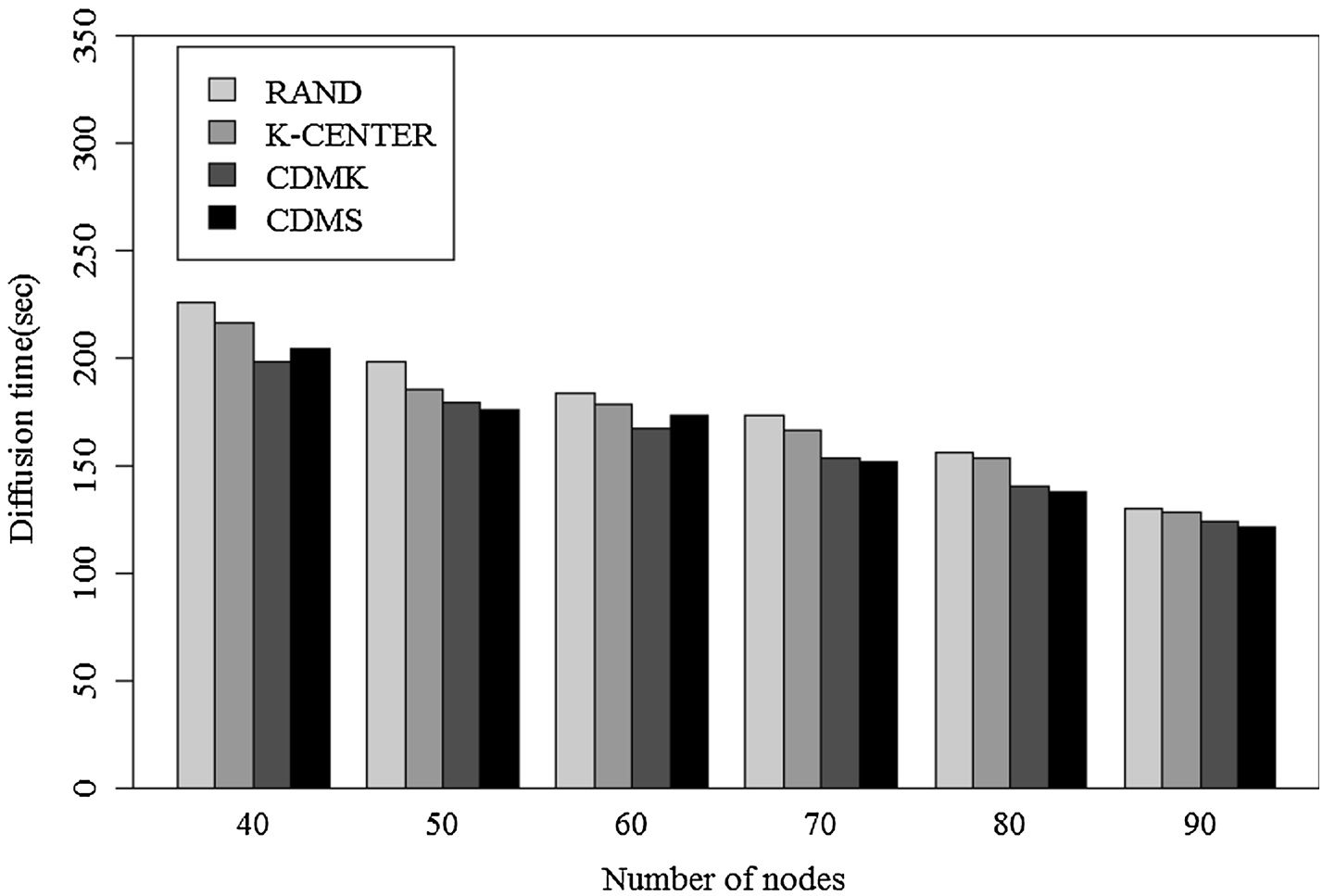 Figure: Comparison of diffusion times across different node counts. CDMS consistently maintains lower total time.
Critical Analysis & Takeaways
The brilliance of CDMS lies in its shift from topological influence (who you know) to geographic influence (where you go). By recognizing that human mobility is regular, the authors transformed a chaotic networking problem into a predictable clustering problem.
Limitations:
- The model relies on a Central Server (CS) during a "warm-up" period to collect logs, which might raise privacy concerns or practical deployment hurdles in fully decentralized scenarios.
- It assumes nodes have enough memory to store and carry messages until the next contact.
Future Outlook: This work sets the stage for integrating more complex social features—like time-of-day dependencies or hierarchical social relationships—into spectral clustering frameworks for even more precise message targeting.