
CTIM: Revolutionizing Viral Marketing through Topic-Aware Community Diffusion
Community-based influence maximization for viral marketing
The paper introduces Community-based Topic-aware Influence Maximization (CTIM), a framework for viral marketing that integrates community detection and topic modeling into influence diffusion. It achieves state-of-the-art performance by selecting seed nodes through a divide-and-conquer strategy that accounts for both latent topics and community structures.
TL;DR
The paper "Community-based influence maximization for viral marketing" introduces CTIM, a method that solves the Influence Maximization (IM) problem by looking through the dual lenses of Community Structure and Topic Relevance. By moving away from individual-level modeling to a community-level latent variable approach, the authors achieve superior influence spread with computational efficiency that is orders of magnitude faster than traditional greedy algorithms.
Problem & Motivation: The Scalability-Sparsity Trap
Influence Maximization—selecting users to maximize information spread—is NP-hard. Early solutions relied on Monte Carlo simulations, which are computationally prohibitive for modern social networks. While community-based methods emerged to improve speed, they suffered from three fatal flaws:
- Two-Stage Disconnect: Performing community detection and seed selection independently adds overhead and ignores the "influence" signals inherent in community formation.
- Topic Blindness: Traditional models often treat every item (e.g., a burger vs. a Ferrari) as having the same diffusion probability across the same link.
- Data Sparsity: Individual user behavior is volatile. Individual-to-individual influence is often hard to observe or predict accurately with sparse logs.
The authors' insight is that users interact as members of communities. By modeling influence at the community level, we can alleviate data sparsity (averaging behavior) and drastically reduce the complexity of the "search" for seed nodes.
Methodology: The Latent Variable Bridge
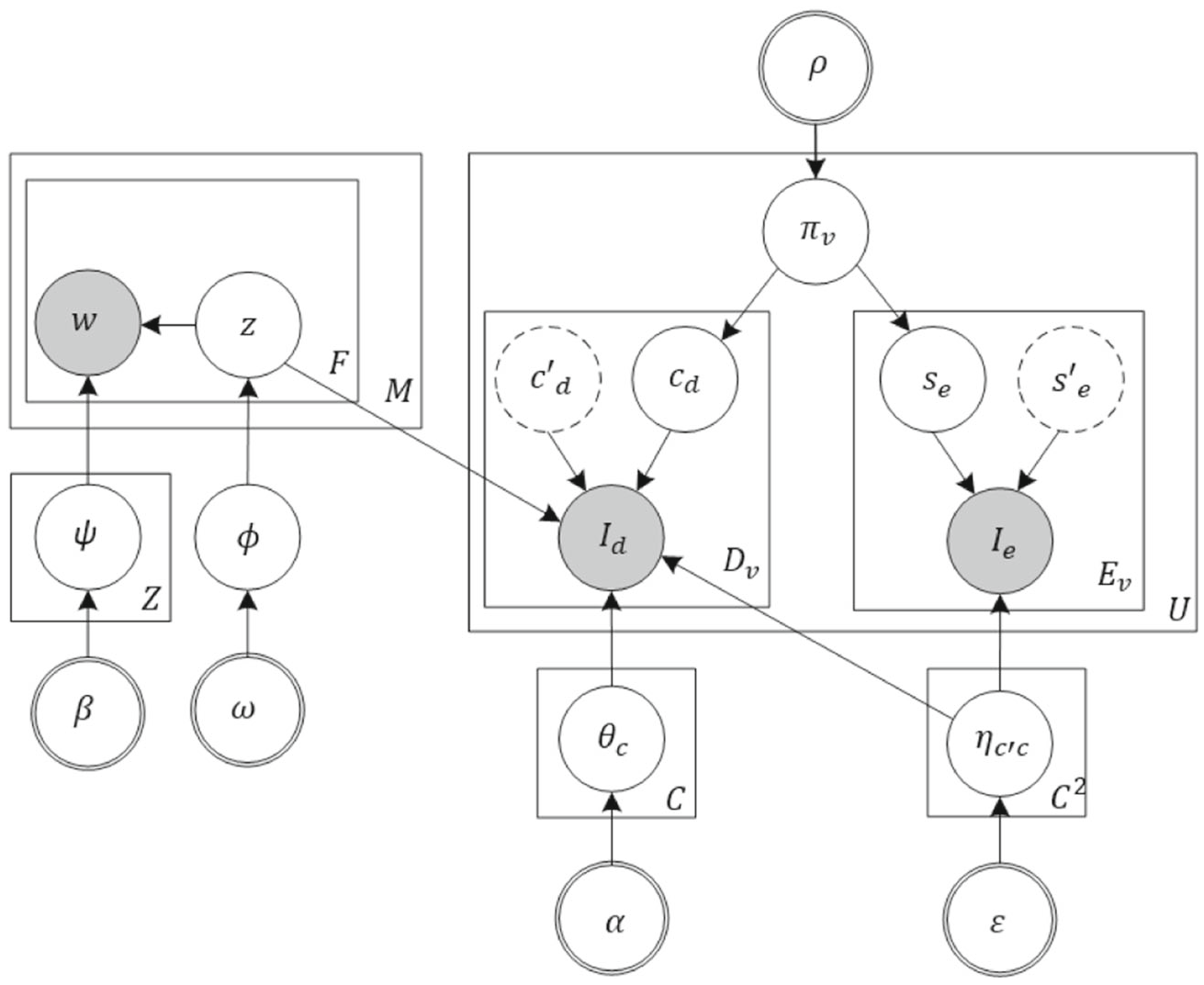
The core of the paper is a Comprehensive Latent Variable Model. Instead of just looking at who follows whom, it looks at why they buy.
1. The Generative Process
The model generates three things simultaneously: Item Attributes, User Edges, and Potential-Influence Logs.
- Communities (): Users belong to communities with a multinomial distribution .
- Topics (): Items are represented as topic distributions.
- Influence Strength (): Influence isn't just a number on an edge; it's a function of the source community, the target community's interest in a topic (), and the item's topic relevance.
2. Divide and Conquer Seed Selection
Once the parameters () are learned via Collapsed Gibbs Sampling, the algorithm identifies influential nodes. Instead of searching the whole graph, it uses a heuristic:
- It determines how many seeds should come from which community using dynamic programming.
- It uses the Maximum Influence Arborescence (MIA) model to approximate spread within those communities, ensuring the algorithm scales to millions of nodes.
Experiments & Results: Speed and Accuracy
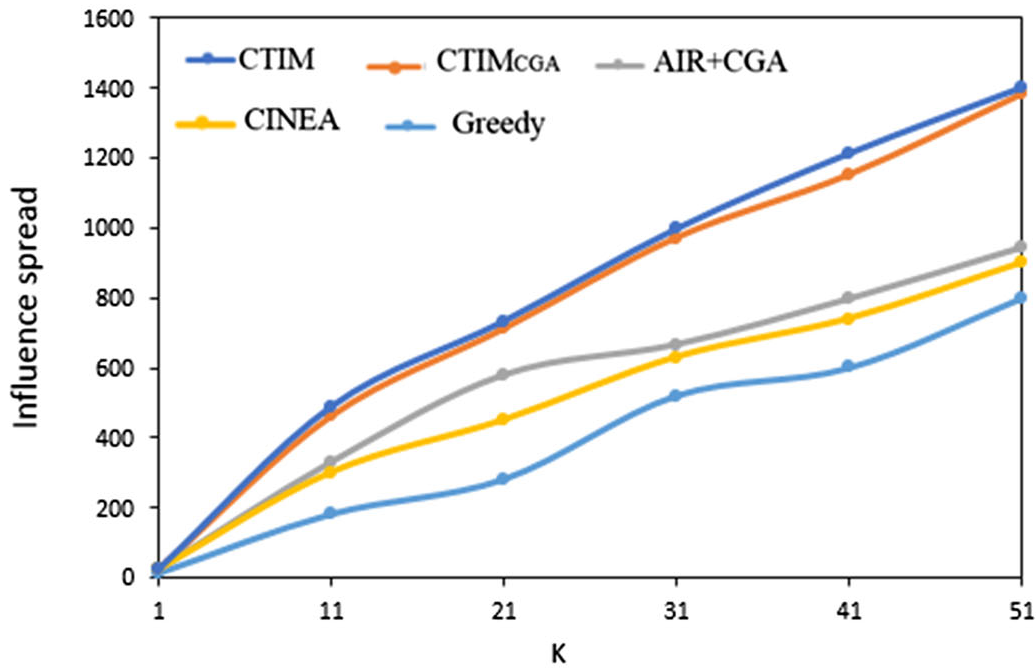
The authors tested CTIM against the standard Greedy algorithm, CINEMA, and topic-aware hybrids.
High Precision Spread
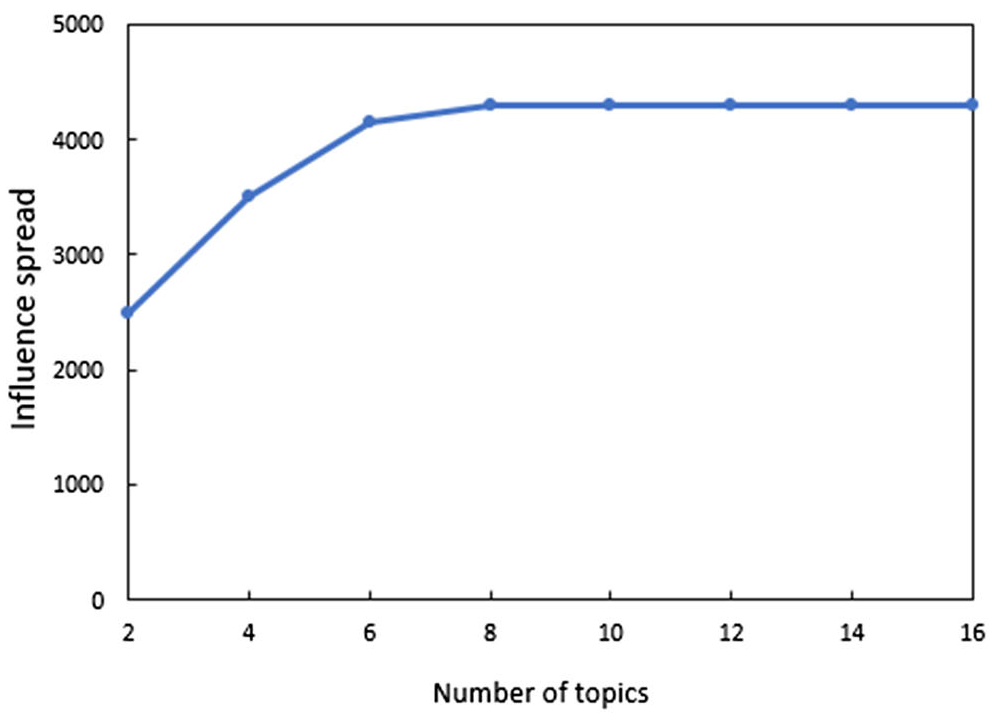
CTIM consistently achieved higher influence spread than baseline models on the Yelp and Digg datasets. The topic-aware nature allows it to pick "experts" in specific niches (e.g., foodies for a restaurant) rather than just "globally popular" nodes.
Extreme Efficiency
The most striking result is the running time. CTIM is orders of magnitude faster than Greedy and significantly faster than other community-based methods. This is because community detection is a byproduct of the latent variable training, not a separate, heavy pre-processing step.
Critical Analysis & Conclusion
Takeaway
CTIM proves that "Topic + Community" is the winning formula for Influence Maximization. By extracting "community-level topic interest," the model captures a stable preference signal that individual-level models miss.
Limitations & Future Work
- Static vs. Dynamic: The current model treats the network as a static snapshot. In reality, community memberships and topic trends evolve.
- Model Assumption: The reliance on the Maximum Influence Arborescence (MIA) assumes that influence primarily flows through "local" high-probability paths, which might miss "strength of weak ties" effects in some diffusion scenarios.
Overall, this work provides a robust blueprint for production-grade viral marketing systems where both speed and topic-relevance are non-negotiable.