
SN Algorithm: Leveraging Community Structure and Herd Influence for Large-Scale Link Prediction
Community-Based Link Prediction in Social Networks
This paper introduces a novel link prediction framework that integrates community information with a "Similar to the Neighbors" (SN) algorithm inspired by the social herd phenomenon. Evaluated on large-scale datasets like YouTube and Sina, the method focuses on leveraging neighbor influence to recover links that traditional similarity metrics often miss.
TL;DR
Predicting missing interactions in massive social networks like Twitter or YouTube is a "needle in a haystack" problem. This paper proposes the Similar to the Neighbors (SN) algorithm, which mimics the real-world herd phenomenon—the tendency of individuals to follow influential neighbors. By combining this social intuition with community detection, the authors achieve superior accuracy and efficiency on million-node datasets.
Problem & Motivation: The Local Information Trap
Most link prediction algorithms are based on the Common Neighbors (CN) logic: if Alice and Bob share many friends, they are likely to become friends. However, this logic breaks down in two scenarios:
- Large Scale Complexity: In a network with millions of nodes, calculating similarity for every pair is computationally impossible ().
- Long Path Neglect: Potential links that are slightly "further away" (higher than 2 hops) often receive scores so low they are ignored, even if social influence suggests a high probability of connection.
The authors' insight is grounded in the Herd Phenomenon: Social connections aren't just about shared friends; they are about the influence of "leader" neighbors who bridge gaps between communities.
Methodology: Community Constraints and SN Similarity
The methodology consists of two core phases designed to balance efficiency with predictive power.
1. Community-Based Evolution
To solve the scalability issue, the authors don't look at the whole graph. They use a density-based link clustering algorithm to segment the network into communities. Prediction is then localized: a node only seeks potential links within its community or among neighbors within a specific distance threshold ().
2. The SN (Similar to the Neighbors) Formula
The core innovation is the SN score, which blends traditional resource allocation with neighbor influence:
- The first term (): Represents standard resource allocation (penalizing high-degree common neighbors to find more meaningful specific overlaps).
- The second term (): Captures the "Herd Influence." It looks for the neighbor () of node that has the strongest connection to node . This accounts for the "follow the leader" behavior in social structures.
 Figure 1: The SN formula balancing common neighbors and neighbor-driven influence.
Experiments & Results
The authors tested their model against datasets including Facebook, Twitter, YouTube, Sina Web, and DBLP.
SOTA Comparison
In datasets characterized as "Hub networks" (low average degree but high clustering potential like Sina and YouTube), the SN algorithm consistently outperformed the Adamic-Adar (AA) and Cohesive Common Neighbors (CCN) metrics.
| Network | SN (AUC) | AA (AUC) | CCN (AUC) |
|---|---|---|---|
| YouTube | 0.976 | 0.974 | 0.975 |
| Sina Web | 0.980 | 0.965 | 0.978 |
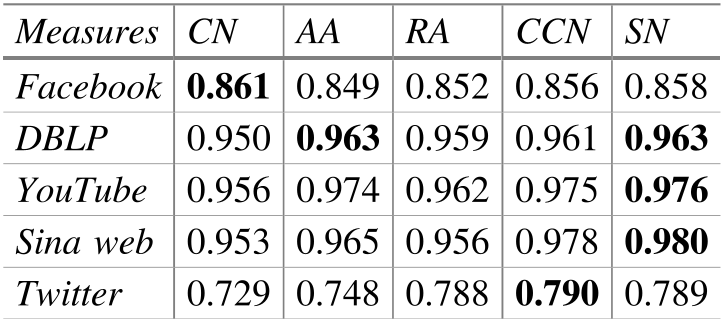 Figure 2: AUC results showing SN outperforming traditional methods in massive social datasets.
Key Observations
- The Rich-Club Limitation: All similarity-based methods (including SN) struggled on Twitter and Facebook. The authors attribute this to the "rich-club" effect, where high-degree nodes connect to each other regardless of similarity, making common-neighbor metrics less relevant.
- Precision Gains: SN showed an 8% lead over AA in Precision on the YouTube dataset, indicating it is much better at identifying the most likely next links.
Critical Analysis & Conclusion
Takeaway
The SN algorithm proves that link prediction is not just a mathematical distance problem but a sociological one. By incorporating the herd phenomenon, the model effectively "boosts" the scores of nodes that are influenced by community leaders.
Limitations
- Parameter Sensitivity: The factor needs careful tuning for different network types.
- Rich-Club Failure: The algorithm does not yet solve the link prediction problem in highly dense "Uniform" networks where the "rich-club" phenomenon dominates.
Future Work
The authors suggest that future research should focus on network-type classification. By automatically detecting if a network is a "Hub," "Uniform," or "Trend Center" network, the system could adaptively choose the best prediction strategy.