
Beyond Idea Submission: Designing for True Co-Creation in Open Innovation
Designing Community-Based Open Innovation Platforms Based on Actual User Behavior
This study methodology explores the design of Community-Based Open Innovation Platforms (COIPs) by analyzing user interaction patterns. The authors propose a framework integrating "Communicative Usability" and "Sociability" to transform individual ideas into collaborative co-creation outcomes.
TL;DR
Open innovation is often treated as a numbers game—the more ideas, the better. However, this study by Digmayer and Jakobs reveals that without intentional design for Sociability and Communicative Usability, these platforms devolve into competitive arenas rather than collaborative spaces. By analyzing user behavior on a mobile tech innovation platform, the authors provide a roadmap for turning passive commentators into active co-creators.
The "Recipient" Trap in Modern Innovation
Most product development fails because it treats the customer as a mere recipient. While Open Innovation (OI) platforms aim to fix this, they often suffer from a "Usability Gap." Economic research tells us why OI is good, but it rarely explains how to design an interface that stops users from attacking each other's ideas or falling victim to cognitive overload.
Methodology: Decoding the Comment Section
The researchers analyzed a corpus of 269 ideas and 655 comments. They weren't just looking at what people said, but the sequences of interaction.
Key Participation Triggers
The study found that user activity is not organic; it is reactive. Peaks in participation were directly tied to:
- External Advertising and Newsletters.
- Impending Submission Deadlines.
- Deadline Extensions.
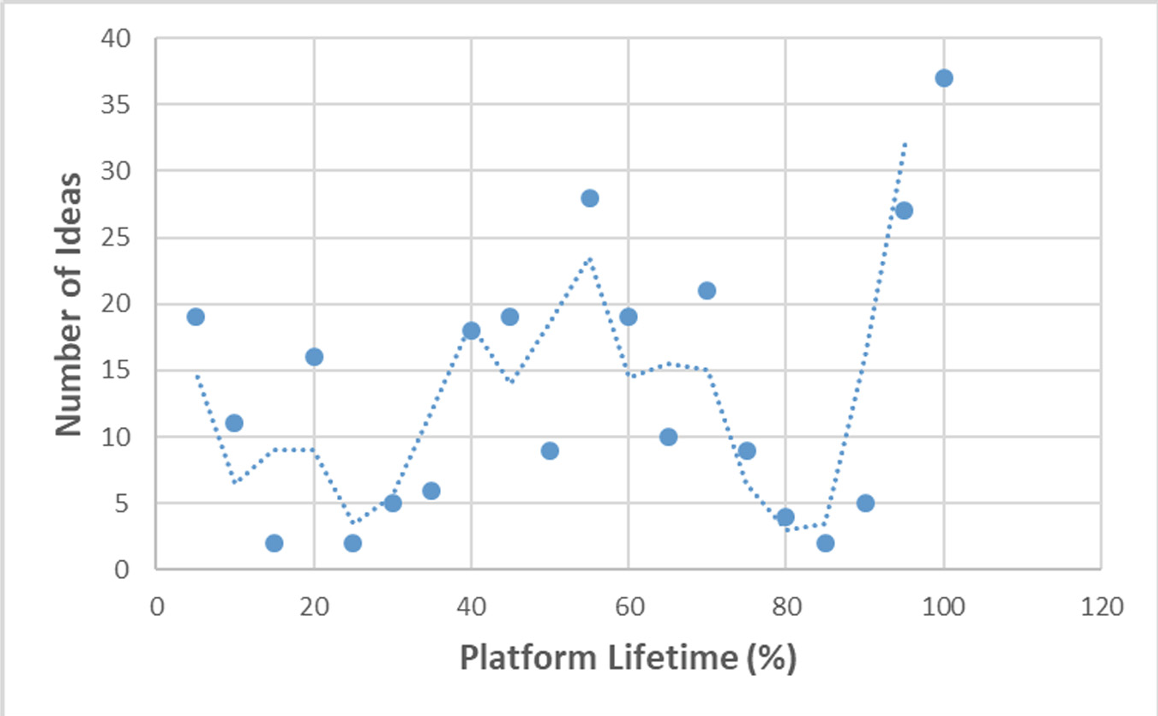 Figure 1: Spikes in idea submissions correlate heavily with management-led triggers rather than spontaneous community growth.
The Anatomy of Social Interaction
The paper categorizes comments into five functional types: Questions, Endorsement, Criticism, Improvements, and Reactions.
The "Idea Theft" Paradox
One of the most striking findings was the prevalence of "Idea Theft" accusations (65.87% of all criticism). Instead of using similar ideas as a springboard for collaboration, users used hyperlinks to prior art to "disqualify" competitors. This creates a toxic environment that the authors label as Sociability-Hindering.
Note: Table 3 in the text highlights that while most sequences are short (2-3 comments), those regarding misconduct tend to be the longest and most aggressive.
Designing for "Communicative Usability"
To move from competition to co-creation, the authors suggest shifting the platform's DNA:
- From Forms to Writing Tools: Simple web forms lead to sloppy, low-quality descriptions. Platforms should use structured "writing technologies" that guide users through technical terminology and visualization.
- Automated Filtering: To prevent the "I didn't know this existed" excuse for duplicate ideas, the authors propose using Text Mining and Topic Tracking to flag similar submissions before they are even posted.
- Enforced Justification: A "5-star" rating is useless without an explanation. The authors argue that the interface should literally block a rating unless a justification is provided, ensuring that the author of the idea receives actionable feedback.
The 11 Rules of Engagement (The Code of Conduct)
The paper concludes with a robust set of rules designed to be enforced by moderators. Some of the most critical include:
- Rule 8 (The Snitch Rule): Users should report suspected idea theft privately to the operator rather than publicly shaming the author. Matches are then handled by a jury based on timestamps.
- Rule 9 (The Responsiveness Mandate): Authors must react to community comments. High activity without author engagement leads to devalued scores.
- Rule 11 (Objective Rebuttal): Authors cannot simply say "No" to criticism; they must provide evidence-based arguments to stay in the running.
Critical Insight: The "Collaboration Gap"
Despite the high number of constructive comments, the study found that only 5.2% of authors updated their idea descriptions. This suggests a massive "Collaboration Gap." Users are talking, but the platform isn't effectively closing the loop. Future platforms must make "Version 2.0" or "Collaborative Updates" a core, rewarded part of the user journey.
Conclusion
Open innovation is not just about the "crowd"; it is about the "community." To unlock the collective intelligence of a target group, developers must treat Sociability as a first-class citizen in the UI/UX design process. Without a strict code of conduct and tools that support communicative clarity, the "wisdom of the crowd" remains a chaotic noise.